Is jojoba oil good for oily skin? What the chemistry says
You have oily skin, or skin that breaks out, and everything you read says the same thing: jojoba is the one oil that is safe, because it is "just like your skin's own sebum". Your skin recognises it. It balances oil production. It will not clog anything.
Two of those three sentences have no evidence behind them, and the first one is half true in a way that matters.
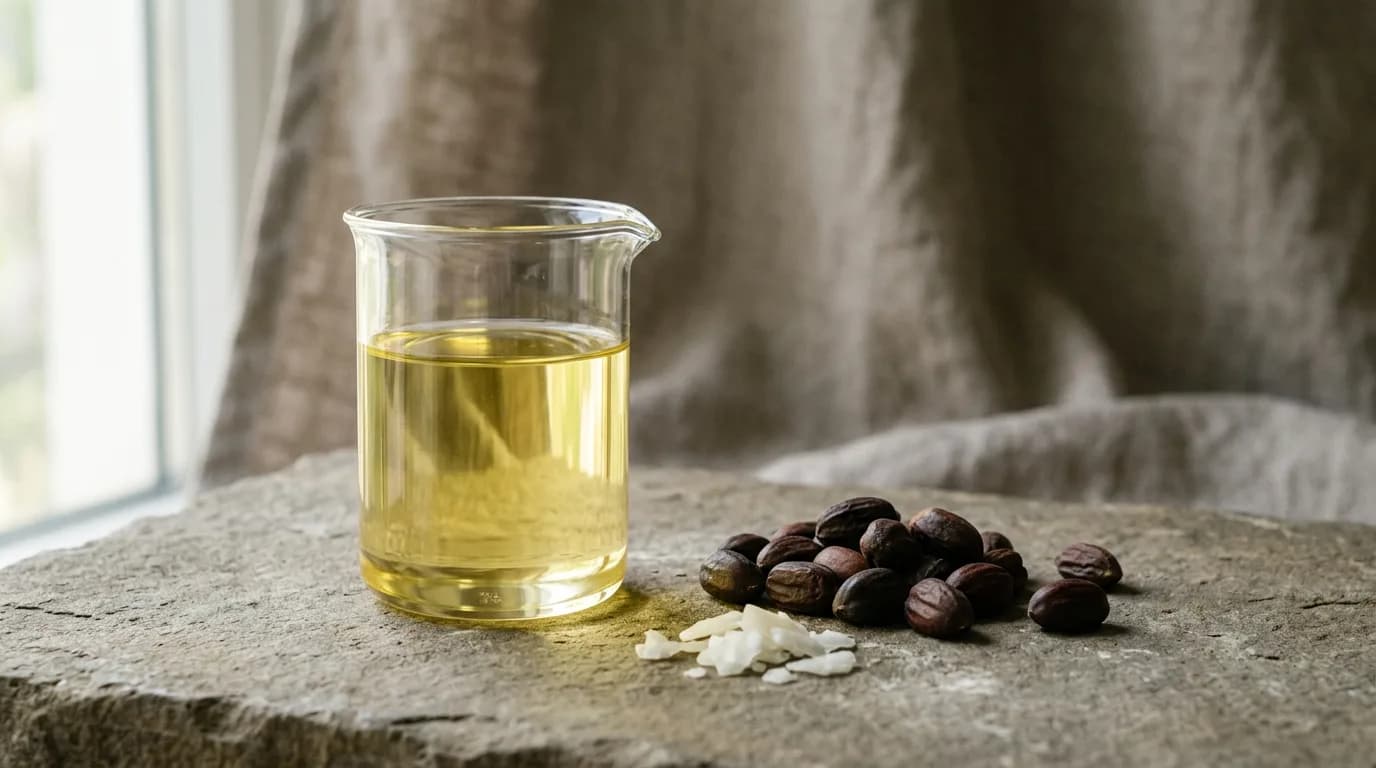
Jojoba genuinely is unlike every other bottle on the shelf — but not because it resembles sebum. It is unlike them because it is not an oil at all. It is a liquid wax, and that single structural fact explains its behaviour on a shelf, most of its behaviour in a formula, and the exact point at which the sebum story stops being defensible. This article, part of our series organised by fatty-acid group, is about where the chemistry supports the reputation and where it does not.
Ester versus triglyceride: what the molecule actually is
Almost every comparison you will read puts jojoba beside sweet almond or grapeseed, as though the three were cousins with different fatty acids. They are not related at all.
A triacylglycerol — sweet almond, grapeseed, sunflower, every other oil in this series — is glycerol esterified with three fatty acids. Hydrolyse it and you get glycerol plus three fatty acids.
A wax ester is one fatty acid joined to one long-chain fatty alcohol by a single ester bond. No glycerol anywhere. Hydrolyse jojoba and you get a fatty acid and a fatty alcohol.
Gad and colleagues, in a review in Polymers (2021), put it plainly: jojoba oil "is composed of almost 98% pure waxes (mainly wax esters, few free fatty acids, alcohols, and hydrocarbons), sterols, and vitamins with few triglyceride esters, so it is widely known as liquid wax rather than oil or fat."
The chain lengths are the distinguishing feature. El-Mallah and El-Shami in the Journal of Oleo Science (2009), analysing Egyptian jojoba seeds by capillary GLC, found seeds rich in wax esters at 55 per cent, with the fatty alcohols C20:1 at 43.0 per cent and C22:1 at 45.6 per cent, followed by C24:1 at 9.6 and C18:1 at 1.3. On the acid side C20:1 was the major constituent at 60 per cent, then C18:1 at 14.5 and C22:1 at 11.8, with C24:1 low at 1.6. Put those two distributions together and the wax esters themselves came out as C42 at 51.1 per cent and C40 at 30.1, with C44 at 10.0, C38 at 6.3, and C36 and C46 minor at 1.4 and 1.1.
So the bulk of the material sits in the C40–C44 band — roughly twice the molecular size of a fatty acid in a conventional seed oil. Gad and colleagues give the average molecular weight of the wax esters as 606.
Tada and colleagues (Shokuhin Eiseigaku Zasshi, 2005) reached the same picture from a different direction, quantifying the intact esters by LC/MS/MS without hydrolysing them first — docosenyl eicosenoate (C22:1–C20:1) at 37.8 per cent, eicosenyl eicosenoate (C20:1–C20:1) at 21.4, eicosenyl octadecenoate (C20:1–C18:1) at 5.5.
| Wax ester (alcohol–acid) | Total carbons | Per cent of the wax | Source |
|---|---|---|---|
| Eicosenyl octadecenoate (C20:1–C18:1) | C38 | 5.5 | Tada 2005, LC/MS/MS |
| Eicosenyl eicosenoate (C20:1–C20:1) | C40 | 21.4 | Tada 2005, LC/MS/MS |
| Docosenyl eicosenoate (C22:1–C20:1) | C42 | 37.8 | Tada 2005, LC/MS/MS |
| C40 esters, as a class | C40 | 30.1 | El-Mallah & El-Shami 2009, GLC, Egyptian seed |
| C42 esters, as a class | C42 | 51.1 | El-Mallah & El-Shami 2009, GLC, Egyptian seed |
| C44 esters, as a class | C44 | 10.0 | El-Mallah & El-Shami 2009, GLC, Egyptian seed |
Different methods on different material, so the two sets are not directly comparable — they are two independent readings of one underlying structure, not an average.
The pairing is not random, either. Gad and colleagues report Miwa's finding that the observed acid–alcohol combinations differ significantly from those calculated for a random association: C22:1 acid with C20:1 alcohol observed at 41.4 per cent against 32.0 predicted by chance, C20:1 with C22:1 at 10.3 against 5.7, while C22:1 with C22:1 came in at 1.9 against 5.7. The plant assembles particular pairs — which, as the review notes, is one way natural jojoba wax can be told from synthetic substitutes.
At the bench: stop comparing jojoba with triglyceride oils by fatty-acid profile. The comparison has no meaning: its "fatty acids" are half of a molecule twice the size, and half the mass of the material is an alcohol that a fatty-acid table has no column for.
Saponify jojoba and half of it does not become soap
Here is the consequence that generates the most unnecessary emails to suppliers.
For most named vegetable oils, Codex unsaponifiable-matter ceilings sit at 10–20 g/kg — one or two per cent, with a few higher. In jojoba, the alcohol half of every wax ester is itself unsaponifiable: alkali cleaves the ester bond and liberates a C20 or C22 fatty alcohol which is not a soap and does not partition like one.
The compiled physical-properties table in Gad and colleagues lists unsaponifiable matter 51 per cent, total acids 52 per cent, iodine value 82 and saponification value 92, with a melting point of 6.8–7.0 °C. (That table gives no methods, so anything method-specific should come from your supplier's own specification.)
Read a jojoba certificate against a triglyceride specification and every one of those numbers looks wrong. It is the specification that is wrong for the material, not the lot. The saponification value is low because there is one ester bond per molecule instead of three and the molecules are large. Unsaponifiable matter is fifty-odd per cent because half the mass is fatty alcohol by construction.
At the bench: write the expected jojoba ranges into your internal raw-material specification, with a one-line note saying why they differ from a triglyceride. It takes five minutes and it stops the next person raising the same query.
Why jojoba barely oxidises — and why that is about structure, not antioxidants
Three things work in the same direction here, and it is worth separating the arguments from structure from the actual measurement.
Structurally: each chain carries a single double bond, positioned at ω-9 on both the alcohol and the acid side. Gad and colleagues describe jojoba molecules as containing two double bonds at ω-9 positions in both alcohol and acid, separated by an ester bond — and unlike typical plant oils, where double bonds sit close together, in jojoba they are far apart. With one double bond per chain there is no bis-allylic methylene: the carbon sandwiched between two double bonds, where a polyunsaturated chain gives up a hydrogen most readily and where autoxidation of linoleic and linolenic oils begins. And there is no glycerol backbone, so none of the glycerol-linked degradation routes of a triglyceride apply.
One honest caveat, because it rarely gets printed. In the Egyptian material analysed by El-Mallah and El-Shami, C18:2 was present among the fatty acids at 8.7 per cent. "Predominantly monounsaturated" is not the same as "polyunsaturate-free", and the figure varies with the lot.
Experimentally: Fagoaga and colleagues in Antioxidants (2026) put four oils through the Rancimat method at 373 K. Jojoba's induction period was 39.80 ± 3.46 hours, against 27.50 ± 2.08 for extra virgin olive, 10.39 ± 0.03 for refined sunflower and 4.45 ± 0.07 for cold-pressed rosehip. The authors attribute that to the ester bonds and long straight hydrocarbon chains, together with a very low proportion of polyunsaturated components — they report jojoba at 97 per cent monounsaturated and around 1 per cent polyunsaturated.
The most telling detail sits in the same paper. In their electrochemical antioxidant measurement, jojoba had the lowest total antioxidant capacity of the four at 298 K — and still lasted the longest. Its stability is a property of the chains, not of the antioxidants riding along in them.
Which leads to the grade-related caveat Gad and colleagues add: refined or bleached jojoba, obtained by passing the natural oil over activated charcoal and treating it with caustic alkali, has low oxidative stability owing to the subsequent removal of the antioxidants. The oil carries α-, γ- and δ-tocopherol, with γ-tocopherol at around 79 per cent of the tocopherols in the Egyptian analysis. Robust by structure is not the same as robust in every grade.
At the bench: jojoba is the right carrier when you need an oil phase that will not develop a fatty odour — which makes it a sensible base for anything where you want a fragrance or an essential-oil blend to stay clean. But buy the grade deliberately: a golden unrefined lot and a bleached clear one are not the same on stability, whatever the price list implies.
The sebum comparison: what is confirmed and what is retold
Now the claim you came for. Two different statements travel under "similar to human sebum", and they deserve separating.
What is confirmed is the class. Human sebum genuinely does contain wax esters, and they are not incidental to it. Picardo and colleagues (Dermato-endocrinology, 2009) state that human sebum contains unique lipids — squalene and wax esters — not found anywhere else in the body nor among the epidermal surface lipids. Smith and Thiboutot (Journal of Lipid Research, 2008) make the same point: of the lipids produced by the sebaceous gland, two are characteristic of it, wax esters and squalene. Mijaljica and colleagues (Progress in Lipid Research, 2024) describe sebum as a waxy mixture predominantly composed of acylglycerols, wax esters, non-esterified fatty acids, squalene, cholesterol and cholesterol esters.
So jojoba and human sebum share the wax-ester lipid class. That much is real, and it is not nothing.
What is retold is the idea that jojoba's wax esters resemble sebum's specifically. They do not, and the difference was described in detail nearly sixty years ago. Nicolaides (Lipids, 1967) isolated the wax alcohols of human skin surface lipid, separated them into saturated and monoene fractions, and found four main chain types in both: normal even, normal odd, iso and anteiso. Working out the double-bond positions by reductive ozonolysis, he concluded that both the fatty-acid and fatty-alcohol chains were first biosynthesised at lengths mainly C14 to C18, then desaturated at Δ6, with the alcohols subsequently extended mainly by two, three or four C2 units.
| Feature | Jojoba wax esters | Human sebum wax esters |
|---|---|---|
| Chain skeleton | Straight-chain throughout | Normal even, normal odd, iso and anteiso — branched types in both acids and alcohols (Nicolaides 1967) |
| Alcohol chain length | Predominantly C20:1 and C22:1 (El-Mallah & El-Shami 2009) | Built from C14–C18 chains, then extended by two to four C2 units (Nicolaides 1967) |
| Double-bond position | ω-9 on both halves (Gad et al. 2021) | Δ6 desaturation (Nicolaides 1967) |
| Odd-numbered chains | Not a feature | Normal odd chain type present, about 5 % (Nicolaides 1967) |
Same lipid class. Different chain lengths, different branching, different double-bond position. "Sebum-like" is a defensible statement about the class and an indefensible one about the molecules — and the honest version, a wax ester, as the skin surface makes wax esters, but not the same wax esters, survives a review far better than the version that has to be walked back later.
Note also what is missing from the comparison entirely. Nothing in any of these papers says a plant wax ester tells a sebaceous gland to produce less sebum. That idea — "jojoba balances oil production because your skin thinks it already has enough" — is an origin story, not a finding, and we could not locate evidence for it.
At the bench: if the reason jojoba is in your formula is that it is a light, oxidation-resistant, odour-neutral lipid, say that, and you can defend every word. If the reason is that it "mimics sebum", you have built a product on a sentence you cannot support past the word "class".
What the UK's own dermatologists actually tell patients
This is where a British formulator has something better than a blog post to work from.
The British Association of Dermatologists' patient information leaflet on acne (produced May 2007, updated July 2024, next review July 2027) sets out the mechanism: sebaceous glands sensitive to hormones produce too much oil; "the lining of the pores… becomes thickened and dead skin cells build up and block the pores"; and the build-up of oil creates conditions in which harmless resident bacteria multiply and cause inflammation.
Two lines from the same leaflet are directly relevant to what you put in a bottle:
"Oily skin care products, greasy moisturisers and hair products… can also cause or worsen acne." "Choose products that are labelled 'non-comedogenic' or non-acnegenic."
And one that quietly contradicts a lot of what gets sold alongside facial oils: "Scrubbing too hard can irritate the skin and make acne worse. Remember blackheads are not due to poor washing."
Read that carefully and you get the real brief for an oil product aimed at oily skin: the risk is the product as a whole being oily or greasy, not the presence of a lipid as such. It is a formulation question — how much lipid, in what system, with what after-feel — not a question of finding one magic oil. The related point, that the word "non-comedogenic" itself carries baggage and a specific legal weight in Britain, is worked through in what a UK label can say about an oil, and the feel of the finished product is the subject of why does my cream feel greasy.
At the bench: if your customer is buying for oily or breakout-prone skin, design the product to be light overall — a low total lipid load in a well-built system, tested for after-feel on real people — rather than swapping one lipid for another and hoping. Jojoba's structural advantages are real and they are about stability and feel; they do not exempt a heavy formula from being a heavy formula.
The line you must not cross in Britain
One paragraph of law, because it is the paragraph that catches small brands.
Acne is a medical condition. The moment your marketing says your jojoba serum treats it, clears it, or is for acne, you have changed what your product legally is. The MHRA's borderline products guidance (published 6 January 2021, last updated 2 July 2026) lists cosmetics among the categories that sit on the borderline with medicines, and applies two limbs: presentation — "any substance or combination of substances presented as having properties of preventing or treating disease" — and function. A product that falls within both the cosmetic definition and the medicinal one is classified as a medicinal product. If you want a view before you print, the MHRA takes submissions through the Medicines Borderline Advice Form.
The practical translation: a cosmetic that manages how skin looks and feels is a cosmetic. A cosmetic that says it gets rid of spots is a medicine you have not licensed. That is a different regulator, a different regime and a different budget — and unlike most compliance questions, this one is decided entirely by words you chose.
At the bench: write the claim before you finish the formula, then check the claim against this line. It is much cheaper to discover in week one that "clears breakouts" is unusable than to discover it after the labels are printed.
Sensory, and the small evidence there is
Neat jojoba has a relatively light, dry sensory profile. Because it is a wax rather than a fat, it does not develop the fatty-acid odour that gives away an oxidising triglyceride. Gad and colleagues cite a melting range of 6.8–7.0 °C, so it is liquid at bench temperature — though in an unheated British room, or in a January delivery van, it is not far above its melting point, and any low-temperature clouding should be assessed against the supplier's grade-specific specification rather than treated as a fault.
On the skin side, published evidence for jojoba-derived materials is thin and small-scale, and worth citing at the size it actually is. Meyer and colleagues (Journal of Cosmetic Dermatology, 2008) ran a small pilot study on healthy volunteers, with evaluations at baseline, 8 hours and 24 hours. Formulations containing 3.75 per cent glycerol together with 1.25 per cent hydrolysed jojoba esters gave significantly lower TEWL values (P < 0.05) than glycerol alone in the same base lotion at both time points. Two things to hold alongside that result: it is a proof of concept on one base with one combination, and the authors were affiliated to Floratech, a supplier of jojoba-derived ingredients. Neither fact makes it wrong. Both belong in the sentence when you cite it.
At the bench: that study supports nothing about neat jojoba oil — it was run on a different INCI material, at 1.25 per cent, with glycerol. Do not let it migrate onto your jojoba oil product.
Where a "similar oil" will not do
Three distinct INCI materials come from the same seed, and they are not interchangeable with each other — still less with a triglyceride of similar viscosity.
| INCI name | What it is | What it is for |
|---|---|---|
| Simmondsia Chinensis Seed Oil | The liquid wax itself; C40–C44 monoesters; liquid at room temperature, melting range 6.8–7.0 °C | Emollient lipid phase — the material described throughout this article |
| Hydrogenated Jojoba Oil | The same esters with the double bonds saturated: a solid wax. Knoepfler and colleagues, cited by Gad et al., report melting points of 67–68 °C for wax from cold-pressed oil and 74–76 °C for wax from solvent-extracted oil | Structurant and body-builder in anhydrous and stick systems |
| Jojoba Esters | Transesterified or interesterified derivatives spanning liquid to solid grades. Hydrolyzed Jojoba Esters is a separate INCI material — and that is what the Meyer study used | Texture modification and structuring, chosen by melting behaviour rather than by origin |
Two substitutions are worth naming as errors.
Replacing Simmondsia Chinensis Seed Oil with a light triglyceride of matched viscosity buys the viscosity and loses the reason the material was specified. A triglyceride reintroduces the glycerol backbone and, unless it is an unusually saturated one, reintroduces polyunsaturated chains with the bis-allylic positions jojoba largely does not have.
Replacing Hydrogenated Jojoba Oil with the liquid oil in a stick or balm is a straightforward category error: the hydrogenated material is there for a melting point in the sixties or seventies, and the liquid one melts at seven degrees. Between the two sits the family of Jojoba Esters, which has to be selected on the declared melt profile of the specific grade rather than on the family name — treating "Jojoba Esters" as one material is a reliable way to lose a batch of sticks. Where structure rather than substitution is the goal, see how to turn a body oil into a balm without beeswax.
At the bench: keep the three INCI names separate everywhere they appear — specification, formula sheet, purchase order, label. Most jojoba disasters are a purchasing substitution nobody flagged as a formulation change.
The rule worth keeping past the jojoba shelf
Comparing oils by fatty-acid profile works because they share a structure. When the structure changes — a wax instead of a fat — the comparison scales change with it, and a specification written for one will misread the other. Among the oleic oils a high monounsaturated figure means one thing. In jojoba, the predominant C20 and C22 acid and alcohol chains form C40–C44 monoesters with no glycerol backbone, so its composition is not directly comparable with any triglyceride fatty-acid profile at all.
Read the structure first, then the numbers. And when somebody tells you an ingredient works because it is "just like" something in your skin, ask which level the resemblance is at — because for jojoba the honest answer is the class, and not the molecules, and that answer is still a good enough reason to use it.
Sources
- Gad H. A. et al. Jojoba oil: an updated comprehensive review on chemistry, pharmaceutical uses, and toxicity. Polymers 13(11), 1711, 2021. PubMed 34073772 — physical-properties table and Miwa figures read from the full text.
- El-Mallah M. H., El-Shami S. M. Investigation of liquid wax components of Egyptian jojoba seeds. Journal of Oleo Science 58(11), 543–548, 2009. PubMed 19844068
- Tada A. et al. Analysis of the constituents in jojoba wax used as a food additive by LC/MS/MS. Shokuhin Eiseigaku Zasshi 46(5), 198–204, 2005. PubMed 16305174
- Fagoaga C. et al. Oxidative stability and kinetics of oxidation of rosehip, sunflower, olive and jojoba oils. Antioxidants 15(5), 646, 2026. PubMed 42193267
- Nicolaides N. The monoene and other wax alcohols of human skin surface lipid and their relation to the fatty acids of this lipid. Lipids 2(3), 266–275, 1967. PubMed 17805778
- Picardo M. et al. Sebaceous gland lipids. Dermato-endocrinology 1(2), 68–71, 2009. PubMed 20224686
- Smith K. R., Thiboutot D. M. Sebaceous gland lipids: friend or foe? Journal of Lipid Research 49(2), 271–281, 2008. PubMed 17975220
- Mijaljica D. et al. The heterogeneity and complexity of skin surface lipids in human skin health and disease. Progress in Lipid Research 93, 101264, 2024. PubMed 37940006
- Meyer J. et al. Evaluation of additive effects of hydrolyzed jojoba (Simmondsia chinensis) esters and glycerol: a preliminary study. Journal of Cosmetic Dermatology 7(4), 268–274, 2008. PubMed 19146603
- British Association of Dermatologists. Acne — patient information leaflet. Produced May 2007, updated July 2024, review July 2027. bad.org.uk — consulted 22 September 2026.
- Medicines and Healthcare products Regulatory Agency. Borderline products: how to tell if your product is a medicine. Published 6 January 2021, last updated 2 July 2026. gov.uk — consulted 22 September 2026.