How to turn a body oil into a balm without beeswax
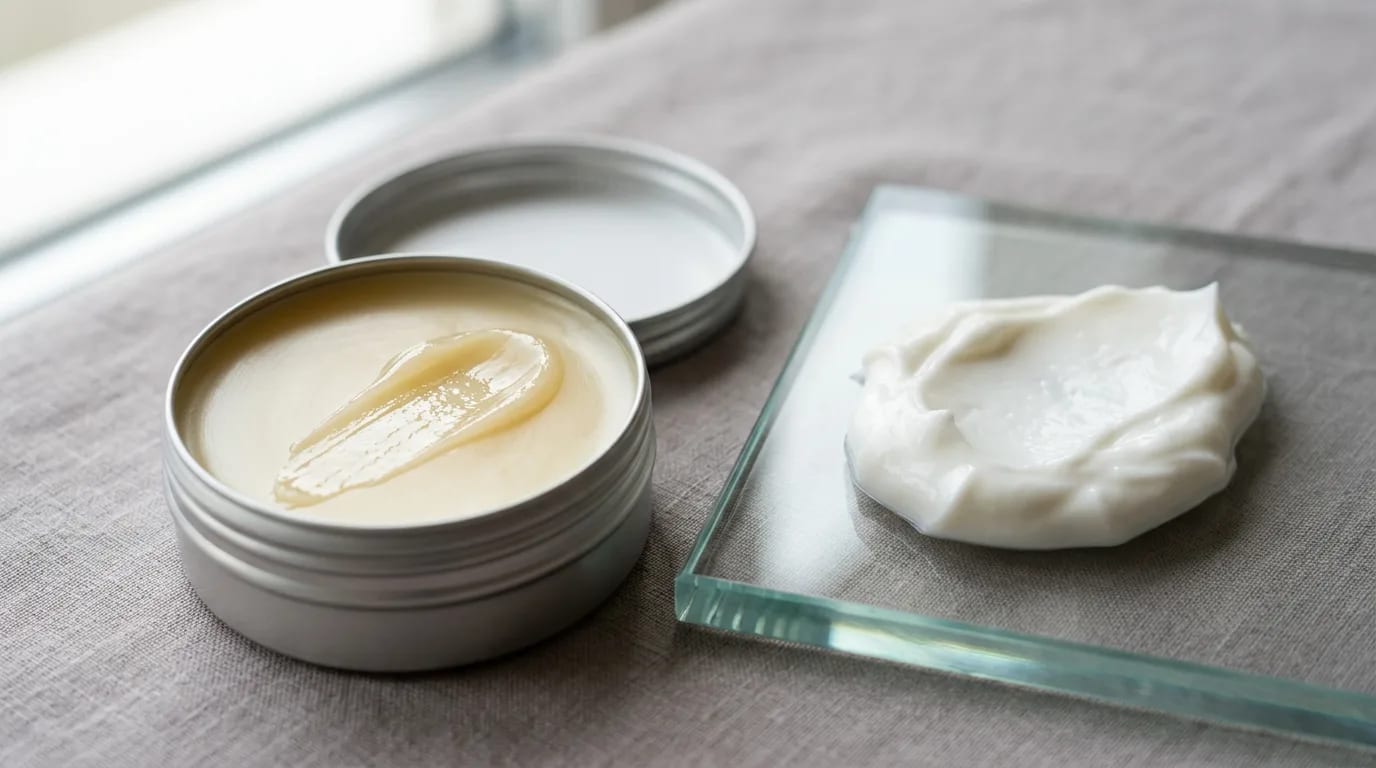
You have a body oil that works. Now you want it as a balm — something solid in a tin that softens under a thumb and does not leak into a handbag. Every recipe you find says the same thing: melt in some beeswax.
Maybe you would rather not. Maybe the product is meant to be vegan. Maybe you tried it, and a month later the tin had a puddle of oil sitting on top of a waxy disc, and you assumed you had done something wrong.
You probably had not. Of the four waxes most commonly used for this, beeswax was measured as the worst at holding oil in — and the two that held oil best are both plant waxes. This article is about what actually sets an oil solid, at what concentration, and how to find out whether yours has worked before a customer does.
The technical name for what you are making is an oleogel: an oil held solid by a network of something else, with no water in it at all. That covers balms, sticks, cleansing oils, oil serums and anhydrous sunscreens — no water phase, no emulsifier, no preservative decision of the usual kind. The oils themselves are grouped in our pillar article on plant oils by fatty-acid group; here they are simply the continuous phase.
One caveat governs the whole piece. Most published oleogel work is food science — margarine analogues, chocolate spreads, fat replacement in sausages — and that is where the measurements are, so that is what is cited, and every time it is, it says so. The physics of a crystal network in a triglyceride does not care whether the triglyceride ends up on toast or on a shin. Anything downstream of structure does not carry across, and no pretence is made that it does.
Two networks, two ways of failing
The first route is a crystalline network. You dissolve a structurant that melts well above room temperature in hot oil, then let it crystallise on cooling into solid particles — platelets, needles, fibres — that touch, overlap and jam. The oil is not chemically bound to anything; it is trapped in the pore spaces of the crystal scaffold by capillary forces. Waxes work this way, and so do fatty alcohols and fatty acids. The gel melts when the crystals melt and re-forms on cooling, which is both the convenience and the hazard: everything about the finished structure depends on how the cooling was done.
The shape of those crystals is not a detail. Gu, Du and Meng (Food Research International, 2023) prepared systems from six natural waxes — sunflower, rice bran, carnauba, beeswax, candelilla and sugarcane — and imaged them by polarised light, confocal laser scanning and scanning electron microscopy. All except sugarcane formed platelets that built networks by stacking on one another; the floc-like sugarcane wax instead adsorbed at the interface and formed what the authors call a "crystalline shell". They report that the surface area and pore size produced by each wax varied widely, and that this accounted for the differences between them in gelation ability, oil binding capacity and crystal-network strength. (That study is on water-in-oil emulsion gels rather than pure oleogels; it is read here for the network, not for the emulsion.)
The second route is a polymer or particle network. Nothing crystallises: long polymer chains entangle, or solid particles aggregate into a space-filling floc, and the oil is again held in the pores. Ethylcellulose is the polymer example, fumed silica the particle example. These gels have no sharp melting point in the wax sense, and their strength is governed by chain length or particle surface chemistry rather than by a crystallisation history.
The failure modes differ accordingly. A crystalline network fails by recrystallising — crystals coarsen, pores widen, oil weeps out. A particle network may lose integrity under shear, or through structural ageing and densification with the oil release that accompanies them.
At the bench: decide which network you are building before you buy anything, and test for that network's failure. If you built a wax gel, your enemy is time and temperature cycling. If you built a silica gel, your enemy is shear and ageing. Testing the wrong one tells you nothing.
Beeswax, measured against the alternatives
Here is the study that should change what most people reach for first.
Ghazani, Dobson and Marangoni (Current Research in Food Science, 2022) structured olive oil with 3 per cent of each of four waxes, then stress-tested the gels for oil loss: about 1 mL of melted oleogel into a pre-weighed tube, left to crystallise for two days at room temperature, then centrifuged at 14,000 rpm for 30 minutes and inverted overnight on filter paper so the released oil drained off and could be weighed.
| Wax, 3 % in olive oil | Oil lost under centrifugation |
|---|---|
| Sunflower wax | 0 % |
| Rice bran wax | 0 % |
| Candelilla wax | 23.50 ± 2.12 % |
| Beeswax | 28.17 ± 2.47 % |
Beeswax, the default, came last. Not by a little — nearly three in ten parts of the oil came straight back out under stress, while two plant waxes at the same loading held everything.
The blends make the same point in a more interesting way. At 1:1 in olive oil, rice bran with sunflower lost nothing and candelilla with beeswax lost nothing; but sunflower with candelilla lost 58.49 per cent — dramatically worse than either wax on its own. Two structurants that each work can combine into one that does not. The authors read the good pairings as genuine synergy: image analysis showed that samples with a higher elastic constant had a lower box-counting fractal dimension and larger crystals, consistent with established fractal models for van der Waals colloidal networks, while X-ray diffraction showed orthorhombic perpendicular subcell packing in every case, unchanged by mixing — so the synergy is not a change of crystal form.
Two honest qualifications. This is olive oil, not your oil blend; the wax–oil pair is the unit, not the wax. And centrifugal oil binding capacity is a method-specific stress measurement — its relationship to oiling-off on a shelf has to be established by storage testing, not assumed.
At the bench: if your balm weeps, try sunflower wax or rice bran wax at the same percentage before you add more beeswax. And never assume a two-wax blend is at least as good as its worse component — run the blend, because one of the four pairings tested here was worse than either wax alone.
The vegan question, and what it actually costs you
In Britain the recognised mark here is the Vegan Trademark, administered by The Vegan Society — a registered charity that coined the word in 1944 and has been certifying products since 1990. Its standards are short and absolute: "The manufacture and/or development of the product, and its ingredients, must not involve or have involved, the use of any animal product, by-product or derivative", with "animal" understood to mean the entire animal kingdom — all vertebrates and all multicellular invertebrates — plus a standard on animal testing and a requirement to minimise cross-contamination as far as reasonably practicable.
Beeswax is Cera Alba: a product of honeybees, which are multicellular invertebrates. A beeswax balm cannot carry the mark.
Two things are worth being clear about. First, this is a certification scheme, not a legal status: registration is voluntary, renewed annually, and held by the scheme owner rather than conferred by any regulator. Second — and this is the useful part — the technical cost of the swap is not what people assume. On the measurements above, moving from beeswax to sunflower or rice bran wax did not cost oil binding. It improved it.
At the bench: if you are going to make the vegan claim, get the certification question settled before you formulate, because the standard reaches back into your ingredients' own manufacture, not just your bill of materials. And do not treat the plant wax as a compromise: at 3 per cent in the tested system it was the better structurant.
The number that decides your recipe: critical gelling concentration
The single most useful figure for a balm is the critical gelling concentration — the lowest level of structurant at which the system stops flowing.
Penagos and colleagues (Foods, 2023) determined it in sunflower oil by a method you can run at home. Weigh wax and oil together; heat to 15 °C above the wax's melting temperature under constant stirring at 500 rpm until no solid particles are visible; pour into small cylindrical containers; refrigerate at 5 °C for one hour; invert. The critical gelling concentration is the lowest concentration with no visible mobility.
Their results:
| Wax | Critical gelling concentration in sunflower oil | Heated to |
|---|---|---|
| Beeswax | 1.5 % w/w | 80 °C |
| Carnauba wax | 5.0 % w/w | 98 °C |
Those two figures deserve emphasis, because craft sources often imply the reverse. Carnauba is the harder, higher-melting raw material — and it needed more than three times as much of it to immobilise the same oil. Hardness of the raw wax and gelling efficiency are different properties, and the second is the one your recipe depends on.
Note also what a critical gelling concentration is not. It is the threshold for standing up. It is not the threshold for staying put — beeswax immobilised sunflower oil at 1.5 per cent and still lost 28 per cent of olive oil under centrifugation at twice that loading.
At the bench: run your own inversion series first, in the actual oil blend you will use, because the critical gelling concentration belongs to the wax–oil pair and not to the wax. Then take the gel to roughly one and a half times that concentration before judging anything else.
Melting points move, and they move downwards
The number on the wax supplier's data sheet is for the neat wax. It is not the melting point of your balm, and the gap is large.
Ghazani and colleagues measured the pure waxes by differential scanning calorimetry:
| Wax | Neat melting point (DSC) | Dissolved in olive oil |
|---|---|---|
| Rice bran | 84.12 ± 0.23 °C | 65.48 ± 0.35 °C at 2.5 %, rising only to 67.35 ± 0.56 °C at 4 % |
| Sunflower | 77.83 ± 0.30 °C | 60.73 ± 0.52 °C at 3 % |
| Candelilla | 68.07 ± 0.23 °C | — |
| Beeswax | 64.90 ± 0.25 °C | 48.66 ± 0.26 °C at 3 % |
Across all their binary blends the melting range ran from 43.2 °C to 67.4 °C, and they attribute the drop to dilution — a pseudo-ideal mixing behaviour, with the melting point of the blend falling where the proportions say it should.
Rice bran wax loses nineteen degrees on dilution. Beeswax loses sixteen. A neat-wax DSC figure is therefore neither the oleogel melting range nor, by itself, a validated processing temperature.
At the bench: never quote a neat wax melting point as your product's melting point, and never set a processing temperature from it either. Establish the minimum temperature and hold time that dissolves your wax in your oil completely — undissolved particles are nucleation sites that will change the structure you get on cooling.
A second structurant beats more of the first
If a gel is not holding, the instinct is to add wax. The evidence points somewhere cheaper.
Okuro and colleagues (Food & Function, 2018) combined fruit wax with lecithin in sunflower oil and found synergy in gel strength at wax-to-lecithin ratios of 75:25 and 50:50. Lecithin enabled gel formation below the fruit wax's own critical gelling concentration, and both oil-binding capacity and thixotropic recovery improved. Raman spectroscopy suggested hydrogen bonding between the two, with lecithin acting as a crystal habit modifier and delaying both crystallisation and gelation. The authors put the practical value plainly: harder self-standing structures at a lower gelator concentration, which means less wax and so less waxy mouthfeel — read, for our purposes, less waxy drag on skin.
That is a food study and is cited only for the network interaction it demonstrates. But it names the lever: the fix for a weak gel is often a different molecule at low level, not more of the same one.
At the bench: before you take a balm from 4 per cent wax to 6 per cent — which will change the feel and usually not for the better — try a second structurant or a crystal habit modifier at low level and re-run the oil-loss test.
Silica, organoclay and other particles
Particle gelation obeys different rules and gives a different feel.
Whitby, Krebsz and Booty (Journal of Colloid and Interface Science, 2018) dispersed fumed silica nanoparticles in a triglyceride solvent, varied the particle surface chemistry from oleophobic to oleophilic by functionalising it with hydrocarbons, and visualised the networks by confocal microscopy. The mechanism is hydrogen bonding between silanol groups on different particle surfaces, driving aggregation into a network — and their key finding is that pore size depends on the fraction of silanol groups still available to hydrogen-bond. Methylate the particles and the network becomes more tenuous, the pores larger, the elasticity lower.
The lesson for a purchase order: "silica" on a supplier list is not one material. Hydrophobic and hydrophilic grades build different networks in the same oil, and swapping one for the other is a formulation change, not a substitution.
Fumed silica does appear as an oleogel structurant in the topical literature — Ambrogi and colleagues (Journal of Functional Biomaterials, 2023) used it as a bifunctional excipient in a topical oleogel, both as a support and as the gelling agent itself. That paper is cited here for the gelling role only; its subject was an antimicrobial preparation, and nothing here makes or supports any biological claim.
The most directly cosmetic measurement available is Yamaguchi, Maeda, Masaki and Iwabuchi (Journal of Oleo Science, 2021), who thickened the oil phase of sunscreens and measured the effect on a skin-mimicking substrate. Of four thickeners compared — petrolatum, dextrin palmitate, silica silylate and organoclay — only organoclay and silica silylate significantly increased the sunscreen's ultraviolet absorbance on the substrate, concentration-dependently; petrolatum and dextrin palmitate did not. On mechanism, film thickness became more uniform as organoclay content rose, shown by decreasing standard deviations of film thickness, with an increase in UV absorbance of more than two-fold relative to sunscreen without organoclay. Their interpretation: a thickener that restores viscosity at low shear after the high shear of application stops the product flowing into the grooves of the skin surface.
Read that precisely. It is a measurement of optical film uniformity on a substrate, not of protection on a person, and it says nothing about any thickener outside the product tested. What it establishes is that the choice of oil thickener changes how a film sits on a surface — which is the whole point of an oleogel, and is almost never measured.
At the bench: if the brief is "a balm that sits evenly rather than sinking into the lines", a particle structurant is a legitimate lever and a wax is not the only answer. Choose the grade on its surface chemistry, and write the grade into the specification, not just the INCI name.
Ethylcellulose: a polymer that behaves like a polymer
Ethylcellulose is the best-characterised polymeric oleogelator. Gravelle and Marangoni (Advances in Food and Nutrition Research, 2018) review it as the gelator of widest applicability across food systems and note that the strategies for tuning its physical properties may extend to pharmaceutical, cosmetic and manufacturing use — a statement of potential from the authors, passed on as such.
The mechanism was characterised by Davidovich-Pinhas, Barbut and Marangoni (Carbohydrate Polymers, 2015) in ethylcellulose–canola oil gels. Thermal analysis detected no evidence of transitions attributable to secondary conformational changes, supporting a non-crystalline physical-network mechanism. Three consequences follow from their rheology, and all three are levers:
- Higher polymer molecular weight raised the final gel strength, the modulus at cross-over, and the gel-point temperature.
- Cooling and heating rates affected the modulus only in the low-molecular-weight samples.
- Gel strength decreased as cooling rate increased, and slow cooling produced a stable gel faster.
That last pair inverts the intuition most people bring from wax work, where fast cooling is used to keep crystals small. With ethylcellulose, in that study, patience made the stronger gel. And the grade you buy — its viscosity designation, which tracks molecular weight — is a formulation decision, not a purchasing one.
At the bench: if you use ethylcellulose, put the viscosity grade on the formula sheet and treat a change of grade as a reformulation. And try cooling slowly before you conclude the polymer is not working.
Testing it properly, in the order that saves batches
Two more findings close the loop on storage.
Penagos and colleagues crystallised their wax systems on a pilot-scale scraped-surface heat exchanger and reported storage stability of over one year — but also notably smaller crystals and reduced rigidity compared with the statically cooled laboratory samples. Same composition, different cooling equipment, different gel. If you move from a bowl to a jacketed vessel with a scraper, you have changed the product.
And Gu and colleagues tie oil binding capacity back to the surface area and pore size of the crystal population — which is why oil binding depends on crystal morphology, network connectivity, wax–oil compatibility, concentration and the test method together. None of these studies establishes a universal optimum crystal size, and anyone who offers you one is guessing.
So, a sequence rather than a recipe:
- Run an inversion series in your actual oil blend to find the critical gelling concentration of the pair. Vial, one hour at 5 °C, invert, lowest concentration with no visible mobility.
- Go to about 1.5× that concentration before judging feel, because not-flowing and not-weeping are different thresholds.
- Test oil binding by centrifugation, not by looking at the jar. Two days to crystallise, then spin it. The shelf will find the weakness eventually; the centrifuge finds it this week.
- Before adding more wax, try a second wax or a crystal habit modifier — and test the blend, because blends can be worse than either component.
- Re-test whenever the cooling changes. New equipment, new room temperature, new batch size, new gel.
At the bench: cited, tested starting points, each belonging to its own oil and wax lot: beeswax 1.5 % and carnauba 5.0 % as critical gelling concentrations in sunflower oil (Penagos); 2–4 per cent total wax in olive oil, with 3 per cent of a binary blend recommended for a spread-like texture (Ghazani); gelation below the wax's critical gelling concentration with lecithin at 75:25 or 50:50 (Okuro). Use them to bracket your first trial, not as your formula.
Two boundaries that close the subject
Fatty structurants that crystallise in more than one form bring their own problem, covered in polymorphism of butters — and if your balm has gone gritty rather than weepy, that is the article you want, not this one.
And an anhydrous gel is still made of oil, so its shelf life has an oxidative component that no amount of structure addresses. The relevant measurements are in oxidative stability of oils, and if the oil you are gelling is a fragile one, why rosehip oil smells like crayons after three months applies to the balm exactly as it applies to the bottle. Preservation of anhydrous systems is a separate question again, covered in preserving anhydrous products.
Structure and stability are two separate audits, and a product has to pass both.
Sources
- Ghazani S. M., Dobson S., Marangoni A. G. Hardness, plasticity, and oil binding capacity of binary mixtures of natural waxes in olive oil. Current Research in Food Science 5, 998–1008, 2022. PubMed 35755304 — oil-loss and DSC tables read from the full text.
- Penagos I. A., Murillo Moreno J. S., Dewettinck K., Van Bockstaele F. Carnauba wax and beeswax as structuring agents for water-in-oleogel emulsions without added emulsifiers. Foods 12(9), 1850, 2023. PubMed 37174387
- Thakur D. et al. Oleogelation based on plant waxes: characterization and food applications. Journal of Food Science and Technology 60(12), 2927–2944, 2023. PubMed 37786600
- Gu X., Du L., Meng Z. Comparative study of natural wax-based W/O emulsion gels: microstructure and macroscopic properties. Food Research International 165, 112509, 2023. PubMed 36869516
- Okuro P. K. et al. Synergistic interactions between lecithin and fruit wax in oleogel formation. Food & Function 9(3), 1755–1767, 2018. PubMed 29508864
- Gravelle A. J., Marangoni A. G. Ethylcellulose oleogels: structure, functionality, and food applications. Advances in Food and Nutrition Research 84, 1–56, 2018. PubMed 29555066
- Davidovich-Pinhas M., Barbut S., Marangoni A. G. The gelation of oil using ethyl cellulose. Carbohydrate Polymers 117, 869–878, 2015. PubMed 25498711
- Whitby C. P., Krebsz M., Booty S. J. Understanding the role of hydrogen bonding in the aggregation of fumed silica particles in triglyceride solvents. Journal of Colloid and Interface Science 527, 1–9, 2018. PubMed 29775816
- Yamaguchi K., Maeda M., Masaki H., Iwabuchi T. Oil thickening with organoclay enhances the ultraviolet absorption ability of sunscreen on a skin-mimicking substrate. Journal of Oleo Science 70(5), 721–730, 2021. PubMed 33840665
- Ambrogi V. et al. Antimicrobial oleogel containing sustainably prepared silver-based nanomaterials for topical application. Journal of Functional Biomaterials 15(1), 4, 2023. PubMed 38276477
- The Vegan Society. Vegan Trademark standards. vegansociety.com — consulted 22 September 2026.