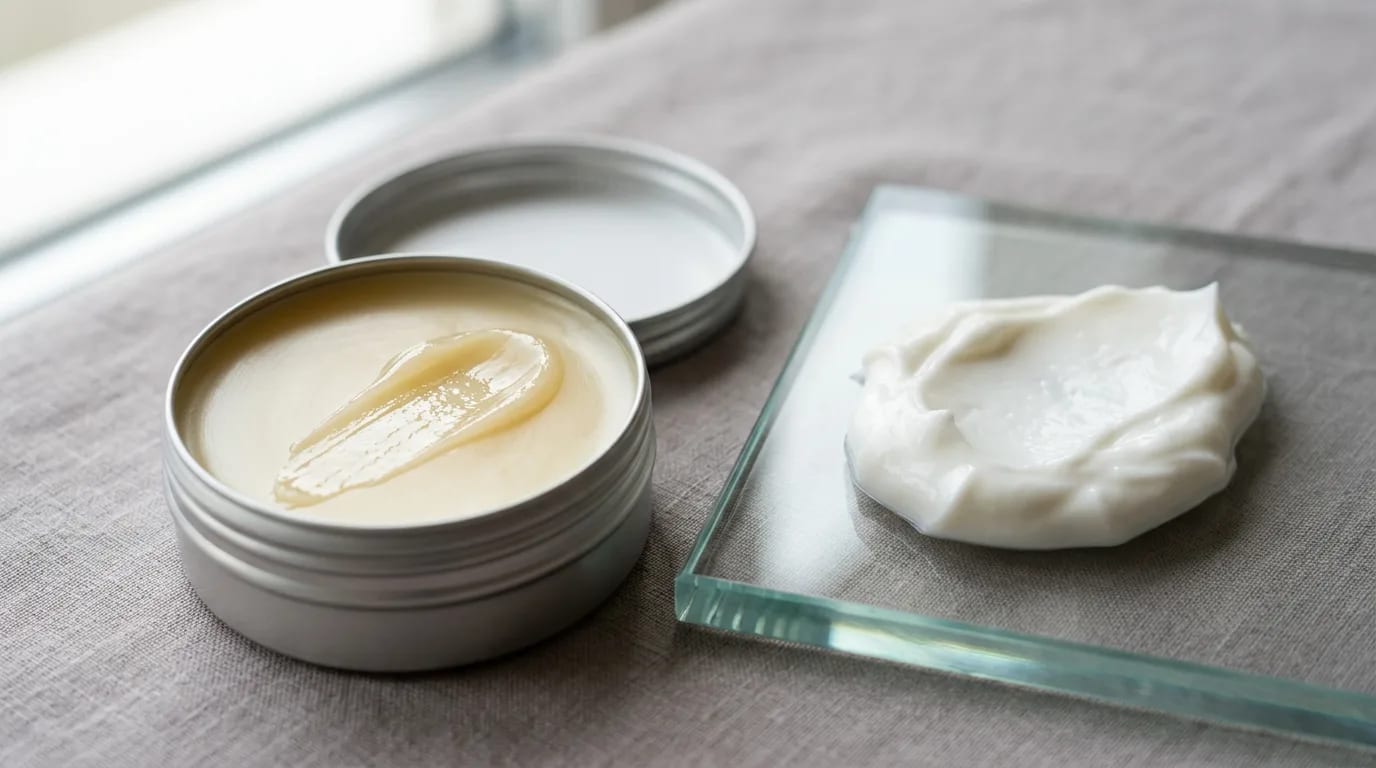
Anyone who has worked with cocoa butter or shea butter knows that moment of frustration: you carefully melted the butter, added your actives, poured it into a mould — and a couple of days later, instead of a smooth balm, you ended up with a grainy, crumbly mass with a whitish film. This is not a defect or an accident. It is polymorphism — a phenomenon from the world of crystallography that determines the texture, stability, and skin feel of your products. Let’s learn how to master it with the Walker Formulation Academy.

What is polymorphism and why is it important
Imagine you are building a wall out of identical bricks. The bricks are the same, but you can lay them in different ways: flat, on their side, or in a herringbone pattern. The wall will look and behave completely differently depending on the laying method. In the same way, triglyceride molecules in butters — identical molecules can “pack” into a crystal lattice in different ways.
This is polymorphism — the ability of the same substance to form different crystal structures. For us formulators, this means that the same cocoa butter can solidify soft and grainy, smooth and creamy, or hard and brittle — it all depends on how we handled it during cooling.
Polymorphism (from the Greek poly — many, morph — form) is the ability of the same chemical substance to form different crystal structures. The most famous example: carbon can be soft graphite or ultra-hard diamond. In the world of fats, there are three main polymorphic forms: α (alpha), β' (beta-prime), and β (beta).
Three crystal forms: α, β', and β
When molten butter begins to cool, its triglyceride molecules strive to organize themselves into an ordered crystal lattice. Depending on the cooling rate and temperature conditions, they can “choose” one of three main packing forms.
Form | Structure | Melting point | Stability | Texture |
|---|---|---|---|---|
α (alpha) | Hexagonal, loose | Lowest | Unstable | Soft, grainy |
β' (beta-prime) | Orthorhombic | Medium | Moderate ✅ | Smooth, creamy |
β (beta) | Triclinic, dense | Highest | Maximum | Hard, brittle |
Rotate your phone to see the full table
The α (alpha) form α is formed during rapid cooling: the molecules are “in a hurry” and pack loosely, haphazardly. Such a structure is unstable and begins to rearrange itself after a few hours or days — this is exactly what causes the graininess and crumbly texture.
The α (alpha) form β'β' (beta-prime) is the golden mean for cosmetics. The molecules are packed more tightly but retain plasticity. The result: a smooth, creamy consistency that holds its shape well in sticks and balms. This is exactly what we strive for.
The α (alpha) form ββ (beta) is the most thermodynamically stable. The molecules are packed as tightly as possible. In chocolate, this is the ideal (shine, snap), but in cosmetics, such a structure is usually too hard and brittle.
α (alpha)
Formed during rapid cooling. Loose molecular packing. Unstable — transitions to β' within hours or days. Grainy, crumbly texture.
β' (beta-prime)
The golden mean for cosmetics. Denser than α, but softer than β. Smooth, creamy consistency. Holds its shape well in sticks and balms.
β (beta)
The densest and most stable form. Very hard and brittle. Ideal for chocolate (shine, snap). Usually undesirable in cosmetics.

Which butters are prone to polymorphism
Not all butters are equally temperamental. The degree of polymorphism depends on the triglyceride composition: the more uniform the fatty acid profile, the more pronounced the polymorphism. Here is how the most popular cosmetic butters behave:
Butter | Polymorphism | Main issue | Working T |
|---|---|---|---|
Cocoa butter | Strong (6 forms!) | Graininess, white bloom | 28–32 °C |
Shea butter | Moderate (3–4 forms) | Graininess upon rapid cooling | 35–45 °C |
Mango butter | Weak (2–3 forms) | Hardness, brittleness | 40–50 °C |
Cupuaçu butter | Moderate | Soft texture, instability | 30–38 °C |
Coconut oil | Minimal | Melts quickly on the skin | 24–27 °C |
Rotate your phone to see the full table
Cocoa butter is the absolute champion of temperamental behaviour! It has 6 polymorphic forms (I–VI), and only form V provides a pleasant, smooth texture. Forms I–IV are unstable, while form VI is too hard and causes fat bloom — that very whitish film on the surface.

How temperature affects crystallisation
Temperature is the main lever for controlling polymorphism. The cooling rate determines which crystal form will 'win'. Rapid cooling (e.g., in the fridge) creates a multitude of small α-crystals — loose and unstable. Slow, controlled cooling allows large, dense β'-crystals to form — exactly the ones that provide a smooth texture.
Here is a universal temperature protocol that works for most butters:
Complete melting (55–60 °C). Destroys all previous crystalline 'memories'. The molecules are completely free and ready for a new organisation. For cocoa butter, at least 55 °C.
Cooling to working temperature (28–35 °C). Slow cooling (approximately 0.5–1 °C per minute) allows stable β'-crystal nuclei to form. Do not rush!
Stabilisation (holding for 15–20 minutes). Holding at a stable working temperature locks in the desired crystal form. Stir periodically, but not too vigorously.
Final cooling (to 20–22 °C). Slow cooling of the product at room temperature. No fridge! The finished product can be left on the table for 12–24 hours for complete crystallisation.
Never put a freshly made balm in the fridge! A sharp temperature drop triggers mass formation of α-crystals. After a few days, they will rearrange — and you will get a grainy, crumbling mass instead of a smooth balm.
Tempering: the formulator's essential tool
Tempering is a controlled heating and cooling process aimed at achieving the desired crystalline form. The term originates from chocolate making, but it is equally important in cosmetics. Here are four methods I use in my practice at Walker Formulation Academy:
Seeding method
Add 5–10% unmelted butter (in the form of shavings) to the melted mass at 33–35 °C. These pieces contain ready-made β'-crystals, which serve as a 'seed' for the proper crystallization of the entire mass. The most reliable method!
Tabliering method
Pour 2/3 of the melted butter onto a marble or granite slab. Stir with a spatula until the mass thickens to a paste-like consistency. Return it to the container and mix with the remaining 1/3. A classic from the world of chocolate making.
Slow cooling
The simplest method. Melt the butter to 55–60 °C, then cool at a rate of 0.5–1 °C per minute while stirring constantly. It requires patience, but works reliably for most formulations.
Adding modifiers
Certain ingredients slow down crystallization and help achieve the desired form: liquid oils (jojoba, almond) 10–20%, waxes (beeswax, candelilla) 2–5%, lecithin 0.5–1%. They 'loosen' the lattice and prevent graininess.

Practical tips for stable formulations
Theory is wonderful, but let's get down to specifics. Here are six rules from Oksana Walker that will help you avoid most polymorphism problems:
Always melt completely. The temperature should be at least 5–10 °C above the melting point of the highest-melting component. For cocoa butter, this is at least 55 °C. This will destroy all 'crystalline memories'.
Add liquid oils. 10–20% liquid oils (jojoba, sweet almond, argan) 'disrupt' the crystal lattice and significantly reduce the risk of graininess.
Use waxes as stabilizers. 2–5% beeswax or candelilla wax creates its own crystalline network, which 'reinforces' the butter structure and prevents rearrangement.
Do not stir too vigorously during cooling. Intensive stirring introduces air and creates numerous crystallization centers — the result will be grainy. Stir gently and periodically.
Store at a stable temperature. Temperature fluctuations are the main cause of bloom. The ideal storage temperature for finished products is 18–22 °C. The bathroom is the worst place to store balms!
Try the seeding method. This is the most reliable way to get a smooth texture, especially for cocoa butter and shea butter. Save 5–10% of the butter unmelted and add it to the mass at 33–35 °C.
Troubleshooting
If something goes wrong, don't panic. Most polymorphism problems are solvable:
Problem | Cause | Solution |
|---|---|---|
Grainy texture | α-crystals (rapid cooling) | Remelt to 55–60 °C and cool slowly with seeding |
White bloom | Fat migration (β-form VI) | Add 2–3% lecithin, re-temper |
Crumbly product | Excess of β-crystals | Reduce % of butter, add 10–20% liquid oil |
Became soft after a week | “Seeds” of the α-form remain | Insufficient heating — remelt completely (≥55 °C) |
Sweating / oil separation | Incompatibility of crystalline phases | Review the ratio of solid to liquid phases |
Rotate your phone to see the full table
Advice from Oksana Walker: Make it a habit to record the temperature protocol for every formulation: at what temperature you melted it, what temperature you cooled it to, how long you held it, and what tempering method you used. After a few experiments, you will find the ideal regime for each butter — and graininess will be a thing of the past.

Understanding polymorphism is what distinguishes a cosmetic chemist from a cook following a recipe. When you know why cocoa butter behaves the way it does, you stop guessing and start controlling the process. This is the transition from “hope it works” to conscious formulation — and it is worth every minute spent studying the theory.
Read also: Climate and vegetable oils • Oils and butters by skin type

Oksana Walker
Cosmetic chemist, founder of the Walker Formulation Academy
IFSCC • SCS • IAA • IAC