A human weighing 70 kg contains about 15 grams of hyaluronic acid — and the vast majority of this supply is concentrated specifically in the skin. Not in the joints, not in the eyes, but in the dermis, where it retains water, supports the matrix structure, and literally determines whether you look your age or not. It would seem that you just need to add it to a cream and everything will work. But then why do half of the products with hyaluronate on the label feel like water applied to the skin? The answer lies at the molecular level, and it is much more interesting than marketing promises of "deep hydration."

What is hyaluronate — and why "acid" is not the main thing here
Hyaluronic acid is a linear polysaccharide built from repeating disaccharide units of glucuronic acid and N-acetylglucosamine. Under physiological conditions, it exists in the form of a salt — sodium hyaluronate (Sodium Hyaluronate according to INCI); this is the form you will most often encounter in cosmetic formulas. The difference between "hyaluronic acid" and "sodium hyaluronate" on the label is not a marketing trick: the salt is more water-soluble and more stable in a formula.
The key property of the molecule is its hygroscopicity. One gram of high-molecular-weight hyaluronate is capable of holding up to 6 liters of water. This is not a metaphor or an advertising exaggeration — it is a physical reality determined by the structure of the polymer chain with a huge number of hydroxyl groups that attract water molecules. This is precisely why hyaluronic acid for the face became the standard for hydration in professional cosmetology long before bloggers started talking about it.
Where does HA for cosmetics come from?
Historically, the first method of production was extraction from biological material of animal origin: rooster combs, bovine umbilical cords. Today, this path has practically fallen out of use — not only for ethical reasons, but also due to the risk of allergic reactions and the unstable molecular weight of the final product [1].
The modern standard is biotechnological synthesis. Specially cultivated bacteria (most often Streptococcus zooepidemicus or genetically modified strains of Bacillus subtilis) are grown on wheat substrates and produce hyaluronate during the fermentation process [2]. The resulting material undergoes multi-stage purification, which yields a product with a controlled molecular weight and minimal allergenic potential. It is this form that constitutes the basis of what we call hyaluronic acid in cosmetics today.
Molecular weight: the parameter that changes everything

This is where real chemistry begins — and it is exactly where most consumers (and, to be honest, quite a few manufacturers) get lost. Hyaluronate is not a monolithic molecule. It is a polymer, and its chains can vary in length, which directly determines how it works in the skin.
High-molecular-weight hyaluronate: film, not penetration
High-molecular-weight HA (usually above 1000 kDa) is too large a molecule to pass through the stratum corneum of the epidermis. It remains on the skin surface and forms a moisture-retaining film — an occlusive barrier that slows down transepidermal water loss (TEWL). This is not a flaw; it is a function. After application, the skin becomes softer and firmer to the touch, and fine dehydration lines are visually smoothed out. The effect is real, but superficial in the literal sense of the word.
Low-molecular-weight hyaluronate: working in the depths
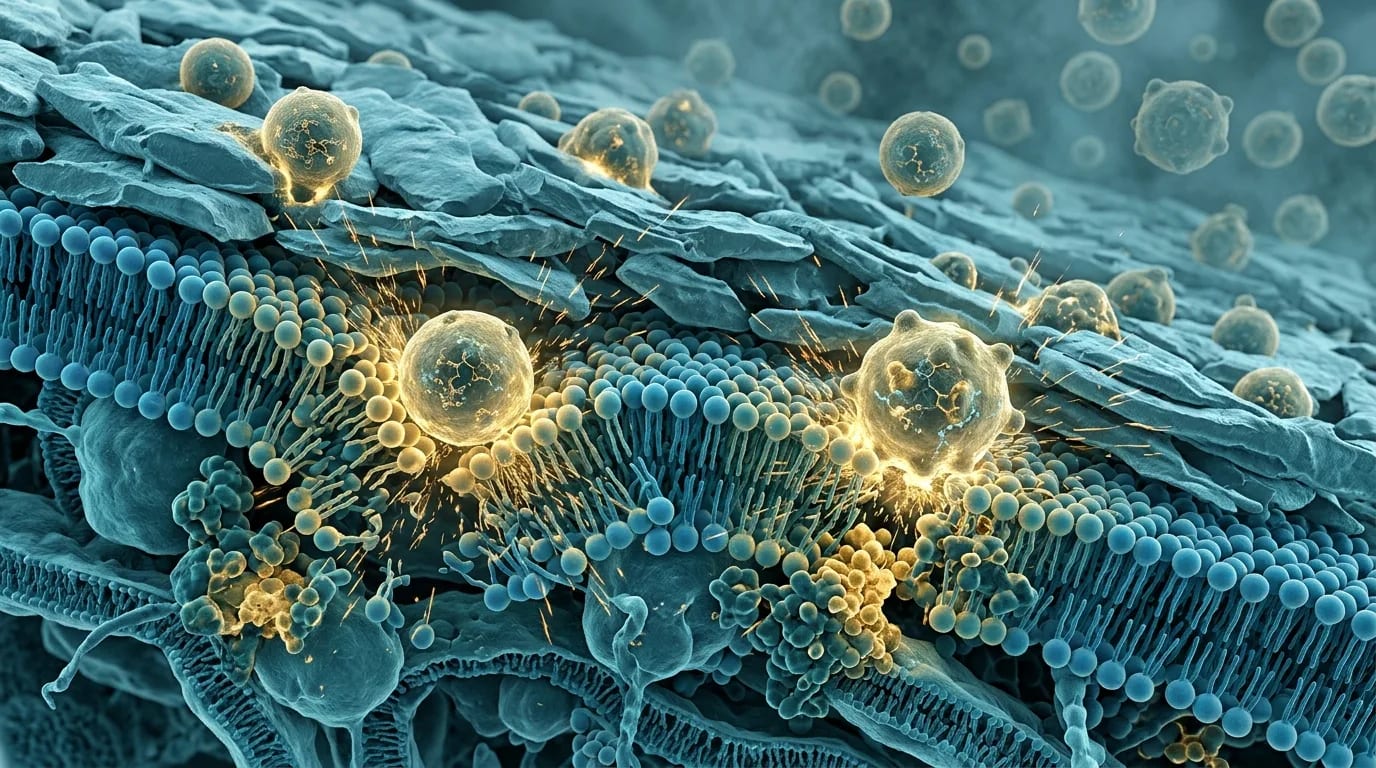
Low-molecular-weight fractions (from 10 to 300 kDa) are capable of penetrating into deeper layers of the epidermis and interacting with CD44 and RHAMM receptors on the surface of keratinocytes and fibroblasts [3]. This triggers cellular signaling cascades, including the stimulation of collagen and elastin synthesis. Fibroblasts accelerate their migration to sites of damage, and regeneration processes are activated. This is exactly what hyaluronic acid is needed for in premium cosmetics — not just to hydrate the surface, but to initiate a biochemical dialogue with the cells of the dermis.
There is, however, a nuance: very low-molecular-weight fragments (oligomers, less than 10 kDa) have shown pro-inflammatory activity in a number of studies — they bind to TLR4 receptors and can enhance the inflammatory response [3]. For a formulator, this is an important signal: "the smaller the molecule, the better" is a simplification that can harm sensitive skin.
Multi-weight formulas: why professional cosmetics follow this path
The best hyaluronate serums work with a combination of molecular weights simultaneously. The high-molecular-weight fraction creates a surface moisture reservoir and tactile comfort immediately after application. The medium-molecular-weight fraction penetrates the epidermis and supports hydration of the stratum corneum. The low-molecular-weight fraction reaches the living layers and stimulates cellular processes. This is not a marketing story about "three types of HA" — it is real functional logic supported by clinical data.
Hyaluronate in formulation: what a formulator needs to know
If you have ever tried to incorporate sodium hyaluronate into a homemade cream formula and ended up with either a slimy gel or a watery mess with no effect at all, you are not alone. Working with this ingredient requires an understanding of a few key parameters.
Concentration: less doesn't mean worse
The typical working range for Sodium Hyaluronate in cosmetic formulas is from 0.01% to 2%. High-molecular-weight hyaluronate provides a pronounced film-forming effect and noticeably changes the rheology of the formula at just 0.1–0.5%. Exceeding this concentration does not enhance hydration; instead, it creates a sticky, uncomfortable texture that feels like glue on the skin. Low-molecular-weight fractions can be used in higher concentrations (up to 1–2%) without sacrificing tactile comfort.
pH and stability
Hyaluronate is stable in the pH range of 5–8, which aligns well with the physiological pH of the skin (4.5–5.5) and most cosmetic formulas. At a pH below 4, acid hydrolysis of the polymer chains begins, and the molecule literally breaks down into fragments. This is critical if you are formulating acidic toners or peels: adding hyaluronate to a medium with a pH of 3.5 means ending up with an expensive ingredient with an unpredictable molecular weight.
Temperature stability also matters: prolonged heating above 80°C destroys high-molecular-weight chains. It is best to add hyaluronate to the water phase at a temperature no higher than 40°C, or into a finished, cooled emulsion. For more details on how temperature regimes affect the behavior of ingredients in a formula, read our article on homemade cosmetic formulation.
Synergy with other ingredients
- Panthenol — a classic partner for hyaluronate: it strengthens the barrier function and reduces TEWL through a complementary mechanism.
- Niacinamide — works at the level of ceramide synthesis and does not compete with hyaluronate for receptors; the combination provides a synergistic effect for dehydrated skin.
- Succinic Acid — when conjugated with hyaluronate, it accelerates tissue metabolism and enhances the regenerative potential of the molecule [2].
- Peptides — low-molecular-weight hyaluronate can act as a transport agent for short peptide chains, improving their delivery into the epidermis. For more on the anti-ageing potential of peptides, see our analysis of the super-peptide for skin.
- Cationic polymers — be careful: hyaluronate is an anionic polymer, and mixing it with cationic agents (such as polyquaternium) may result in the formation of insoluble complexes and precipitation.

Hyaluronic acid for the face: when it actually works and when it doesn't
The most common disappointment with hyaluronate products sounds something like this: "I applied the serum, and an hour later my skin felt even drier." This is neither a myth nor a placebo effect — it is a real physical phenomenon, and there is an explanation for it.
The dry air paradox
Hyaluronate is a hygroscopic agent. It pulls water — but from where? Under ideal conditions (air humidity above 70%), it draws moisture from the atmosphere. In the conditions of a dry office with air conditioning or frosty winter air (20–30% humidity), the molecule begins to pull water from the deeper layers of the skin — and TEWL paradoxically increases. The solution is simple: you always need an occlusive or emollient layer on top of a hyaluronate serum — a cream, an oil, or at least a product with ceramides. Without it, high-molecular-weight HA turns from a humectant into a dehydrator.
Skin type and expected results
For oily and combination skin, hyaluronate is an almost perfect moisturizing agent: it does not add lipids, does not clog pores, and does not create a greasy shine. For dry skin, it is necessary but insufficient — it must be combined with emollients and occlusives. For sensitive skin, the choice of molecular weight is critical: high-molecular-weight hyaluronate works gently and predictably, whereas oligomeric fractions can trigger irritation.
If you are formulating for sensitive skin, study how azelaic acid works when paired with soothing agents: the principles of a gentle approach to reactive skin overlap in many ways.
How to read the label: a practical guide

Manufacturers rarely indicate the molecular weight of hyaluronate on the packaging — but there are indirect signs worth paying attention to.
- INCI name: Sodium Hyaluronate — the classic salt, usually high-molecular-weight. Hydrolyzed Hyaluronic Acid — a hydrolyzed form with a lower molecular weight. Sodium Hyaluronate Crosspolymer — a cross-linked polymer that creates a long-lasting moisture depot on the skin.
- Position in the formula: if hyaluronate is listed after preservatives and fragrances, its concentration is below 0.1%, and you shouldn't expect any real effect.
- Combination of forms: if the formula contains both Sodium Hyaluronate and Hydrolyzed Hyaluronic Acid, it is a good sign of a multi-molecular weight approach.
- Supporting ingredients: the presence of panthenol, niacinamide, or ceramides alongside hyaluronate suggests that the formulator was thinking about synergy rather than just adding a trendy ingredient to the formula.
- Product form: serums and essences are better carriers for hyaluronate than thick creams with a high oil content, which can interfere with the even distribution of the polymer on the skin.
If you want to understand how to work correctly with emulsions and incorporate water-soluble actives into them, take a look at our article on emulsifiers in cosmetics: without understanding these basics, any active ingredient risks ending up where it shouldn't be.
What remains behind the scenes: limitations and an honest look
Hyaluronic acid in cosmetics is one of the few ingredients whose efficacy has been confirmed both in vitro and in clinical settings. But it has real limitations that are rarely talked about.
Firstly, cosmetic hyaluronate does not replace injectable forms. Even the smallest molecules in topical formulas do not reach the mid-dermis—the area where fillers work. These are different tools with different tasks, and it is incorrect to compare them.
Secondly, long-term stimulation of collagen synthesis via topical hyaluronate is an area where there is not yet enough data. Short-term hydration and improvement of skin turgor are well-proven. The cumulative anti-ageing effect is a topic of active research, but not an established fact.
Thirdly, the quality of the raw material is of great importance. Hyaluronate from different manufacturers can differ significantly in molecular weight, purity, and rheological properties—even if the same INCI name is written on the label. For a home formulator, this means: buy from trusted suppliers with technical data sheets (TDS) and certificates.
Understanding why ingredients behave differently depending on their source and processing is a skill that comes with practice. If you want to build a systematic understanding of cosmetic chemistry and learn how to create effective formulas, that is exactly what we do every day in our Walker Formulation Academy Club.
How does Sodium Hyaluronate differ from Hyaluronic Acid in a cream formula?
It is the same substance in different chemical forms. Hyaluronic Acid is the free acid, while Sodium Hyaluronate is its sodium salt. The salt is more water-soluble, more stable in a formula, and better tolerated by the skin. In practice, most cosmetic products use Sodium Hyaluronate, although consumer packaging often says "hyaluronic acid"—this is a marketing simplification, not a chemical error.
Can hyaluronate be used in anhydrous formulas?
No — and here is why: sodium hyaluronate is only soluble in water. In anhydrous systems (oil serums, balms, solid butters), it simply will not dissolve and will either precipitate or remain as undissolved granules. For anhydrous formulas, there are alternative moisturizing agents — for example, oil esters with emollient properties. Read more about this in our guide to anhydrous products.
At what concentration does hyaluronate start working in a home formulation?
For high-molecular-weight Sodium Hyaluronate, a noticeable film-forming and moisturizing effect begins at just 0.1%. The optimal range is 0.1–0.5%: above this concentration, the texture becomes sticky without a proportional increase in effect. Low-molecular-weight fractions can be used up to 1–2% without losing application comfort. Always check the molecular weight of the specific raw material with your supplier — it directly affects the working concentration.