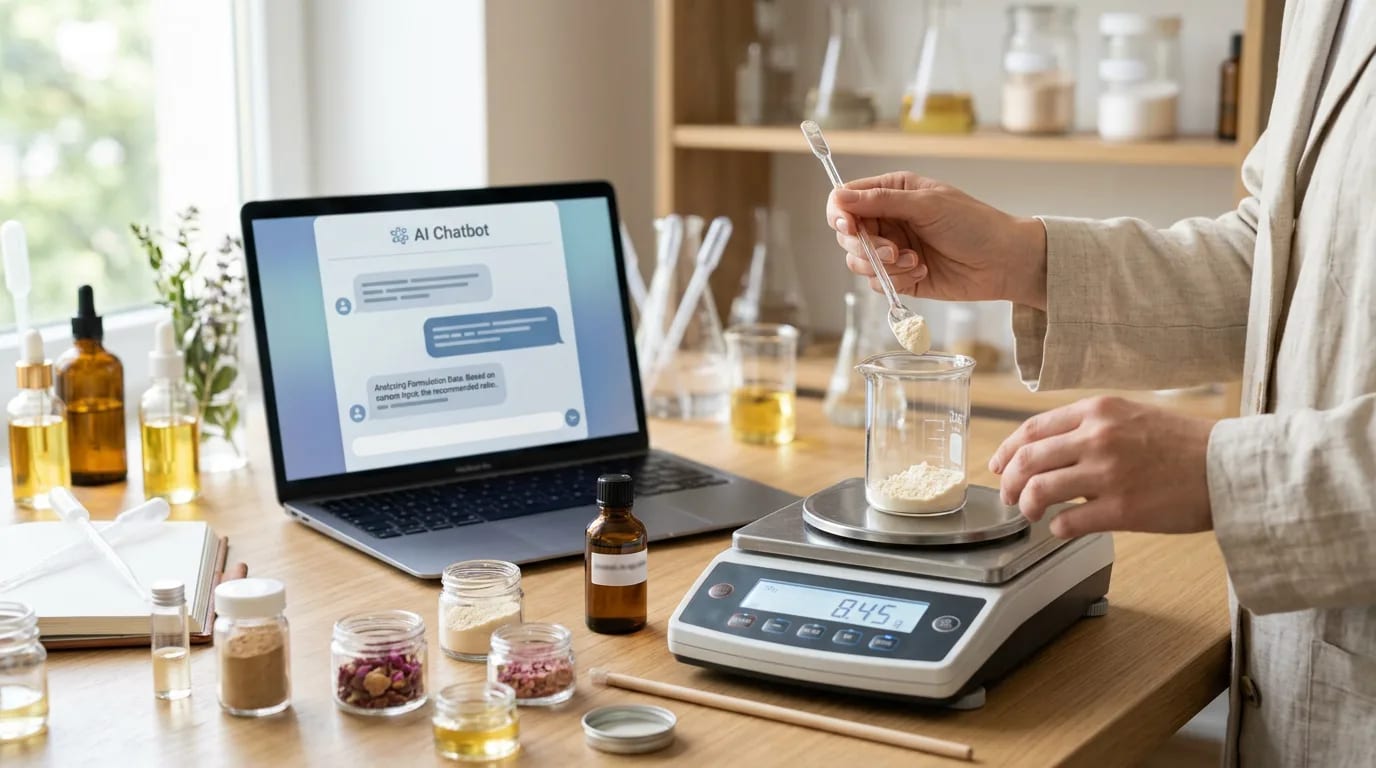
Home cosmetic formulation is not just a hobby: it is an exact science that requires an understanding of emulsion chemistry, raw material properties, and technological processes. If you want to understand how to make a cream at home so that it is stable, safe, and truly effective for the skin, this article will be your starting point. We will break down everything: from choosing equipment and raw materials to pH control and common mistakes made even by experienced formulators. This material was prepared by the team at the online school "Walker Formulation Academy" and is based on practical experience in teaching cosmetic chemistry.
What you need to know before starting formulating at home
Before you reach for the scales and water bath, it is important to form a correct understanding of exactly what you are working with. A cream is an emulsion: a thermodynamically unstable system in which oil and water phases are held together by an emulsifier. Without an understanding of this foundation, any attempt to create a product will turn into a guessing game.
Home cosmetic formulation requires the discipline of a laboratory technician: precise measurements in percentages (not spoons), adherence to temperature regimes, and an understanding of the role of each ingredient in the formula. That is why we strongly recommend studying the basic principles of cosmetic chemistry before moving on to experiments.
Basic terminology for the formulator
To read formulas and professional literature, you will need to master several key concepts:
- Water phase (phase A) — water, hydrolats, water-soluble actives, glycerin, hyaluronic acid.
- Oil phase (phase B) — oils, butters, waxes, fat-soluble vitamins, emulsifier.
- Phase C — heat-sensitive ingredients added after cooling: essential oils, preservatives, and actives sensitive to heat.
- HLB (hydrophilic-lipophilic balance) — a numerical indicator that determines which system an emulsifier works in.
- pH — the hydrogen index, which is critical for the stability and safety of the finished product.
Read more about the role of thickeners and gelling agents in emulsions in our article Tribology, gums, and gelling agents.
Equipment and tools for a home laboratory

The quality of the final cream depends directly on the accuracy of measurements and the cleanliness of the workspace. The good news is that you don't need expensive equipment to get started — a few basic tools are enough.
The necessary minimum
- Scales with 0.01 g precision — critical for working with actives and preservatives that are added in amounts of 0.1–1%.
- Thermometer — infrared or immersion; monitoring the temperature of the phases (usually 70–75°C) is mandatory.
- Glass beakers or stainless steel containers — do not use plastic when heating.
- Hand mixer or mini-homogenizer — simple stirring with a spoon will not suffice for creating a stable emulsion.
- pH meter or test strips — for monitoring the acidity of the finished product.
- 70% disinfecting alcohol — for sanitizing all equipment before work.
- Sterile jars — preferably with a pump or spatula to minimize contamination.
Beginner formulators should also study the topic pH in cosmetics: a basic guide for formulators — this is one of the most frequently overlooked aspects in home formulations.
Choosing raw materials: oils, emulsifiers, and actives

The quality of raw materials determines the quality of the product. In formulating at home, there are no "magic" ingredients — each component performs a strictly defined function, and replacing one with another without understanding the chemistry can destroy the entire emulsion.
Oils and butters: how to choose for your skin type
Plant oils are the basis of the lipid phase of most creams. Their selection depends on the fatty acid profile and the needs of a specific skin type. Oils rich in linoleic acid (rosehip, hemp, safflower oil) are suitable for oily and problem skin; oils with a high oleic acid content (olive, avocado, macadamia) are for dry and mature skin.
Butters — fats that are solid at room temperature (shea, cocoa, mango butter) — give the cream a denser texture and enhance occlusive properties. It is important to consider their polymorphic properties: more on this in the article Butter polymorphism: why cocoa butter is temperamental and how to work with it. A complete guide to selecting oils and butters for your skin type can be found in the article How to choose oils and butters for your skin type: a guide for beginner formulators.
Emulsifiers: the key to a stable emulsion
An emulsifier is the most important ingredient in a cream formula. It is what ensures the combination of the water and oil phases and keeps the emulsion stable throughout the product's shelf life. An incorrect choice or incorrect concentration of an emulsifier is the #1 reason for homemade creams separating.
Popular emulsifiers for natural cosmetics include: Olivem 1000, Emulsifying Wax NF, Montanov 68, BTMS-50, and Sucragel. Each of them has its own specific application features, recommended concentrations, and compatibility with other ingredients. A detailed analysis can be found in our article Emulsifiers for natural cosmetics: a complete guide to selection and application.
Step-by-step technology: how to make a cream at home correctly

The technology for producing a cream at home does not differ fundamentally from industrial production — the only difference is the scale. Below is a universal algorithm applicable to most classic oil-in-water (O/W) emulsions.
Basic moisturizing cream formula (100 g)
This is a training formula that demonstrates the principles of creating an emulsion. Adapt it to your needs as you gain experience:
- Phase A (aqueous, 69.7–69.8%): distilled water or rose hydrosol — 64.7–64.8%, glycerin — 5%, Xanthan Gum — 0.2–0.3% (disperse in glycerin first, then add to water for even distribution without lumps).
- Phase B (oil, 25%): jojoba oil — 10%, shea butter — 5%, cetyl alcohol — 3%, Olivem 1000 — 6%, vitamin E — 1%.
- Phase C (cold, 5%): preservative (e.g., Euxyl PE 9010) — 1%, niacinamide extract — 3%, lavender essential oil — 1%.
Process:
- Disinfect all equipment with 70% alcohol and let it dry.
- Heat Phase A and Phase B separately in a water bath to 70–75°C.
- Slowly pour the aqueous phase into the oil phase, stirring continuously with a mixer at medium speed.
- Continue stirring while cooling the emulsion to 40°C (you can place the beaker in cold water).
- At 35–40°C, add Phase C and mix thoroughly.
- Measure the pH: for a face cream, the optimal range is 4.5–5.5. If necessary, adjust with citric acid (to lower pH) or a solution of NaOH/triethanolamine (to raise it).
- Pour into sterile jars. The shelf life with proper preservation is 3–6 months.
Quality control of the finished product
A professional approach to homemade cosmetic formulation involves not only production but also product testing. A minimum checklist after preparation:
- Visual uniformity — no separation, lumps, or graininess.
- pH in the target range (measure 24 hours after preparation — the value may change).
- Stability test: leave the sample at 40°C for 2 weeks and check for separation.
- Organoleptic properties: smell, color, and texture meet expectations.
- Tolerance test: apply a small amount to the inside of the elbow and observe for 24–48 hours.
Common mistakes for beginner formulators and how to avoid them
Most failures in formulating at home are due to a few recurring mistakes. Knowing them in advance will save you raw materials, time, and nerves.
Mistakes in formulation and technology
- Measuring in spoons instead of percentages. The density of ingredients varies: 1 teaspoon of shea butter and 1 teaspoon of water have completely different masses. Always work by weight.
- Incorrect phase temperature. If the water phase is significantly colder than the oil phase, the emulsifier will crystallize before an emulsion is formed. Both phases must be heated to the same temperature.
- Adding essential oils to the hot phase. Most essential oils are volatile and break down at temperatures above 40°C. Always add them in phase C.
- Neglecting preservatives. A cream without a preservative is a breeding ground for bacteria and mold. This is not just a matter of quality, but of skin safety.
- Ignoring pH. Many actives (niacinamide, vitamin C, AHA acids) only work within a specific pH range. Preservatives also have pH-dependent efficacy.
- Using non-sterile equipment. Microbial contamination during the production stage will render even the most well-formulated preservation ineffective.
- Lack of a gelling agent in the water phase. Xanthan gum at a concentration of 0.2–0.3% is critical for emulsion stability: it structures the water phase and prevents separation during storage. Do not neglect this component, even in basic formulas.
If you are interested in anhydrous products — balms, oil serums, solid butters — check out our material