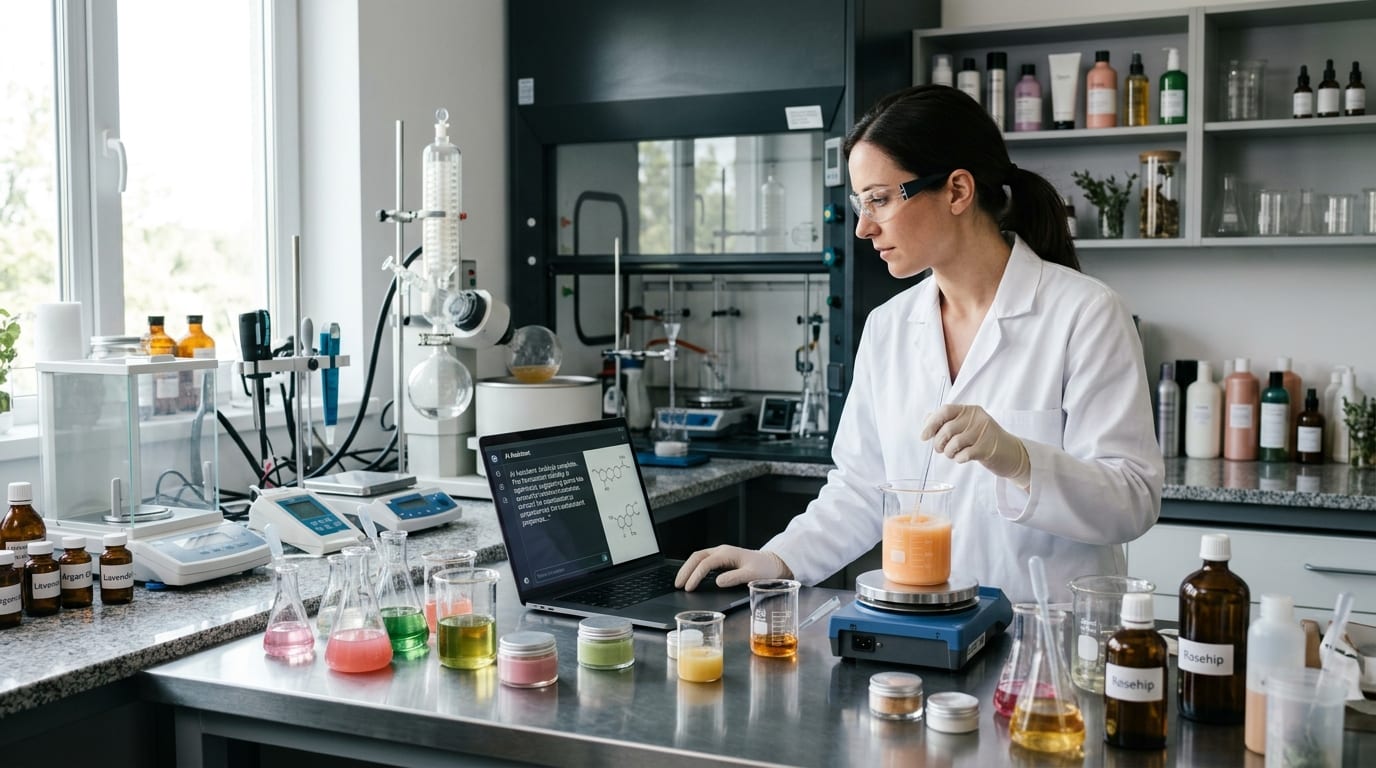
This guide describes the process of preparing a sodium gluconate solution by reacting glucono-delta-lactone (GDL) with sodium hydroxide (NaOH) in a 1:1 molar ratio. The resulting buffer works at pH 3.5–5 and fits perfectly into acidic cosmetic formulas.
What you will need

Reagents | Equipment |
|---|---|
Glucono-delta-lactone (GDL) | Scales (0.01–0.1 g precision) |
Sodium hydroxide (NaOH) — dry or solution | pH meter (or 5.0–9.0 test strips) |
Distilled water | Magnetic stirrer or glass rod |
Safety goggles and gloves ⚠️ |
Safety: Always work wearing safety goggles and gloves! Alkali (NaOH) is caustic. Alkali burns are serious, and the pain is delayed: you won't notice immediately that something has happened.
Key proportion
For 1 gram of GDL → 0.225 grams of dry NaOH
This is a 1:1 molar ratio (not by weight!). Example: for 10 g of GDL → 2.25 g of NaOH.
Step-by-step procedure

Preparation. Calculate the reagent quantities using the proportion above. Put on your goggles and gloves.
Dissolving GDL. Dissolve the GDL in distilled water. Use 3–5 times the weight of the GDL in water (for 10 g of GDL → 30–50 ml of water). Stir until the crystals have completely disappeared.
Hydrolysis (important stage!). GDL is a lactone (a ring) that must open into gluconic acid before the reaction. Heat the solution to 50–70°C and hold for 30–60 minutes. Without heating, hydrolysis is very slow and the pH will be unstable.
Preparing the alkali. Separately, dissolve the NaOH in a small volume of cold water. Be careful — it is an exothermic reaction! The water will get very hot. Always add alkali to water, never the other way around. Wait for it to dissolve completely and cool down.

Neutralization. Slowly add the NaOH solution to the warm GDL solution in portions while stirring constantly. Maintain a temperature of 50–60°C — the heat accelerates the opening of any remaining lactone molecules and prevents “pH drift”.
Checking and stabilization. Measure the pH. Target: pH 6.5–7.5. If the pH is below 6.5 after 10 minutes → add a drop of NaOH solution. If the pH is above 8.0 → there is too much alkali (adjust with a tiny amount of GDL). Success criteria: the pH is stable at ~7.0 for 10–15 minutes.
Finish. The finished solution is pure sodium gluconate. You can use it as is or evaporate the water to obtain a white crystalline powder.
Practical example: 10 g GDL

Stage | Ingredient | Quantity |
|---|---|---|
Dissolution | GDL | 10 g |
Dissolution | Water | 50 g |
Neutralisation | NaOH (caustic soda) | 2.25 g |
Neutralisation | Water (for dissolving NaOH) | 10 g |
Yield | Sodium gluconate | 12.25 g (pure substance) |
Yield | Total solution weight | ~72.25 g (~17%) |
Rotate your phone to see the full table
A small excess of NaOH (2.25 g instead of the theoretical 2.245 g) is perfectly fine. It ensures the complete reaction of all the GDL.
How to incorporate the buffer into an emulsion
Add the calculated amount of sodium gluconate and gluconolactone to the water
Heat to 60–70°C — this will accelerate the reaction and prepare the water for further processing
Continue making the emulsion as usual
Buffer working range: pH 3.5–5.0
If you need a higher pH, it is better to use a different buffer, as you would need too much conjugate base, which could destabilise the emulsion. More on pH in our guide to pH in cosmetics.

Gluconolactone + NaOH = sodium gluconate — a simple and elegant way to create a buffer system for acidic cosmetic formulas. The key to success: complete hydrolysis during heating, a precise 1:1 molar ratio, and pH monitoring. The resulting buffer stabilises your product in the pH 3.5–5 range — exactly where many actives and preservatives work best.
Read also: pH in cosmetics • Preservation in cosmetics

Oksana Walker
Cosmetic Chemist, founder of the Walker Formulation Academy
IFSCC • SCS • IAA • IAC