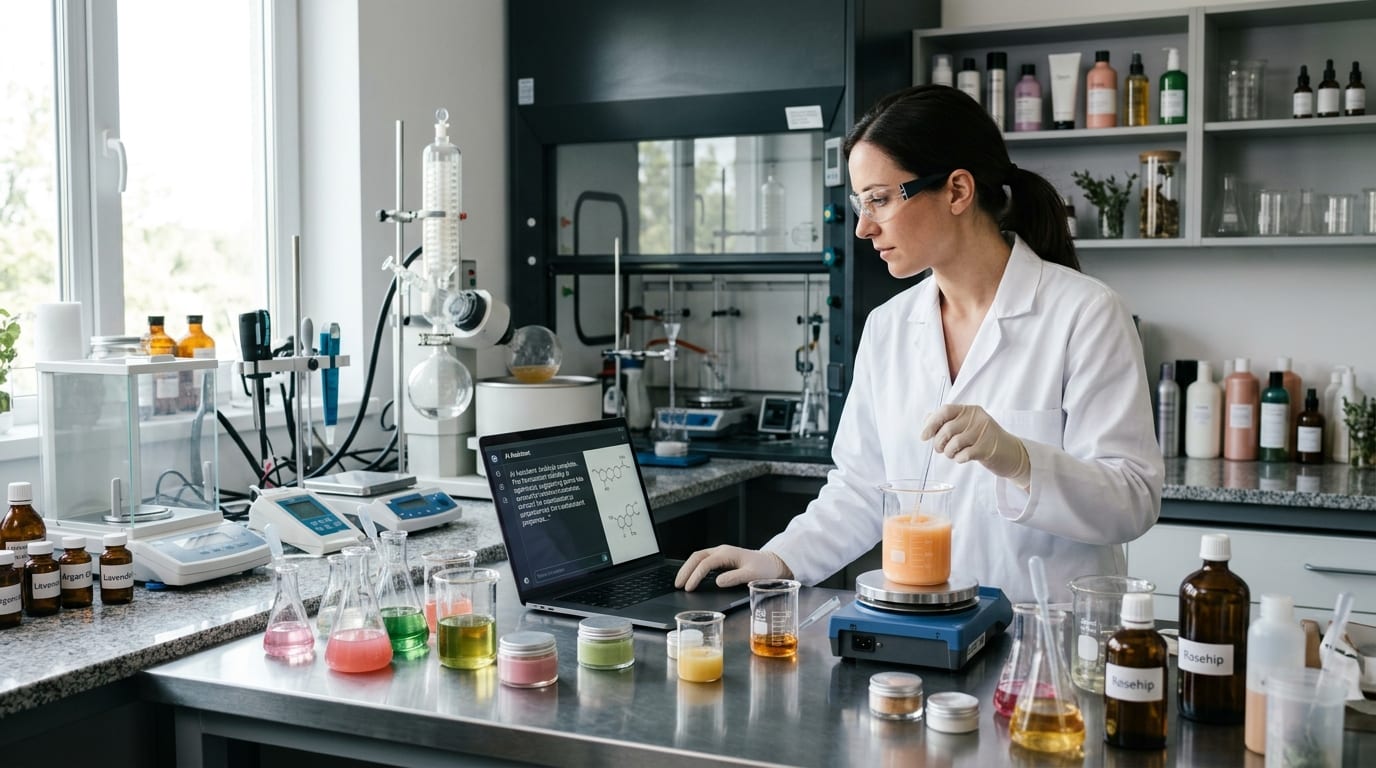
When we apply a cream to our skin and say, “Oh, how silky!” — there is a whole science behind that sensation. Tribology studies friction, wear, and lubrication between surfaces. In cosmetics, it is the science of how a product glides over the skin, absorbs, and what tactile sensations it leaves behind. And it is gelling agents — gums — that play a key role here.

Most formulators evaluate texture intuitively: they rub the cream between their fingers, apply it to the back of their hand, and watch how it absorbs. But few people stop to think that behind each of these sensations — slipperiness, tackiness, “velvety” feel — lie specific physical processes. Tribology allows us to measure, understand, and, most importantly, predict them at the formulation stage.
In this article, we will break down what tribology is in the context of cosmetics, how guar and xanthan gums influence the sensory profile of a cream, and why their combination yields better results than each of them individually.
Tribology is not an abstract laboratory science. Every time you rub a cream between your fingers and decide whether you “like” or “dislike” it, you are conducting a tribological test. The only difference is that scientists do it using a tribometer and get numbers, while we get subjective sensations.
What is tribology in cosmetics

Tribology (from the Greek τρίβος — “rubbing”) is the science of the interaction of surfaces in relative motion. In cosmetics, a tribological system consists of three elements: skin (the first surface), finger or applicator (the second surface), and cosmetic product (the lubricating layer between them).
When you apply a cream, a thin film of the product forms between your finger and your skin. The coefficient of friction of this film is exactly what you “feel.” Low friction means the cream feels slippery and silky. High friction means a sensation of tackiness and “drag.” Tribometers measure this coefficient at different application speeds, creating what is known as a Stribeck curve — a graph showing the relationship between friction and speed.
How we “feel” a cream
Every sensory parameter of a cream has a direct link to its tribological characteristics. Here is how our sensations correlate with the physics of friction:
Sensory parameter | What we feel | Link to friction |
|---|---|---|
Slipperiness | Easy, smooth application without resistance | Low coefficient of friction at medium speeds |
Tackiness | The cream “drags” and leaves a film sensation | High friction in the stopping phase (adhesion) |
Absorbency | Rapid disappearance of the product from the surface | Sharp increase in friction as the film dries |
Silkiness | Velvety, weightless texture | Consistently low friction across a wide range of speeds |
Rotate your phone to see the full table
Guar gum
Guar gum (Guar Gum, Cyamopsis tetragonoloba) is a natural polysaccharide derived from the seeds of the guar plant. In cosmetics, it is used as a thickener and emulsion stabilizer. Guar forms viscous solutions even at low concentrations (0.5–1.0%) and provides soft, enveloping glide upon application. The tribological profile of guar is characterised by a moderate reduction in friction — the cream feels smooth, but may leave a slight tackiness after absorption. This is because guar forms a thin film on the skin with relatively high adhesion.
Xanthan Gum
Xanthan Gum is an exopolysaccharide produced by the bacterium Xanthomonas campestris. It gives formulations pseudoplastic properties: the gel thins upon application (under shear) and recovers its structure at rest. Xanthan provides a clean, non-tacky after-feel — after absorption, the skin feels dry and smooth. However, during application, xanthan can create a “jelly-like” sensation and lack of slip due to higher initial friction.
Guar gum
Pros: soft slip, good viscosity, natural origin. Cons: residual tackiness, film on the skin, can cloud transparent formulations.
Xanthan Gum
Pros: clean after-feel, pseudoplasticity, stability across various pH levels. Cons: “jelly-like” application texture, can cause stringiness.
No single gum is perfect on its own. Guar provides a pleasant application but a tacky finish. Xanthan offers a clean finish but a “jelly-like” start. The solution? Combine them. The synergy of the two gums compensates for the weaknesses of each.
Synergy: guar + xanthan

Studies show that a blend of guar and xanthan gum in a ratio of approximately 70:30 (guar:xanthan) produces a synergistic effect. Guar provides slip during the application phase, while xanthan “cleans up” the finish, removing tackiness. In tribological tests, this combination shows a consistently low coefficient of friction at all stages: from application to full absorption.
Parameter | Guar (100%) | Xanthan (100%) | Blend 70:30 |
|---|---|---|---|
Slip during application | ★★★★☆ | ★★★☆☆ | ★★★★★ |
Finish cleanliness | ★★☆☆☆ | ★★★★★ | ★★★★☆ |
Emulsion stability | ★★★☆☆ | ★★★★☆ | ★★★★★ |
Overall sensory score | 7/10 | 6/10 | 9/10 |
Rotate your phone to see the full table
Practical recommendations

How to apply knowledge of tribology in practice? Here are three key tips to help you improve the sensory profile of your creams:
Combine gums
Start with a 70:30 ratio (guar:xanthan) at a total concentration of 0.3–0.8%. Adjust based on the desired profile: more guar for a softer application, more xanthan for a cleaner finish.
Test mindfully
When evaluating a cream, divide sensations into phases: initial slip (first 3 seconds), spreading (5–10 seconds), and finish (after 30 seconds). This is your “home tribometer”.
Keep a sensory diary
Record sensations for each phase for every sample. Over time, you will learn to predict the sensory profile from the composition — and that is more valuable than any tribometer.
Tribology is the bridge between formulation chemistry and consumer experience. By understanding how gelling agents affect friction, you move from intuitive selection to scientifically-backed development. Even if you don't have a laboratory tribometer, your fingers, trained in mindful testing, can become an equally precise tool.
Read also: Polymorphism of butters • Sunscreen products

Oksana Walker
Cosmetic chemist, founder of the Walker Formulation Academy
IFSCC • SCS • IAA • IAC