The light oils, and what they cost you
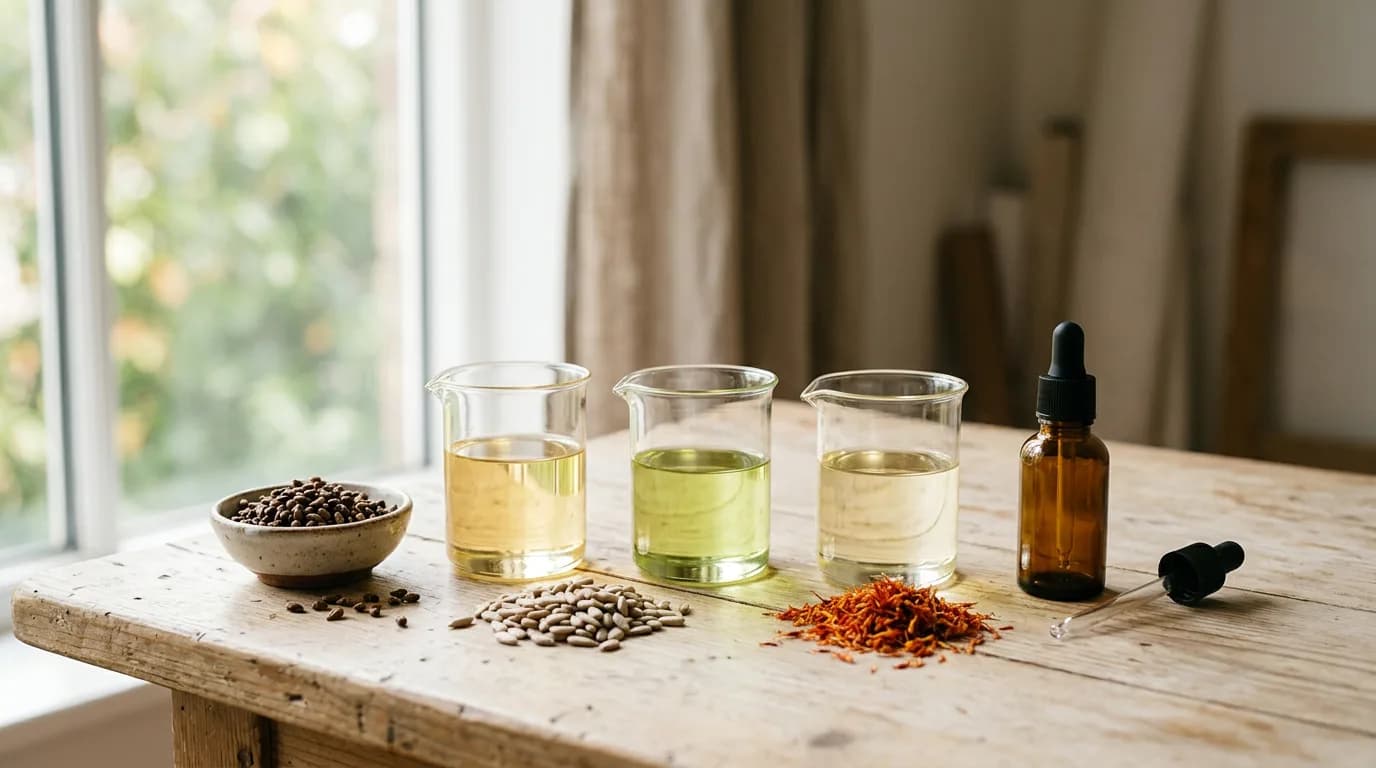
Sunflower, grapeseed, safflower, soybean and maize oil are the oils formulators describe as light. In our formulators' experience they are what goes into a facial oil "for combination skin", a fast-absorbing body oil or a serum that must not feel greasy, and they are also the oils whose oxidation has to be planned for most carefully. Linoleic acid, C18:2, has two double bonds. One more than oleic acid is enough to change how an oil oxidises, its relevance to the skin barrier and, in practice, how it is perceived on skin. This article, the third spoke of our series on plant oils by fatty-acid group, is about that trade-off: what the linoleic group gives, what it takes, and how to pay for it sensibly rather than by accident.
Two double bonds: the whole story in one carbon
Linoleic acid is an 18-carbon chain with two cis double bonds, between carbons 9 and 10 and between carbons 12 and 13, with a single carbon, C11, between them. A carbon flanked by two double bonds is called bis-allylic, and it is particularly susceptible to losing a hydrogen atom, which is how lipid oxidation begins. Oleic acid has no bis-allylic carbon; linoleic has one; alpha-linolenic, with three double bonds, has two. The number of such carbons is a rough index of how readily a fatty acid oxidises, and a well-known experiment illustrates the scale. Chapman, Kim and Min (Journal of Food Science, 2009) stored a mixture of oleic, linoleic and linolenic acids, to which 10,000 ppm of oxidised alpha-tocopherol had been added, in the dark at 55 °C and followed how much of each was lost: after 30 days the reported oxidation ratio of oleic to linoleic to linolenic was 1 to 12 to 26. That is one experiment under one set of conditions, not a shelf-life multiplier for a cream, but it shows the direction and the rough size of the difference that the extra double bond makes.
The Codex Alimentarius standard for named vegetable oils (CXS 210-1999) gives the reference ranges. Sunflower oil carries 48.3–74.0 percent linoleic acid, grapeseed 58.0–78.0, safflower 67.8–83.2, soybean 48.0–59.0 and maize 34.0–65.6. Their iodine values, an analytical measure related to the degree of unsaturation, sit accordingly: sunflower 118–141, grapeseed 128–150, safflower 136–148, soybean 124–139, maize 103–135, against 78–90 for high-oleic sunflower and 6.3–10.6 for coconut. A 2008 review of sunflower breeding in the Canadian Journal of Physiology and Pharmacology puts a typical conventional sunflower oil at 16–19 percent oleic and 68–72 percent linoleic: in that oil, roughly two chains in three carry the bis-allylic carbon.
What linoleic acid does in the skin barrier
The linoleic group's reputation for "barrier support" is not marketing invention; it rests on some of the better-established lipid biochemistry of the skin, and it is worth stating precisely because the precise version is more useful than the slogan.
The outermost layer of the skin is held together by a specific lipid architecture, and one class of lipids in it is unusual: the acylceramides, in which a very long ceramide carries an additional fatty acid esterified at its far end. One of them, Cer[EOS], carries omega-O-esterified linoleic acid, and Kato and colleagues describe it as a lipid essential for the skin barrier. Its role was tested directly by Imokawa and colleagues in the Journal of Clinical Investigation in 1994. In rats made deficient in essential fatty acids, daily application of a synthetic pseudo-acylceramide carrying ester-linked linoleic acid produced a dose-dependent, significant reduction in transepidermal water loss, while the same molecule built with oleic acid or a saturated chain, and ordinary ceramides, had a poor effect. In a second model, UVB-irradiated guinea-pig skin, the linoleate-carrying pseudo-acylceramides reduced epidermal hyperplasia whereas linoleic acid itself did not; in those experimental models it was the acid in its structural role, not the free acid, that produced the effect. The 2022 study by Kato and colleagues in Biochimica et Biophysica Acta looked at the supply chain in mice lacking the enzyme Acsl1: linoleate-containing Cer[EOS] was significantly reduced, its precursor accumulated, and the authors considered triglycerides containing linoleic acid to be the reservoir from which that linoleate is drawn.
That is the mechanism as far as the animal work takes it. What it does not say is that applying a linoleic-rich oil to skin rebuilds acylceramides, and no formulator should print that. The human evidence is narrower. In the Danby study discussed in the oleic article (Pediatric Dermatology, 2013), a small study of 19 adults, the relevant cohort applied olive oil to one forearm and sunflower seed oil to the other twice daily for four weeks: sunflower preserved stratum corneum integrity and improved hydration, olive oil reduced integrity. A 2018 review in the American Journal of Clinical Dermatology concluded that oils with a higher ratio of linoleic to oleic acid have better barrier-repair potential, and that cold pressing is the preferred extraction because it preserves the oil's beneficial lipids. The formulator's position that follows is modest: a linoleic-rich oil is a reasonable starting choice for a leave-on product intended for dry-feeling skin, the biochemistry explains the interest, and whatever the finished product claims has to be substantiated on the finished product.
There is a second, older thread in the literature that is often quoted around this group. Downing and colleagues (Journal of the American Academy of Dermatology, published in 1986) noted that people with acne had been shown to have low levels of linoleic acid in their skin surface lipids and advanced the hypothesis that low linoleate in sebum imposes a local essential-fatty-acid deficiency on the follicle lining, provoking the hyperkeratosis that blocks it. It is a hypothesis paper, and it licenses no claim about spots on a cosmetic label; in the UK, a claim to prevent or treat acne makes a product a medicine. It is quoted here as scientific context and as a good example of a research idea that should be cited as an idea, not as a result.
Why the group oxidises, and what that means for a product
Return to the chemistry: the bis-allylic carbon makes linoleic chains far more prone to oxidation than oleic ones, and the Chapman ratio gives a sense of the scale under one set of conditions. A cream or facial oil built on a linoleic oil rather than a high-oleic one therefore carries a more perishable oil phase, and three practical consequences follow.
The period-after-opening has to be earned, not assumed. The Cosmetic Product Safety Report must address the stability of the finished product under reasonably foreseeable storage conditions, and "the supplier's iodine value was in range" is only the start of that. The test design and acceptance criteria have to be justified for the finished product; for an oil phase that is mostly linoleic, stability on the finished product in its final pack is what supports the number on the jar.
The oil may arrive with measurable oxidation already. Codex quality factors allow cold-pressed and virgin oils to be delivered with a peroxide value of up to 15 milliequivalents of active oxygen per kilogram (10 for refined). The peroxide value is a snapshot of primary oxidation at testing; as a matter of formulation judgement, for an oil that will oxidise readily, we ask for the batch value and treat a low one as worth paying for.
The group is not uniform in its own defences. Codex Table 4 lists the tocopherol content of authentic oils, and the differences are large. Sunflower oil carries 440–1520 mg/kg of total tocopherols, of which alpha-tocopherol is 403–935 mg/kg; soybean 600–3370 mg/kg, of which gamma-tocopherol is 89–2307 mg/kg; maize 330–3720; safflower 240–670; and grapeseed only 240–410 mg/kg. Grapeseed, with one of the highest iodine-value bands in the group (128–150), arrives with the least of its own antioxidant. In our formulators' experience that combination is why grapeseed has a reputation for going off, and why it is the oil in this group that most needs help from the formula.
Antioxidants: what extends shelf life and what only looks as if it does
The reflex answer is "add vitamin E", and it is half right. Two findings from the food-oil literature sharpen it.
First, more tocopherol is not automatically better. Hwang, Winkler-Moser and Liu (Journal of Food Science, 2019), working in soybean oil at 180 °C, refer in passing to the pro-oxidant activity of alpha-tocopherol at high concentrations as a known behaviour. A related finding comes from Chapman, Kim and Min: alpha-tocopherol that has itself been oxidised acted as a pro-oxidant when added to oils, and its pro-oxidant effect was greater in soybean and corn oil, at about 55 percent linoleic acid, than in oils with about 12 percent. Both are food-oil studies at food-oil conditions; they do not set a cosmetic use level. What they do establish is that tocopherol is not a safety margin that grows with the dose, and that the concentration for a given product has to come out of that product's stability testing.
Second, rosemary extract is a serious alternative rather than a "natural" gesture. Guo and colleagues (Foods, 2023) stored rapeseed oil with rosemary extract and found that 100 mg/kg of the extract gave a shelf life equivalent to 50 mg/kg of the synthetic antioxidant TBHQ, that the optimum addition at room temperature was 50–200 mg/kg, and that the extract delayed the degradation of the oil's own alpha-tocopherol. The numbers were measured in rapeseed oil, not in a cosmetic, so they are a starting point for a stability study, not a specification.
Third, and least glamorous, the pack. Oxidation needs oxygen and is accelerated by light and warmth, so a clear dropper bottle opened twice a day and an airless pump kept in a drawer are, in our formulators' experience, two different products with the same formula. Whether that difference matters for a given product has to be demonstrated, which is why the stability study should be run in the pack the customer will hold.
The feel, and the substitution trap
In our formulators' experience the linoleic oils are described as light, quick to absorb and low in residual film, which is why they dominate facial oils for combination skin, gel-creams, hair serums for fine hair and any product where "non-greasy" is on the brief. That is craft experience rather than a measured property, and it varies with everything else in the formula. The trap is the substitution that changes the group without changing the label. Sunflower oil exists in three Codex-recognised forms: conventional (linoleic), mid-oleic with 43.1–71.8 percent oleic acid, and high-oleic with 75.0–90.7. A supplier moving a customer from conventional to high-oleic sunflower is moving the oil from this group to the oleic one, with a different unsaturation and, in our experience, a different feel, so the product has to be re-tested as if it had a new oil in it, which it has. Read the oleic and linoleic percentages on every new batch, not just the first.
Who is in the group
- Sunflower (conventional). The reference member: 48.3–74.0 percent linoleic on Codex ranges, rich in alpha-tocopherol. The most studied of the group on skin (Danby, 2013).
- Grapeseed. 58.0–78.0 percent linoleic, an iodine-value band of 128–150 and the lowest tocopherol content in the group (240–410 mg/kg). Light and inexpensive in our experience; the one most in need of an antioxidant plan.
- Safflower (conventional). 67.8–83.2 percent linoleic, the most linoleic-rich common oil. Like sunflower it has a high-oleic twin (70.0–83.7 percent oleic) that belongs to a different group.
- Soybean. 48.0–59.0 percent linoleic with 4.5–11.0 percent alpha-linolenic, which adds chains with two bis-allylic carbons; rich in gamma-tocopherol. In our experience more common in body-care bases than in facial products.
- Maize. 34.0–65.6 percent linoleic, a wide range that is itself a reason to read the certificate; tocopherol-rich.
Reading a certificate of analysis for a linoleic oil
- Linoleic and oleic percentages. Place the oil in its group and, for sunflower and safflower, confirm the variety. A "sunflower oil" at 80 percent oleic is not in this group.
- Iodine value against the Codex band for the named oil. A value far below the band for a "conventional" sunflower or safflower suggests a high-oleic variety.
- Peroxide value. The Codex maximums are 15 for cold-pressed and virgin oils and 10 for refined; for this group, the lower the better, and the batch figure matters more than the specification.
- Tocopherol content, where the supplier reports it. Compare with the Codex ranges above; a grapeseed oil is starting from a low base whatever the certificate says.
- Refined or cold-pressed. Cold pressing is the extraction the 2018 review prefers because it preserves the oil's beneficial lipids; refining gives a paler, less odorous oil. Which you want depends on the product, but the choice belongs on the specification, not left to the supplier.
Where the group belongs
| Format | Typical practice | What the chemistry and the studies say |
|---|---|---|
| Facial oils and serums for combination or oily skin | In our experience the usual starting group | Light feel reported by formulators; oxidation is the constraint; no claim about spots is available to a cosmetic |
| Leave-on products for dry-feeling skin | Common in our experience, often blended with oleic oils | Sunflower preserved stratum corneum integrity and improved hydration in 19 adults (Danby, 2013); acylceramide biochemistry explains the interest (Imokawa, 1994; Kato, 2022); finished-product substantiation still required |
| Hair serums for fine hair | Common in our experience | Low residual film reported by formulators; oxidation is the constraint |
| Rich body butters and balms | Usually a minority share | Liquid at room temperature, so it adds nothing structural; the saturated and oleic groups carry these formats |
| Anhydrous products in clear packaging | Formulators avoid it as the main oil | High unsaturation (iodine values 118–150 across the group) and exposure to light and oxygen; stability must be shown in the final pack |
The linoleic group is the one where the formulator's two instincts, "make it feel light" and "make it last", pull hardest against each other. The chemistry says you cannot have both for free. Composition tells you where the risk is; it does not tell you the sensory result, the oxidative stability or the period-after-opening of your product. Those come from testing the finished formula in its final pack, and for this group that testing is the price of the lightness.
Sources
- Codex Alimentarius. Standard for Named Vegetable Oils, CXS 210-1999 (amended 2015): fatty-acid composition (Table 1), iodine values (Table 2), tocopherols (Table 4), quality factors (Appendix). FAO PDF
- Chapman T. M., Kim H. J., Min D. B. Prooxidant activity of oxidized alpha-tocopherol in vegetable oils. Journal of Food Science, 74(7), C536–C542, 2009. PubMed 19895457
- Škorić D., Jocić S., Sakač Z., Lečić N. Genetic possibilities for altering sunflower oil quality to obtain novel oils. Canadian Journal of Physiology and Pharmacology, 86(4), 215–221, 2008. PubMed 18418432
- Imokawa G., Yada Y., Higuchi K., Okuda M., Ohashi Y., Kawamata A. Pseudo-acylceramide with linoleic acid produces selective recovery of diminished cutaneous barrier function in essential fatty acid-deficient rats and has an inhibitory effect on epidermal hyperplasia. Journal of Clinical Investigation, 94(1), 89–96, 1994. PubMed 8040295
- Kato A., Ito M., Sanaki T., Okuda T., Tsuchiya N., Yoshimoto R., Yukioka H. Acsl1 is essential for skin barrier function through the activation of linoleic acid and biosynthesis of ω-O-acylceramide in mice. Biochimica et Biophysica Acta, Molecular and Cell Biology of Lipids, 1867(2), 2022. PubMed 34813948
- Danby S. G. et al. Effect of olive and sunflower seed oil on the adult skin barrier: implications for neonatal skin care. Pediatric Dermatology, 30(1), 42–50, 2013. PubMed 22995032
- Vaughn A. R., Clark A. K., Sivamani R. K., Shi V. Y. Natural Oils for Skin-Barrier Repair: Ancient Compounds Now Backed by Modern Science. American Journal of Clinical Dermatology, 19(1), 103–117, 2018. PubMed 28707186
- Downing D. T., Stewart M. E., Wertz P. W., Strauss J. S. Essential fatty acids and acne. Journal of the American Academy of Dermatology, 14(2), 221–225, 1986. PubMed 2936775
- Hwang H. S., Winkler-Moser J. K., Liu S. X. Study on Antioxidant Activity of Amino Acids at Frying Temperatures and Their Interaction with Rosemary Extract, Green Tea Extract, and Ascorbic Acid. Journal of Food Science, 84(12), 3614–3623, 2019. PubMed 31769515
- Guo M. et al. Antioxidant Efficacy of Rosemary Extract in Improving the Oxidative Stability of Rapeseed Oil during Storage. Foods, 12(19), 3583, 2023. PubMed 37835236