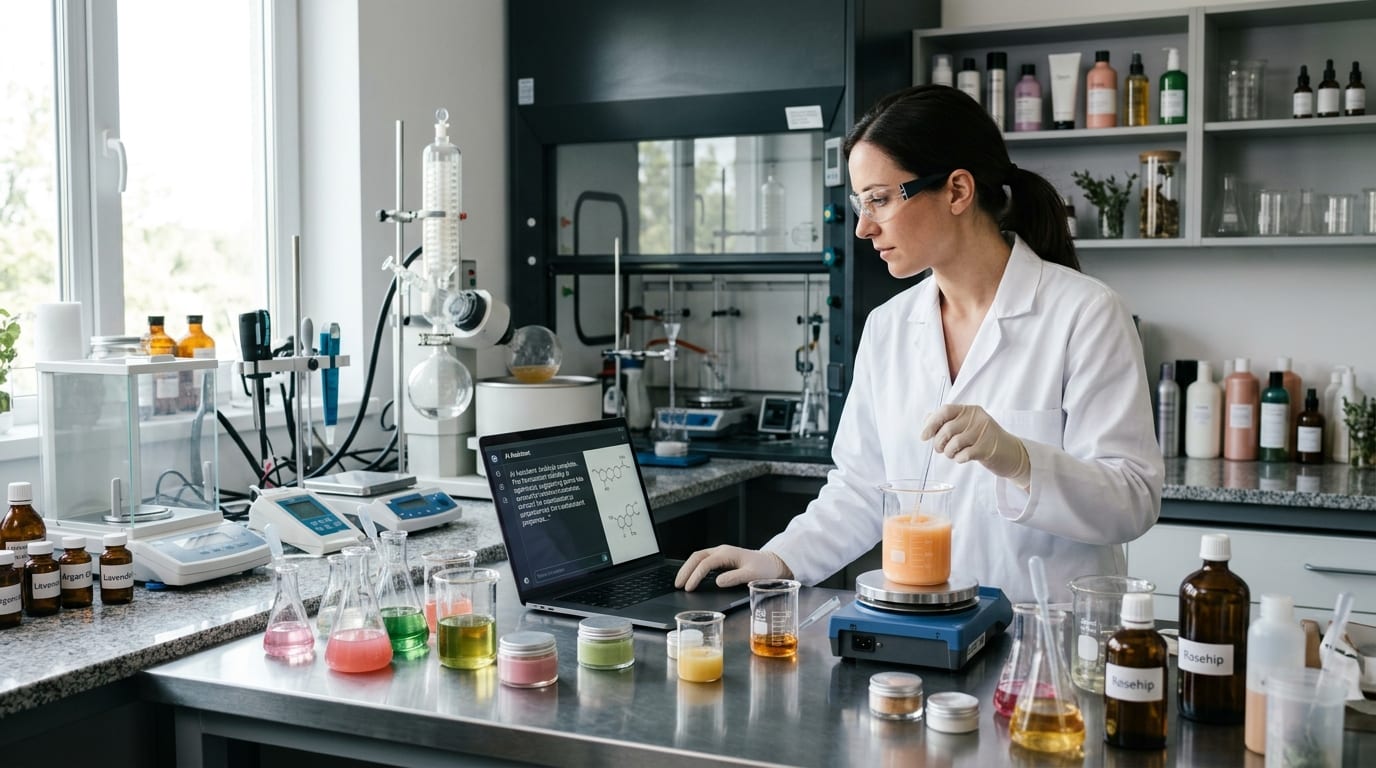
The concept of pH might seem like a simple chemical topic, but it is arguably the most important factor for anyone involved in cosmetic development, whether an amateur or a professional. Ignoring pH can lead to product instability, ingredient inactivity, and, most importantly, skin irritation or damage. In this guide, we will break down everything from basic theory to a step-by-step protocol for adjusting pH in your formulations.

What is pH
The term pH stands for “potential of hydrogen” (from the Latin pondus hydrogenii) and measures the acidity or alkalinity of an aqueous solution on a scale from 0 (most acidic) to 14 (most alkaline), where 7 is neutral. Each unit on the scale represents a tenfold change in hydrogen ion concentration. This means a solution with a pH of 4 in ten times more acidic than a solution with pH 5, and a hundred times more acidic than pH 6.
pH range | Characteristics | Examples |
|---|---|---|
0–2 | Strong acids | Hydrochloric acid, gastric juice |
3–4 | Acidic products | Vitamin C serums, AHA peels |
4.5–5.5 | The skin's acid mantle | Healthy human skin |
5–6 | Mildly acidic | Most creams and lotions |
7 | Neutral | Purified water |
8–9 | Mildly alkaline | Soap, some cleansers |
10–14 | Strong alkalis | Hair straightening products, depilatories |
Rotate your phone to see the full table
Why pH is so important in cosmetics
Active ingredients
Many active ingredients only work within a narrow pH range. Vitamin C (L-ascorbic acid) is effective at a pH below 3.5. Niacinamide — at 5.0–7.0. AHAs — at 3.0–4.0. Outside of this range, the active is either ineffective or degrades rapidly.
Preservation system
Most preservatives have their own “working pH range” and are ineffective outside of it. Potassium Sorbate works only at pH < 5.5, Sodium Benzoate — at pH < 5.0. More details in our article on preservation.
Emulsion stability
pH affects the charge of emulsifiers and thickeners. Incorrect pH → the cream formula thins out or separates. Polymeric thickeners (Carbomer) require neutralisation to pH 5.5–6.5 to swell. Surfactants, colourants — everything depends on the pH.
Skin health
The skin's acid mantle: pH 4.5–5.5. Alkaline products (soap, pH 9–10) disrupt the lipid barrier → dryness, irritation, microbiome imbalance. Overly acidic ones (pH < 3) can cause chemical burns and redness.
The ideal pH for most rinse-off and leave-on products: 5.0–6.0 — as close as possible to the skin's natural pH. However, the final pH is dictated by the composition: if an active or preservative requires a specific pH to function, that is the pH the product will have.
How to measure pH accurately

There are two main ways to measure pH: using a digital pH meter or test strips. The difference in accuracy is fundamental.
Parameter | pH meter | pH strips |
|---|---|---|
Accuracy | Up to 0.01 pH | 0.5–1.0 pH |
Opaque/coloured samples | Works perfectly | Difficult to determine the colour |
Calibration | Required (buffers 4.0, 7.0, 10.0) | Not required |
Cost | 2 000–£150 | £2–5 per pack |
Recommendation | Best choice for serious work | For quick reference |
Rotate your phone to see the full table
Calibration is mandatory. A pH meter is only as good as its last calibration. Calibrate with certified buffer solutions (pH 4.0, 7.0, 10.0) before every session. Without calibration, the readings are meaningless.
Safe pH adjustment
When your product's pH is outside the desired range (usually 5.0–6.0), it needs to be adjusted. Diluted acid or alkali solutions are used for this.

Lowering the pH (making it more acidic)
For example, from 7.5 to 5.5. 50% citric acid solution — the most common.Lactic acid — a skin-identical ingredient, a milder option. Always use diluted solutions: pure acid causes too sharp a drop.
Raising the pH (making it more alkaline)
For example, from 4.0 to 5.5. 10% NaOH solution — very effective, requires caution.Triethanolamine (TEA) or Tromethamine — milder, neutralises certain thickeners. NaOH: add powder to water, not the other way around!
pH adjustment protocol: step-by-step
Check the current pH of the fully mixed and cooled product. Do not measure hot mixtures — temperature affects the readings
Add the diluted pH adjuster one drop at a time. One drop of 50% citric acid can lower the pH by 0.3–0.5 units in 100 g of product
Mix thoroughly after each drop — ensure the adjuster is fully distributed throughout the product volume
Wait ~1 minute for the reading to stabilise before checking again. A pH meter does not provide an accurate value instantly
Record the exact amount of adjuster (in drops or grams) for reproducibility in future batches. This is your “pH formulation adjustment”
Golden rule: it is better to under-correct and add another drop than to over-pour and miss your target. This is especially critical with NaOH — one extra drop can raise the pH by a whole unit.
Cheat sheet: pH by product type

Product type | Target pH | Notes |
|---|---|---|
Moisturising cream, serum | 5.0–6.0 | Close to skin pH, optimal for most preservatives |
Shower gel, shampoo | 5.0–5.5 | Compatibility with skin and hair, good foaming |
Toner | 4.5–5.5 | Restoring the acid mantle after cleansing |
Peel (AHA/BHA) | 3.0–4.0 | For acid activity, only for those with sufficient experience |
Vitamin C serum | < 3.5 | L-ascorbic acid requires a very acidic environment |
Soap (natural) | 9.0–10.0 | Alkaline by nature, cannot be lowered without destroying the soap |
Rotate your phone to see the full table
Advice from Oksana Walker: pH is the main regulator that binds safety, efficacy, sensory properties, and stability into a single system. Invest in a good pH meter (it doesn't have to be a laboratory one for £150 — a pocket one for £20–£30 with a replaceable electrode will do), calibrate it before every batch, and record your readings. The correct pH is the hallmark of an experienced formulator.

pH is not just a number on a device display. It is the key that determines whether your cream will be stable, your preservative will be active, and your active ingredient will be effective. A correctly chosen pH window, careful micro-corrections on a calibrated device, and a recorded protocol turn a “fickle” mixture into a predictable product with reproducible quality.
Read also: GDL → Sodium gluconate: buffer • Xanthan and guar gums

Oksana Walker
Cosmetic chemist, founder of Walker Formulation Academy
IFSCC • SCS • IAA • IAC