Have you ever wondered why a cream for £30 and a cream for £300 can contain almost identical active ingredients — yet feel completely different on the skin? It’s not brand magic. It’s about the molecules that stand between oil and water. Literally. Surface-active agents — surfactants — are the architects of texture. They decide whether your product will be a silky gel, a rich cream, or a weightless fluid. And understanding them means unlocking the key to how modern cosmetics actually work.
A molecule with a double life
A surfactant is an amphiphilic molecule. It has a hydrophilic "head" that loves water and a lipophilic "tail" that reaches for oils. This duality isn't a weakness; it's a superpower. It is precisely because of this that surfactants can do what would otherwise be impossible: combine immiscible liquids, reduce surface tension, and create structures — micelles, lamellar phases, and vesicles.
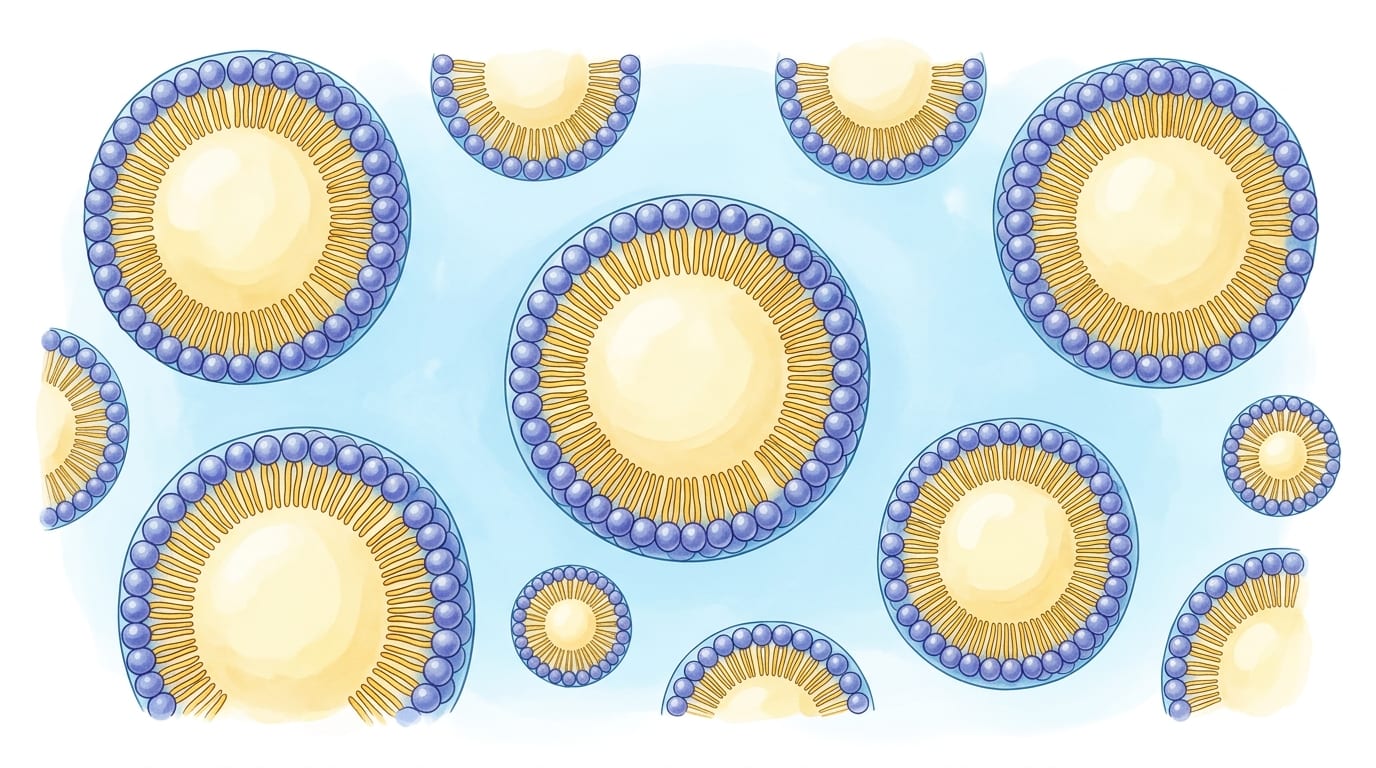
When the concentration of a surfactant in a solution exceeds the critical micelle concentration (CMC), the molecules self-organize: the tails hide inside, the heads face outward — and a micelle is formed. Inside this sphere is a cozy oily space where oil-soluble ingredients can be "packed." This is exactly how solubilization works: a transparent serum with 0.5% essential oil remains transparent only because Polysorbate 20 (INCI: Polysorbate 20) creates micelles smaller than the wavelength of visible light.

Four classes — four personalities
Surfactants are divided into four groups based on the charge of their hydrophilic part — and this isn't just textbook classification; it is practical information for formulation:
- Anionic — carry a negative charge. The most powerful foaming agents and cleansing agents. Sodium Lauryl Sulfate (SLS), Sodium Laureth Sulfate (SLES), Sodium Cocoyl Isethionate. Aggressive to the skin barrier at high concentrations.
- Cationic — positive charge. Attracted to the negatively charged surfaces of hair and skin. Cetrimonium Chloride, Behentrimonium Methosulfate — the basis of conditioning systems.
- Amphoteric — change charge depending on pH. Cocamidopropyl Betaine — mild, synergistic with anionic surfactants, reduces their irritation potential.
- Non-ionic — no charge, the mildest. Polysorbate 60, Cetearyl Glucoside, PEG-40 Hydrogenated Castor Oil. Ideal as emulsifiers and solubilizers.
Understanding these classes is critical if you are working with pH in cosmetics: cationic surfactants lose their effectiveness at high pH, while amphoteric ones behave fundamentally differently in acidic and alkaline environments.
How surfactants build an emulsion
A classic emulsion is a dispersed system where one liquid is distributed within another in the form of droplets. Oil-in-water (O/W) or water-in-oil (W/O) are the two basic types, and it is the emulsifier that determines which one will be formed. Bancroft's rule states: the phase in which the emulsifier is more soluble becomes the continuous phase. A non-ionic emulsifier with an HLB (hydrophilic-lipophilic balance) above 8 will give you an O/W emulsion with a light texture. An HLB below 6 results in a W/O emulsion, which is denser and more occlusive.
HLB is not an abstraction. It is a number from 0 to 20, and it literally tells you where the emulsifier molecule is "looking." Cetearyl Alcohol + Cetearyl Glucoside (trade name Montanov 68) has an HLB of about 11 — an excellent choice for a light O/W day cream. Glyceryl Stearate without PEG has an HLB of about 3.8, acting as an auxiliary emulsifier for W/O systems or a stabilizer when paired with a more hydrophilic component.

Lamellar emulsifiers: when structure is more important than just "mixing"
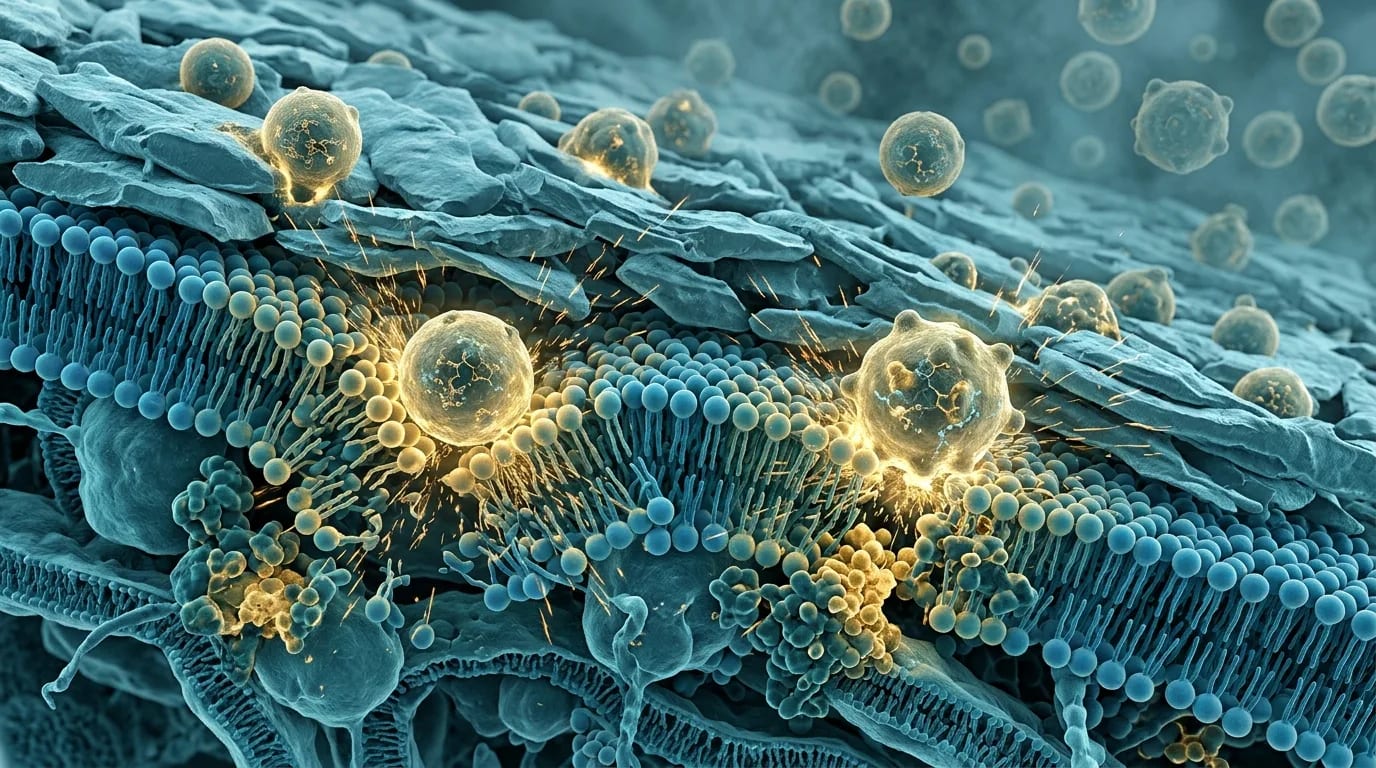
There is a class of emulsifiers that do more than just stabilize an emulsion. They build lamellar liquid-crystal structures — ordered layers that mimic the architecture of the skin's stratum corneum. Cetearyl Alcohol paired with Sodium Cetearyl Sulfate or Cetearyl Glucoside creates exactly this type of gel network around oil droplets. The result is a cream that doesn't just "hold together" but also provides a real barrier effect.
This is especially important for sensitive skin and formulas with active ingredients. A lamellar emulsion releases actives more slowly — in effect, it is a primitive controlled-release system. If you are interested in how texture affects the interaction of a formula with the skin at a molecular level, take a look at our article on tribology, gums, and gelling agents — that topic is explored from a different angle there.
Solubilization: transparency as a technology
Most emulsions are opaque — the droplet size (1–10 µm) scatters light. But what if you need a transparent serum with rosemary extract or a toner with niacinamide and a drop of rosehip oil? This is where solubilization comes into play.
Solubilizing surfactants create micelles so small (10–100 nm) that light passes through the solution without scattering. Polysorbate 20 (Tween 20) is a classic, with an HLB of 16.7, and it excellently solubilizes essential oils at a concentration of 0.5–2%. A rule of thumb: the surfactant-to-oil ratio is usually from 4:1 to 10:1 by weight, depending on the polarity of the oil. The more non-polar the oil (e.g., squalane), the more surfactant is required.
When solubilization doesn't work
A common mistake for beginner formulators is to add 1% essential oil and 1% Polysorbate 20 and wonder why the product is cloudy. This is because the ratio is incorrect. For most essential oils, you need at least 4% Polysorbate 20 for every 1% of oil. For CO2 extracts and resins, you need even more, sometimes 8–10:1. An alternative is PEG-40 Hydrogenated Castor Oil, which is milder and works better with heavier oils.
It is important to remember: solubilizers are not a replacement for emulsifiers. If the oil phase exceeds 5–7%, a transparent product is physically impossible, and a full emulsion is required.
Cleansing: when a surfactant works "the other way around"
The same micellar mechanics that help keep oil in a cream formula work during cleansing — just in the opposite direction. The micelle captures dirt, sebum, and makeup residue, and is rinsed away along with them. But this is where a delicate game begins: a surfactant that is too aggressive will remove not only impurities but also ceramides, cholesterol, and fatty acids from the stratum corneum.
That is why modern cleansers are always a blend of surfactants from different classes. A typical mild face wash formula:
- Primary surfactant: Sodium Cocoyl Isethionate or Sodium Lauroyl Methyl Isethionate — 10–15%
- Co-surfactant: Cocamidopropyl Betaine — 3–5% (reduces irritation, improves foam)
- Mild non-ionic: Decyl Glucoside or Coco Glucoside — 2–5%
- Conditioning agent: Glycerin — 2–3%, or Panthenol — 0.5–1%
Such a combination provides sufficient cleansing with minimal barrier disruption. If you want to go even further in understanding cleansing systems, the principles of working with surfactants in shampoos are analyzed in detail in the article on pet shampoos: there, strangely enough, the logic of surfactant selection is particularly clear due to the specific pH of pets' skin.

Conditioning: cationic surfactants and charged surfaces
At physiological pH, hair and skin carry a negative charge. Cationic surfactants—which are positively charged—are attracted to these surfaces with almost magnetic force. They adsorb onto the hair cuticle, reduce friction, and provide smoothness and shine. This is precisely why Behentrimonium Methosulfate (BTMS) and Cetrimonium Chloride are the foundation of hair conditioners and masks.
However, there is a nuance here that is rarely discussed: cationic surfactants are incompatible with anionic ones in the same phase—they form insoluble complexes and precipitate. This means that a "2-in-1 shampoo-conditioner" is always a compromise, and not an optimal solution for either cleansing or conditioning.
Skin emulsifiers vs. hair emulsifiers: what is the difference
Skin creams and hair conditioners are both emulsions, but the logic behind their formulation is different. In a cream, an emulsifier must be stable, non-irritating, and preferably create a lamellar structure. In a hair conditioner, the key parameter is deposition: how well the active ingredient "settles" on the hair during rinsing. BTMS-50 (Behentrimonium Methosulfate + Cetyl Alcohol) is one of the best examples: it is both an emulsifier and a conditioning agent with excellent deposition.
If you are working with anhydrous formats—balms, oils, solid conditioners—the logic changes radically. This is described in detail in our guide to anhydrous products.
Practice: how to read an ingredient list through the lens of surfactants
Now for the most practical part. Take any cream off the shelf and look at the first 10 ingredients. You will likely find:
- Glyceryl Stearate — an auxiliary O/W emulsifier, HLB ~3.8, stabilizes the system when paired with a more hydrophilic component
- Cetearyl Alcohol — a fatty alcohol, thickener, and co-emulsifier; creates a lamellar structure
- Polysorbate 60 — a primary O/W emulsifier, HLB 14.9
- Sodium Stearoyl Glutamate — a mild anionic emulsifier, often found in "clean" cosmetics as an alternative to PEG emulsifiers
The combination of Glyceryl Stearate + Polysorbate 60 is a classic that has been used since the 1970s. The combination of Cetearyl Alcohol + Cetearyl Glucoside is more modern, with a lamellar profile. Both create a stable O/W emulsion, but with different skin feel and different biocompatibility with the barrier.
The choice of oils and butters for the oil phase is just as important—if you haven't yet decided which fats suit your skin type, start with our guide on how to choose oils and butters for your skin type.

What is the difference between an emulsifier and a solubilizer?
Both belong to the class of surfactants, but they operate in different concentration ranges and create structures of different sizes. An emulsifier stabilizes oil droplets with a diameter of 1–10 μm, resulting in an opaque product. A solubilizer forms micelles of 10–100 nm; light passes through them freely, and the solution remains transparent. Solubilizers work with small amounts of oil (usually up to 5%), while emulsifiers are used for higher oil phase content. Polysorbate 20 is a typical solubilizer; Cetearyl Glucoside is a typical emulsifier.
Why do "natural" emulsifiers stabilize emulsions less effectively?
They aren't necessarily worse, but they do require more precise handling. Natural emulsifiers like Lecithin, Sucrose Stearate, or Cetearyl Glucoside are more sensitive to pH, temperature, and electrolyte concentration. They often require a narrower processing window during production and can be unstable when high concentrations of salts or acids are added. Synthetic emulsifiers—for example, Emulsifying Wax NF—are more forgiving of mistakes. When working with natural systems, it is important to understand the role of pH and conduct stability tests at different temperatures.
Can anionic and cationic surfactants be mixed in the same formula?
As a rule, no. When anionic and cationic surfactants are mixed, they form ion pairs that precipitate or drastically reduce the effectiveness of both components. The exception is specially designed systems with a controlled ratio, but this is advanced formulation. In standard formulas, cleansing products are built on anionic + amphoteric surfactants, while conditioning products are based on cationic + non-ionic ones.
Surfactants are not just "what foams" or "what mixes oil with water." They are the molecular language in which the texture, feel, stability, and effectiveness of almost every cosmetic product are written. Learning to read this language means moving beyond seeing an ingredient list as a string of unfamiliar words and starting to see the architecture behind it. If you want to not only read ingredient lists but also create your own formulas, in the Walker Formulation Academy Club we break down exactly these topics: from theory to practical formulation with real ingredients.