When it comes to the best skin peptide available today, the answer is no longer limited to classic Argireline or Matrixyl. In 2024–2025, a group of scientists from the University of Manchester, in collaboration with the No7 brand team, introduced a matrix super-peptide complex capable of "tricking" the skin into triggering a recovery cascade of over 50 key proteins — including collagen and fibrillin. This is not a marketing gimmick: the technology is patented, the data has been presented at three international dermatological conferences, and the penetration mechanism has been optimized using robotics and mathematical modeling. For those who create cosmetics by hand or professionally formulate anti-ageing products, understanding this development opens up a new horizon for working with peptides.
What is a matrix super-peptide and why is it important for formulators
A matrix super-peptide is not a single compound, but a binary complex of two new chemical entities that have not been seen in any commercial product until now. The key idea: the peptides mimic an extracellular matrix damage signal, making fibroblasts "think" the tissue is injured and prompting them to actively synthesize structural proteins.
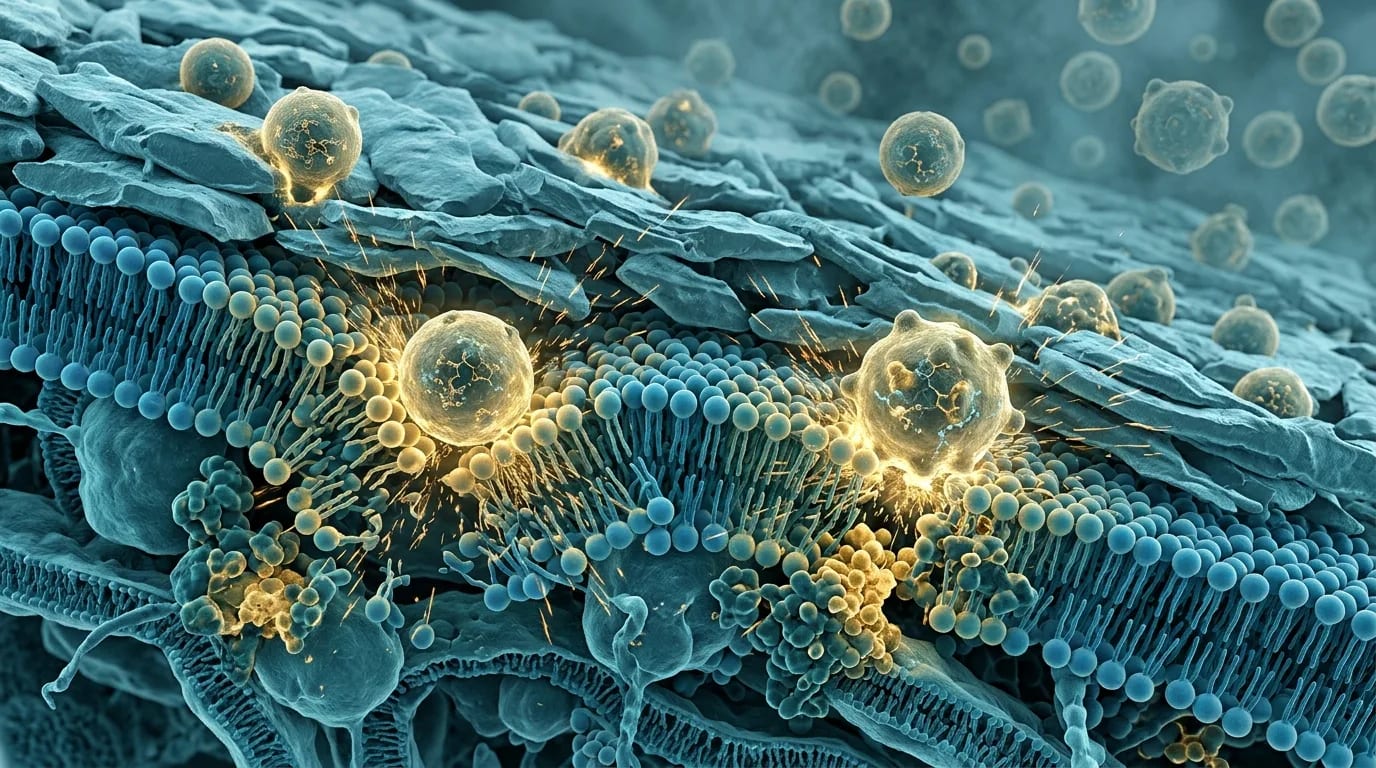
To understand the mechanism, it is important to recall biochemistry: the extracellular matrix (ECM) is a three-dimensional network of collagen, elastin, fibrillin, glycosaminoglycans, and other molecules. When skin is damaged, fragments of this network — so-called matrikines — are released and serve as signals for cellular repair. This very principle lies at the heart of the new super-peptide approach: synthetic peptides replicate the structure of matrikines without causing actual damage.
How the super-peptide differs from classic peptides
Classic peptides in cosmetics are divided into several functional groups:
- Signal peptides (Matrixyl, palmitoyl tripeptide-1) — stimulate collagen synthesis via receptor pathways.
- Neurotransmitter peptides (Argireline, Leuphasyl) — reduce muscle contractions, diminishing expression lines.
- Carrier peptides (GHK-Cu) — deliver trace elements into the dermis.
- Inhibitory peptides — block matrix degradation enzymes (MMP).
The new matrix complex works at the level of ECM signaling in a more comprehensive way: it does not activate a single receptor pathway, but triggers a broad transcriptional response affecting more than 50 proteins. This is a fundamental difference from the targeted action of most commercial peptides.
The role of fibrillin: an underrated protein in anti-ageing chemistry
Most anti-ageing formulas focus on collagen and elastin. Fibrillin, however, remains in the shadows — and quite undeservedly so. Fibrillin-1 and fibrillin-2 form a microfibrillar network that serves as a "scaffold" for elastin deposition and mechanically supports the dermis. With age, it is the fibrillin network that breaks down first — even before visible loss of elasticity. The new super-peptide activates fibrillin synthesis alongside collagen, which means working at a deeper level of age-related changes.

Delivery technology: why penetration is everything
One of the main challenges in working with peptides is their molecular weight. Most biologically active peptides have a molecular weight above 500 Da, which, according to "Lipinski's Rule," makes them poor candidates for transdermal penetration. The skin barrier—the stratum corneum—was evolutionarily designed specifically to keep large molecules out.
Robotics and mathematical modeling in formulation service
The team at the University of Liverpool (Materials Innovation Factory) used robotic high-throughput screening platforms to test thousands of texture and delivery system variants. In parallel, mathematical models predicted the depth of peptide penetration depending on the carrier composition, pH, viscosity, and particle size. The result: a predicted 50% improvement in penetration compared to existing formulas.
For a formulator, this offers an important lesson: the active ingredient and its delivery system are equal variables. Even the best peptide for the skin will not produce results if it does not cross the stratum corneum in a sufficient concentration. Carrier optimization is not a secondary task, but a central part of formulating.
Practical delivery tools available to formulators
Industrial robotic systems are not available in a home or small lab, but the principles they optimize are fully applicable in practice:
- Nanosomes and liposomes — encapsulate the peptide in a phospholipid shell that mimics the cell membrane, which increases affinity for the skin.
- Penetration enhancers — such as pentylene glycol, butylene glycol, or ethoxydiglycol, reduce surface tension and temporarily loosen the stratum corneum.
- pH optimization — most peptides are stable and penetrate better at a pH of 4.5–5.5. Read more about managing the acidity of a cream formula in our article pH in cosmetics: a basic guide for formulators.
- Emulsion architecture — the type of emulsion (O/W vs W/O), globule size, and rheology influence the release rate of the active substance.
- Concentration and synergy — combining peptides with hyaluronic acid or niacinamide can enhance bioavailability.

The best peptide for skin: comparison with retinoids
Retinoic acid has been considered the gold standard of anti-ageing therapy for decades. Its mechanism of action is well-studied: binding to RAR/RXR nuclear receptors, activation of collagen synthesis genes, and acceleration of cell turnover. The problem lies in its tolerability profile. Irritation, flaking, erythema, and photosensitization make retinoids inaccessible to a significant portion of users with sensitive skin, couperose, or rosacea.
According to clinical trials, a new super-peptide complex demonstrates comparable efficacy in stimulating the synthesis of structural proteins without the potential for irritation. This opens up the possibility of creating highly effective anti-ageing cream formulas for sensitive skin — a niche that has traditionally been forced to sacrifice results for the sake of comfort.
What this means for over-the-counter formulation
Retinoic acid is a prescription drug in many countries. Retinol and its derivatives (retinaldehyde, retinyl palmitate) are available in cosmetics but require special handling: photosensitivity, instability in the presence of oxygen, and the need for buffering. Peptides are significantly more technologically advanced in this regard: they are stable across a wide pH range, compatible with most cosmetic systems, and do not require anaerobic storage conditions.
At the same time, it is important to understand: not every peptide is equally effective. The choice of a specific compound should be based on its mechanism of action, molecular weight, stability in the chosen system, and concentration. This is precisely why education in cosmetic chemistry is not an option, but a necessity. If you are just starting your journey, check out our material How to become a cosmetic chemist: the path from curiosity to professional formulation.

How to integrate peptides into an anti-ageing cream formula: practical recommendations
Working with peptides requires an understanding of several key formulation parameters. Below are practical guidelines relevant to both home crafters and small-scale manufacturers.
Concentrations and Incorporation Phases
Most commercial peptide actives are supplied as solutions with a concentration of 1–10% active substance in a carrier (water, glycerin, butylene glycol). Working concentrations in the finished product generally range from 0.5–5% of the supplied solution. Peptides must be added exclusively to the cool-down phase (at temperatures below 40°C), after the main emulsification process is complete, to avoid thermal denaturation.
To understand how to build a product's texture around actives—including rheology and the interaction of gelling agents—we recommend studying our material Tribology, Gums, and Gelling Agents.
Compatibility with Other Actives
Peptides can enter into competitive interactions with certain ingredients:
- Acids (AHA/BHA) at a pH below 3.5 can hydrolyze peptide bonds—it is important to control the acidity of the final product.
- Metal ions (zinc, copper) can form complexes with peptides, altering their bioavailability—this is sometimes used intentionally (GHK-Cu), but requires precise calculation.
- Cationic polymers (for example, certain hair thickeners) can bind with anionic peptides and reduce their activity.
- Preservatives with high reactivity (formaldehyde donors) can modify the amino groups of peptides.
When developing anhydrous formats with peptides (concentrates, silicone-based serums), it is useful to refer to the principles described in the article Anhydrous Products: A Complete Guide for Beginners.

The Future of Peptide Cosmetics: Where the Industry is Heading
The development of a matrix super-peptide is not an isolated event, but a reflection of a broader trend: cosmetic chemistry is increasingly adopting pharmaceutical methodology. High-throughput screening, machine learning for predicting molecular activity, and genomic and proteomic data as a basis for molecular design are all becoming part of the cosmetic developer's toolkit.
For a cosmetic formulator and small-scale manufacturer, this leads to several practical conclusions. Firstly, the availability of high-quality peptide actives will increase: what is a patented technology of a major brand today will appear in the portfolios of specialized cosmetic raw material suppliers in 5–7 years. Secondly, the educational base must grow alongside the market: understanding the mechanism of action of an ingredient is more important than simply knowing the recommended concentration from a technical data sheet.
If you want to delve deeper into professional formulation and work with modern actives consciously, Walker Formulation Academy Club is a community where theory meets practice: ingredient analysis, live formulation sessions, and access to an up-to-date scientific base.
FAQ: questions about peptides and new technologies
Is it possible to independently create a formula with a super-peptide effect using available raw materials?
The matrix super-peptide No7 itself is a patented development and is not available as a commercial raw material. However, the principles underlying it—combining signal peptides with matrikines, optimizing delivery systems, and working with fibrillin-stimulating compounds—are quite applicable when you skillfully select available peptide actives. Combinations such as palmitoyl tripeptide-1 + palmitoyl tetrapeptide-7 (Matrixyl 3000), with the addition of carrier peptides and an optimized emulsion system, provide a measurable anti-ageing effect. The key is in understanding the mechanism, not in copying the composition.
At what temperature do peptides break down, and how should this be taken into account during production?
Most cosmetic peptides begin to denature at temperatures above 50–60°C, although the exact threshold depends on the specific molecule and the pH of the medium. Standard practice is to add peptides to the cool-down phase at a temperature no higher than 40°C, after the main emulsion has been cooled and stabilized. Some suppliers indicate a permissible short-term heating up to 45°C for specific products—always check the technical data sheet (TDS) from the raw material manufacturer.
Is the best peptide for the skin a single molecule or always a complex?
The concept of the "best peptide for the skin" has no universal answer because different peptides work through different mechanisms. Single molecules (e.g., GHK-Cu or Argireline) are effective in their niche. However, modern research increasingly shows that synergistic complexes provide a broader and more sustainable effect: one peptide stimulates collagen synthesis, another inhibits its degradation, and a third improves matrix hydration. The new matrix super-peptide is a prime example of this philosophy: two new compounds together trigger a cascade unattainable for each of them individually.
Peptide chemistry is one of the most dynamically developing fields in cosmetic science. The gap between what happens in research laboratories and what is available to the practising formulator is narrowing every year. Keeping track of this gap, understanding the mechanisms, and being able to adapt scientific principles to real-world formulation — this is exactly what distinguishes a professional from an amateur. Learn more about working with modern actives, delivery systems, and anti-ageing formulas in our courses at the Walker Formulation Academy online school — we translate science into the language of practice.