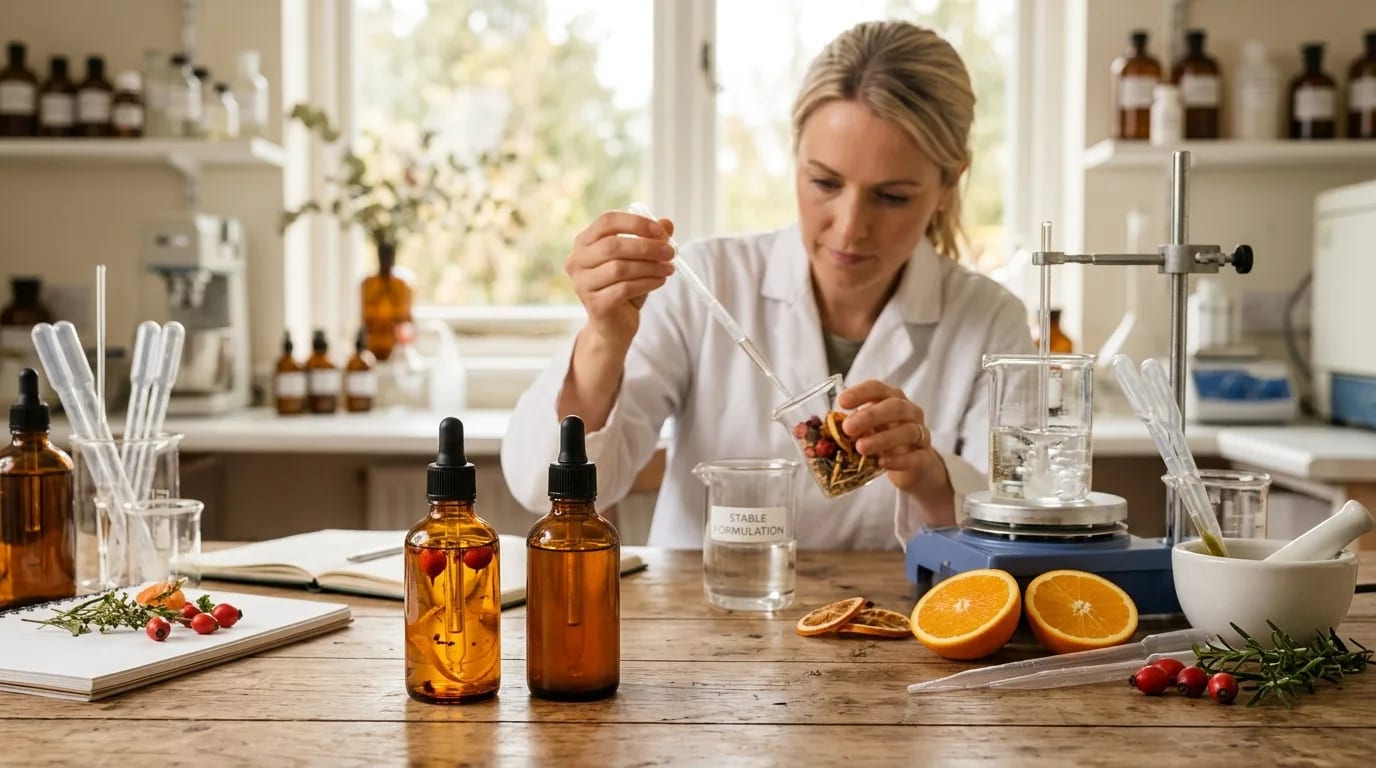
The question "how to become a cosmetologist" sounds different today. While this path used to lead directly to a medical college or a beauty salon, more and more people are now discovering cosmetic chemistry — the science of creating creams, serums, shampoos, and balms from scratch. This field combines biochemistry, emulsion technology, and a creative approach to skincare. This is where the products you see on pharmacy shelves and in Instagram natural cosmetics shops are born. In this article, the online school "Walker Formulation Academy" breaks down what knowledge is truly needed, how to start practising, and how to build a professional path in cosmetic chemistry — step by step.

Cosmetologist and cosmetic chemist: what is the difference and why it is important to know
Before moving forward, it is worth distinguishing between two concepts that are often confused. A classic cosmetologist is a specialist who works directly with a client's skin: facials, peels, and hardware procedures. This is a medical specialty that requires a secondary or higher medical education diploma.
A cosmetic chemist (formulator, formulator) is a person who creates the products themselves. They understand how ingredients interact, why an emulsion separates, which emulsifier to choose for a light serum, and how to balance the pH of a finished cream. This is both a technological and a creative profession.
What unites both fields
Both specialists work with the skin — one with their hands, the other through a formula. Knowledge of skin physiology, types, and conditions (oily, sensitive, mature, acne-prone) is equally important for both. If you want to understand how to become a cosmetologist in the broad sense — a person who has a deep understanding of skincare — cosmetic chemistry provides a unique perspective: you see the product from the inside out.
Which direction to choose
The choice depends on your goal. If you are attracted to working with people face-to-face, choose the medical path. If you are interested in creating products, launching your own brand, or working with cosmetics manufacturers, choose cosmetic chemistry. Many formulators combine both interests: they understand skin needs and translate them into specific formulations.
Fundamental knowledge: what a beginner formulator needs to understand
Cosmetic chemistry is not just about mixing oils and water. Behind every successful product lies an understanding of several key disciplines. The good news is: you don't need a chemistry degree to start. You need a systematic approach.
Emulsion chemistry and the physics of dispersed systems
Most cosmetic products are emulsions: oil-in-water (O/W) or water-in-oil (W/O) systems. You can only understand why a cream remains stable instead of separating after a week by grasping the role of emulsifiers, the Hydrophilic-Lipophilic Balance (HLB), and interfacial tension. Also, study tribology, gums, and gelling agents — this will help you understand how a product's texture is linked to its molecular structure.
pH and buffer systems
pH is one of the main parameters determining the efficacy and safety of cosmetics. The skin's acid mantle has a pH of about 4.5–5.5, and any product that falls outside this range disrupts the barrier function. For a detailed look at how to work with acidity in formulations, read our article pH in cosmetics: a basic guide for formulators.
Oils, butters, and their behavior in a formula
The oil phase is the heart of most skincare products. However, not all oils are equally beneficial for a specific skin type and a specific cream formula. Cocoa butter, for example, exhibits polymorphism—the ability to crystallize in different forms, which affects the texture of the finished product. Learn more about this phenomenon in the article Polymorphism of butters: why cocoa butter is temperamental and how to work with it. And for advice on how to select oils for a specific skin type, check out the guide How to choose oils and butters for your skin type.

Practical start: first steps in a home laboratory
Theory without practice does not work in cosmetic chemistry. Your hands remember what your head struggles to grasp: the consistency of an emulsion, the moment an emulsifier "sets," or the smell of oxidized oil. You can start at home with minimal equipment and a basic set of ingredients.
Minimal kit for your first formulas
- Digital scales with 0.01g precision — cosmetic chemistry works in percentages, not spoons
- Thermometer (infrared or immersion) — temperature control of phases is critical
- Glass beakers and measuring cylinders — chemically inert and easy to clean
- pH meter or strips — without acidity control, a formula remains a "blind" process
- Mini-homogenizer or immersion blender — for stable emulsions
- Basic ingredients: emulsifier (e.g., Olivem 1000 or Montanov 68), oils, distilled water, preservative
First formula: a basic light O/W cream
Here is a training formula that is convenient to start with—it is forgiving of minor mistakes and clearly demonstrates the principles of how an emulsion works:
- Distilled water — 70%
- Glycerin — 5%
- Xanthan Gum — 0.2–0.3% (gelling agent; added to the water phase, pre-dispersed in glycerin to prevent clumping; without it, the emulsion will be unstable)
- Olivem 1000 (emulsifier) — 5%
- Jojoba oil — 8%
- Shea butter — 5%
- Cetyl alcohol — 2%
- Preservative (Euxyl PE 9010 or equivalent) — 1%
- Citric acid — to pH 5.0–5.5
- Fragrance or essential oil — 0.5–1% (optional)
The water and oil phases are heated separately to 70–75°C, then the water phase is poured into the oil phase while stirring constantly. After cooling to 40°C, the preservative is added and the pH is adjusted. A complete guide to the first steps in cosmetic formulation can be found in the article How to make a cream at home: a complete guide to homemade cosmetic formulation.
Expanding your range: anhydrous products and specialized formulas
Having mastered basic emulsions, formulators usually move on to more complex and niche products. Anhydrous products — balms, oil serums, solid shampoos, waxes — do not require preservation and offer wide scope for creativity.
Why anhydrous products are gaining popularity
The absence of water in the composition means there is no risk of microbial contamination — which means you can do without traditional preservatives or use them in minimal concentrations. This is important for an audience looking for "clean" cosmetics. In addition, anhydrous formulas are generally more concentrated and economical to use. Read more about this direction in our guide Anhydrous products: A complete guide for beginners.
Specialized products: shampoos and pet care
A separate and very interesting niche is cosmetics for pets. The skin pH of dogs and cats differs from that of humans, which requires a different approach to the choice of surfactants and preservatives. If you are interested in this topic, read our article Shampoo for dogs and cats: what every pet lover should know 🐶🐱.

How to become a professional cosmetic chemist: education and career paths
Understanding how to become a cosmetologist in the field of cosmetic chemistry at a professional level means building a systematic education. Spontaneous reading of blogs and watching videos provide fragmented knowledge. Professional growth requires structure.
Learning formats
Today there are several paths:
- Academic education — chemistry or pharmacy faculties at universities. A deep theoretical foundation, but a long duration (4–6 years) and not always focused specifically on practical cosmetics.
- Professional online courses — structured programmes from practising formulators. They allow you to master specific skills in 3–12 months, applying knowledge in practice immediately.
- Self-education + community — books (Harry's Cosmeticology, Handbook of Cosmetic Science and Technology), scientific articles, professional forums, and clubs for formulators.
- Internships in production — working at a cosmetic factory or in a brand's R&D laboratory provides invaluable practical experience.
Career paths for a cosmetic chemist
The profession opens up several career tracks:
- Formulation developer at a cosmetic company or contract manufacturer
- Founder of your own brand — from a small handmade shop to full-scale production
- Consultant for startups and small brands that need product development without an in-house chemist
- Instructor and expert — teaching courses, hosting masterclasses, and creating educational content
- Technologist in certification and regulatory affairs — working with documentation to bring products to market
Meet our instructor Oksana Walker and learn more about the school — this will help you understand which learning format is right for you.
Plant-based ingredients and sustainability: a modern look at cosmetic chemistry
Modern cosmetic chemistry is increasingly turning to plant-based raw materials — not for marketing reasons, but out of scientific interest in bioactive molecules. At the same time, it is important to understand: "natural" does not automatically mean "effective" or "safe." A critical evaluation of ingredients is required.
How climate and origin affect the composition of oils
The fatty acid composition in vegetable oils varies depending on the climate, soil, and conditions.