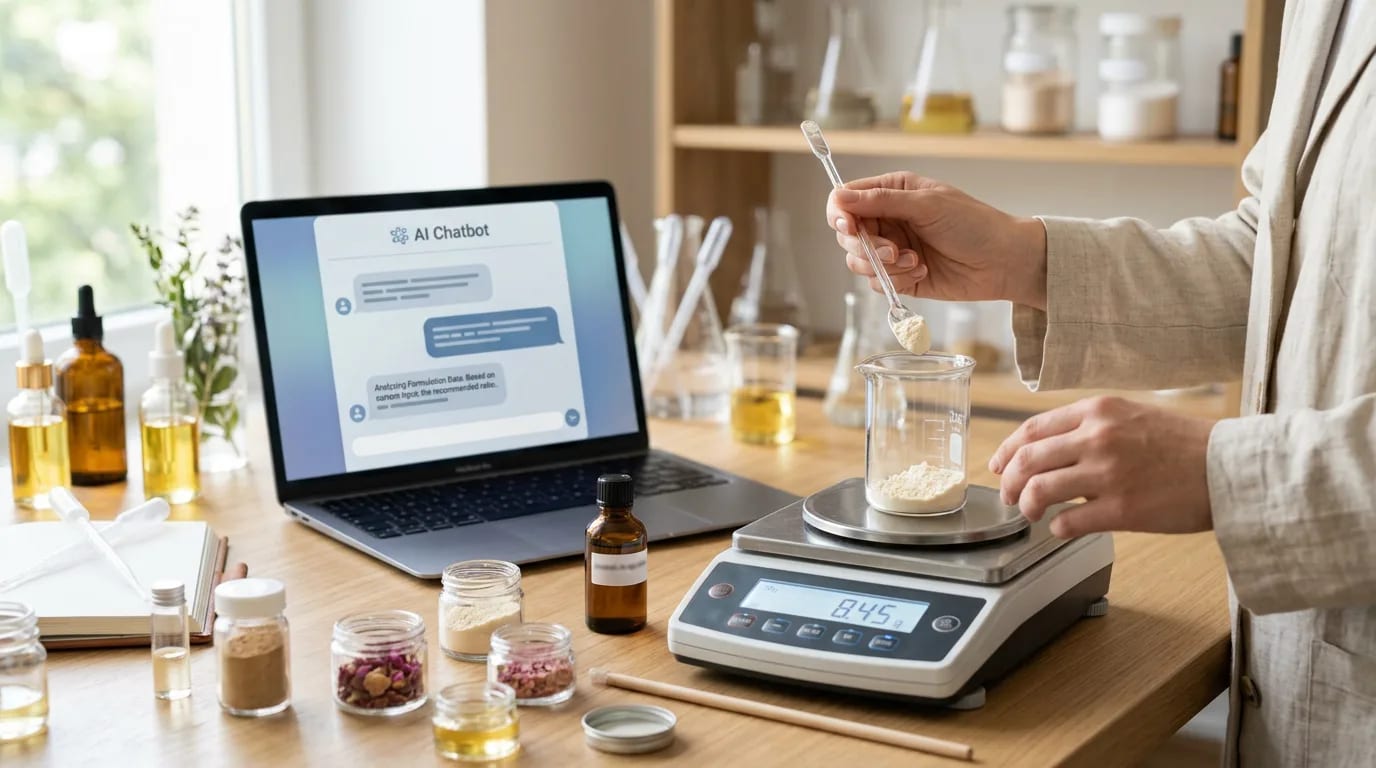
A chemical formulation course teaches the practical chemistry behind creams, serums and cleansers: emulsification, pH adjustment, preservation, INCI labelling under UK Cosmetics Regulation (retained EU 1223/2009), and stability testing. Good courses combine lab practice (weighing, phase mixing, viscosity checks) with regulatory literacy, usually spanning 20–80 hours depending on depth, and reference CosIng, IFRA standards and peer-reviewed formulation science rather than folklore.
- UK Cosmetics Regulation (retained EU 1223/2009) requires a Cosmetic Product Safety Report before any product reaches a shelf, which is why formulation courses spend real time on documentation, not just mixing gov.uk guidance
- The EU CosIng database currently lists tens of thousands of ingredients with restrictions, banned status or maximum concentrations, and formulators are expected to check every raw material against it ec.europa.eu CosIng
- A typical stability protocol taught on formulation courses runs samples at 4°C, room temperature and 45°C for at least 4–12 weeks before a shelf-life claim is made ScienceDirect stability review
- IFRA sets fragrance restriction categories (0–12) that cap allergen and essential oil percentages by product type, a core module in any serious formulation curriculum IFRA Standards
Here's the uncomfortable truth nobody tells beginners: knowing that hyaluronic acid "holds 1000 times its weight in water" is trivia, not formulation skill. A real chemical formulation course is closer to an engineering class than a beauty blog — it's about phase behaviour, HLB values, pH windows for actives, and the paperwork that makes a product legal to sell. If you've ever wondered why your homemade cream separated in the bathroom cabinet after three weeks, the answer usually lives in a module you skipped.
What a Chemical Formulation Course Actually Covers
Most structured programmes are built around four pillars: raw material chemistry, process technique, stability and regulatory compliance. The raw material pillar overlaps heavily with what we've covered in What's on the label vs. what's behind it: a breakdown of cosmetic ingredients — understanding that "Aqua" is never just water, and that emulsifiers, rheology modifiers and preservatives all have INCI names with specific functions and legal limits.
Lab Technique: The Part Nobody Warns You About
Weighing to 0.01 g, phase-heating protocols (typically both water and oil phases brought to 70–75°C before combining, a temperature range widely used in emulsion practice to melt waxes and activate emulsifiers Wiley emulsion science reference), homogenisation speed, and cool-down curves are drilled repeatedly. This is where courses separate from YouTube tutorials — a video shows you the pour; a lab session makes you troubleshoot why your cream turned grainy at 40°C, which is often the white soaping effect in emulsions rearing its head.
Regulatory Literacy
This is the pillar most self-taught formulators skip, and it's the one that determines whether your product can legally be sold. UK courses built for this market teach students to check every ingredient against CosIng, confirm preservative levels against Annex V of the retained Regulation, and verify UV filters against Annex VI — because a percentage that's fine in a US-market product may be restricted or unlisted here, and that gap needs to be flagged, not guessed.
Course Formats: Self-Paced vs Cohort vs Certification
Not all "chemical formulation courses" mean the same commitment. Here's how the common formats compare in practice:
| Format | Typical duration | Best for | Weakness |
|---|---|---|---|
| Self-paced video modules | 10–25 hours | Hobbyists testing interest | No feedback on lab errors |
| Cohort-based course with live labs | 40–80 hours over 2–4 months | Career-switchers, brand founders | Fixed schedule, higher cost |
| University certificate (cosmetic science) | 1–2 academic terms | R&D-track chemists | Less brand/business focus |
| Ingredient-specific mini-courses | 3–8 hours | Filling a specific gap (e.g. preservation) | No full-formula context |
If your goal is to eventually sell a product on a UK shelf, the cohort or certificate route tends to pay off faster, simply because compliance work is heavily practiced rather than mentioned in passing. We map this exact journey — from curiosity to a compliant, sellable formula — in How to become a cosmetic chemist: the journey from curiosity to professional formulation.
The Ingredients Modules: Where Most of the Course Time Goes
A large chunk of any serious formulation curriculum is ingredient behaviour, because that's where formulas actually fail or succeed.
- Emulsifiers and HLB balance — matching an oil phase's required HLB to an emulsifier blend, a concept explored practically in our piece on hydrophilic cleansing oils and HLB
- Butters and their crystal structure — cocoa butter's polymorphism is a classic case study, since the wrong cooling rate produces a grainy bar instead of a smooth one, covered in depth in Shea, cocoa or mango: which butter makes the balm you want
- Oil oxidation and shelf life — iodine value and peroxide value as predictive tools, discussed in Oxidative stability of oils
- Preservative systems — pH-dependent efficacy (many organic acid preservatives lose activity above pH 6, a threshold repeatedly cited in preservative efficacy testing literature PubMed preservative efficacy study)
- Refined vs unrefined raw materials — and what that actually changes in performance and price, unpacked in Refined or unrefined: what you pay for in a cold-pressed oil
Where AI Fits Into a Modern Formulation Course
Courses built in the last two to three years increasingly fold in AI literacy — not as a gimmick, but because reverse-engineering a competitor's INCI list or predicting texture changes from a percentage shift are tasks large language models now genuinely help with, provided you know what questions to ask. We've written a practical walkthrough of this in How to Break Down a Competitor's INCI List with AI, and a broader look at where the technology is heading in AI in cosmetic chemistry: how neural networks are changing hair care formulation. A course that ignores this entirely is arguably teaching 2018's toolkit.
Sources a Trustworthy Course Should Point You To
If a course never mentions these, treat it with caution — they're the backbone of legitimate formulation work in this market:
- UK Cosmetics Regulation (retained EU 1223/2009) — the legal baseline for safety assessment, labelling and the Product Information File, detailed on gov.uk
- EU CosIng database — the definitive list of permitted, restricted and banned ingredients, colorants and UV filters, searchable at ec.europa.eu
- IFRA Standards — fragrance and essential oil concentration limits by category, published at ifrafragrance.org
- CTPA (Cosmetic, Toiletry and Perfumery Association) — UK-specific compliance guidance, at ctpa.org.uk
- Peer-reviewed formulation science — journals indexed via PubMed and ScienceDirect for emulsion stability, preservative efficacy and raw material characterisation
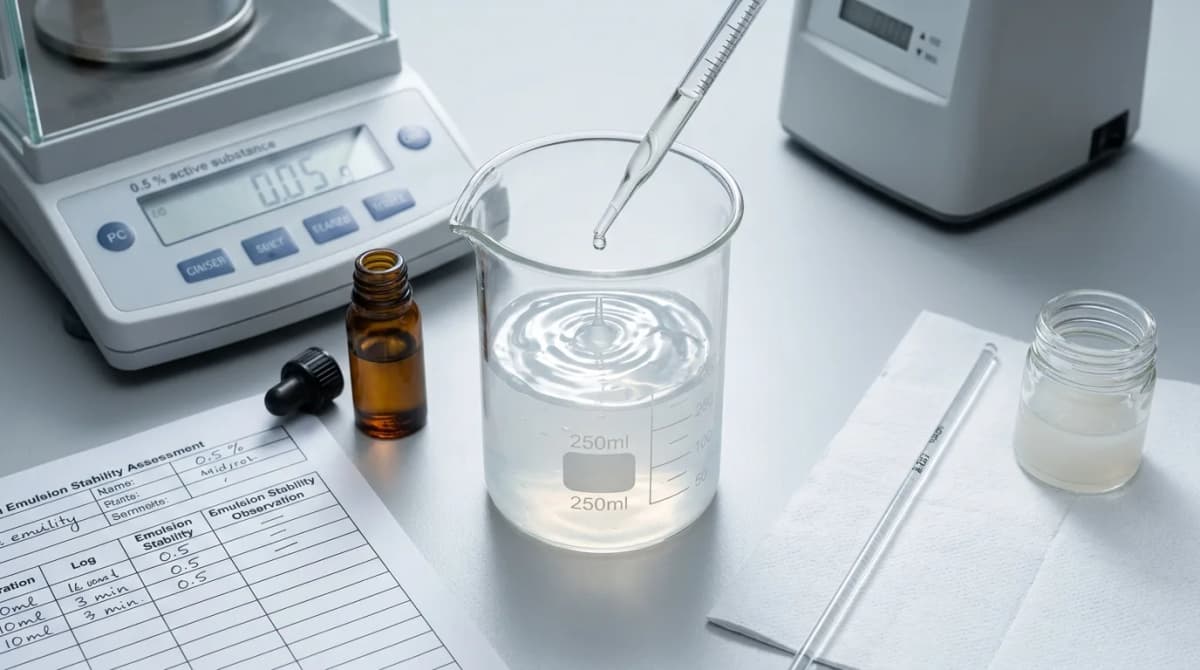
Any percentage or pH figure quoted in a course — say, a preservative used at 0.5% active substance, or a gel adjusted to pH 5.5 — should be traceable back to one of these, not to "what worked for me once." That traceability is, frankly, the entire point of taking a structured chemical formulation course rather than piecing it together from forum posts.
Red Flags in a Course That Calls Itself "Chemical Formulation"
- No mention of CosIng, IFRA or the UK Safety Report at all
- Percentages given without specifying active substance vs raw material mass — a 2% preservative claim means very different things depending on which
- No stability or compatibility testing module — formulas presented as "finished" without a single week of observation
- Claims like "natural preservative" or "chemical-free" used as selling points instead of scientific ones
How Much Time and Money to Expect
Self-paced mini-courses on a single topic — preservation, or emulsifier selection — often run 3–8 hours and, converted from typical market pricing, land around £40–£90. Fuller cohort-based programmes with live labs and feedback on real formulas tend toward £350–£700 for 40–80 hours of content, reflecting the instructor time and lab-grade materials involved. University certificates cost considerably more but carry academic weight useful for R&D roles. None of these numbers replace checking a course's actual syllabus against the sources listed above — price is not a proxy for rigor.
Frequently Asked Questions
What exactly is taught in a chemical formulation course?
Core modules typically cover emulsification technique, pH and preservative science, raw material INCI chemistry, stability testing protocols, and UK/EU regulatory compliance including CosIng checks and IFRA fragrance limits. Practical courses add hands-on lab sessions; theoretical ones lean on case studies.
How long does a chemical formulation course usually take?
It ranges from 3–8 hours for a single-topic mini-course to 40–80 hours for a full cohort programme spread over two to four months, and one to two academic terms for a university-level certificate.
Which sources should a good chemical formulation course reference?
Look for direct references to the UK Cosmetics Regulation (retained EU 1223/2009), the EU CosIng ingredient database, IFRA fragrance standards, CTPA guidance, and peer-reviewed formulation studies indexed on PubMed or ScienceDirect — not just brand blogs or unsourced percentages.
Can I learn cosmetic formulation without a chemistry degree?
Yes — most course providers assume no prior chemistry background and build up from basic emulsion theory, but expect to spend real time on regulatory reading and lab discipline, since that's where self-taught formulators most often fall short.