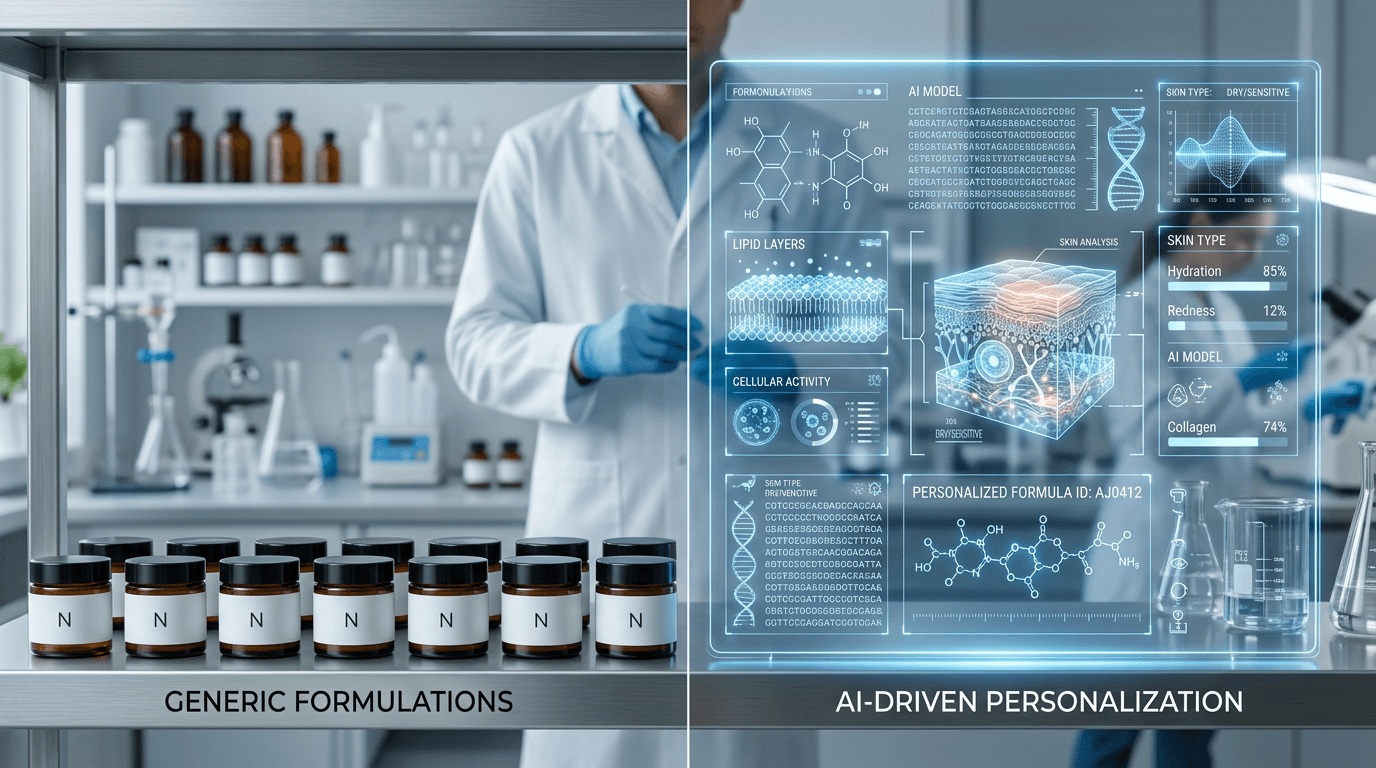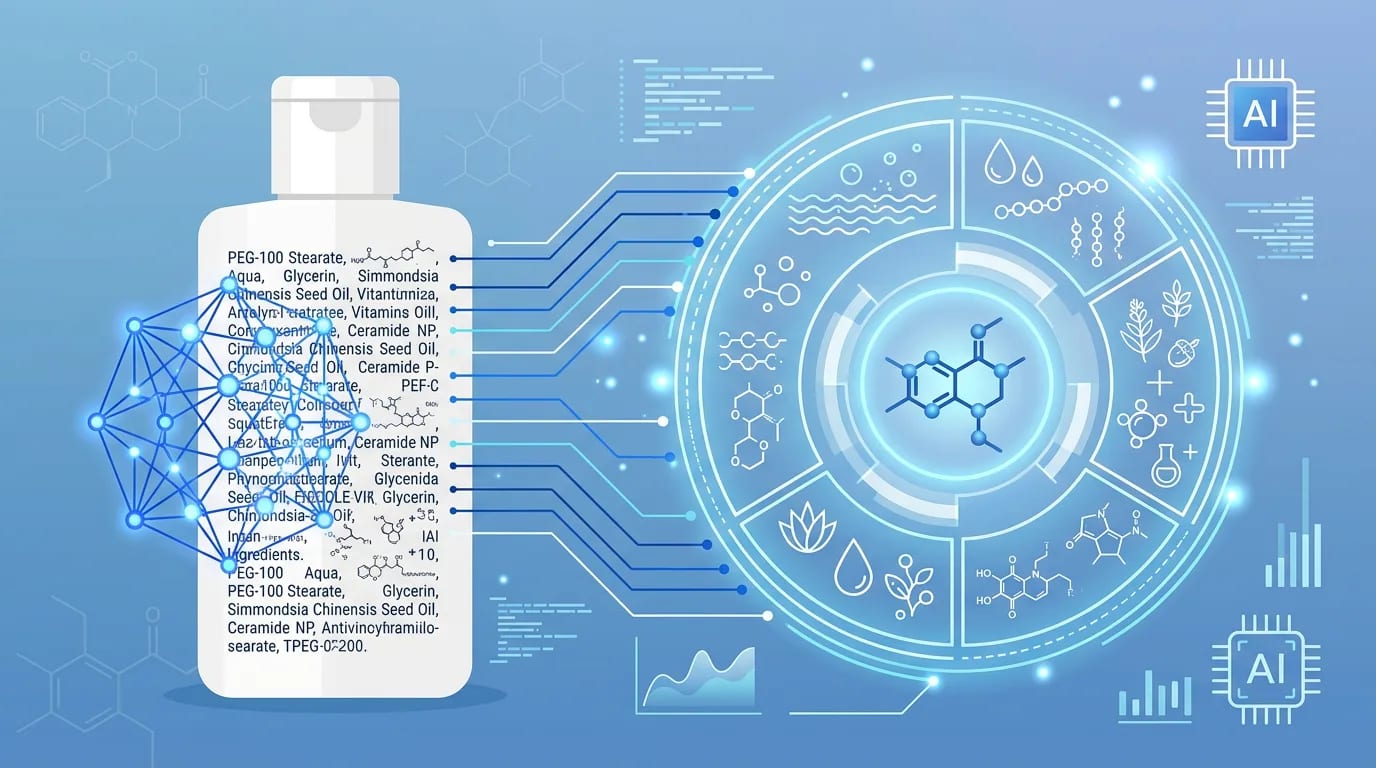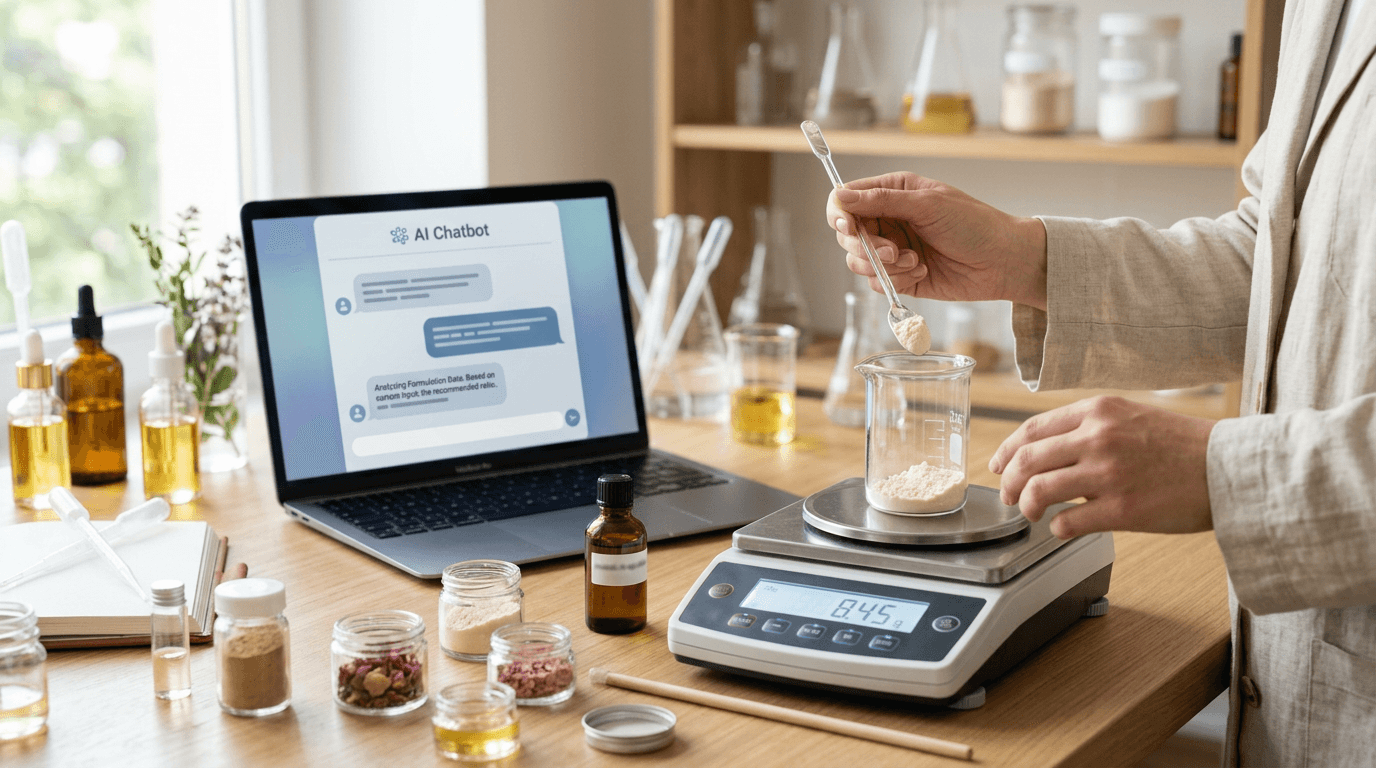
AI errors in calculating cosmetic formula concentrations happen because language models can read only the text-based INCI list, which under EU/UK labelling rules discloses order above 1% concentration but never the actual percentages — so any figure a chatbot states, such as "5% niacinamide," is a statistical guess, not a verified number.
- Above 1% concentration (w/w, as supplied), INCI ingredients must be listed in descending order of weight; below 1% they may be listed in any order, which hides the true dosage entirely. UK Cosmetics Regulation (retained EU 1223/2009), Article 19
- Azelaic acid can appear in a formula anywhere from a fraction of a percent up to about 10% (w/w, active matter) in cosmetics — while 15–20% strengths are prescription medicines — ranges with very different skin tolerability, none of which is visible from the ingredient list alone. Elewski et al., Arch Dermatol, 2003
- A preservative percentage is only worth what the document behind it is worth, and an averaged "safe range" has no document at all. A real figure names a raw material: for the blend euxyl PE 9010, the supplier’s technical data sheet (Ashland) gives a recommended use level of 0.5–1.0% of the product as supplied. That is a manufacturer’s recommendation for that specific material, not evidence that a formula using it is preserved — only a challenge test answers that. Phenoxyethanol, its principal component, is separately capped at 1.0% as a preservative under Annex V, entry 29. UK Cosmetics Regulation, Annex V (preservatives)
- Independent safety bodies such as CIR and the EU SCCS publish ingredient-by-ingredient safety assessments, but no standard yet tests the accuracy of an AI-calculated formula percentage the way preservative efficacy is tested.
- A teaching protocol for preliminary observation — explicitly not a safety assessment: make a 50–100 g trial batch, hold one jar at room temperature and one at 40 °C, and record pH, appearance, colour, odour and any phase separation at least weekly for 4 weeks. It can show that an AI-proposed dosage is wrong; it cannot show that a formula is safe or set a shelf life, which need preservative challenge testing and a stability study on the finished pack.
Imagine typing the ingredient list of your favorite serum into a chatbot and asking whether the niacinamide concentration is "safe." The bot confidently replies: "5%, that's fine." The problem is, it made that up. The label doesn't carry a single figure on the actual dosage — only the descending order by mass fraction above 1%. The neural network fills in the missing data with a statistically plausible, but not necessarily accurate, number. And this is where things get interesting — and dangerous — for anyone trying to formulate at home or relying on AI ingredient analyzers instead of a cosmetic chemist.
What the INCI list doesn't show — and why AI can't see it
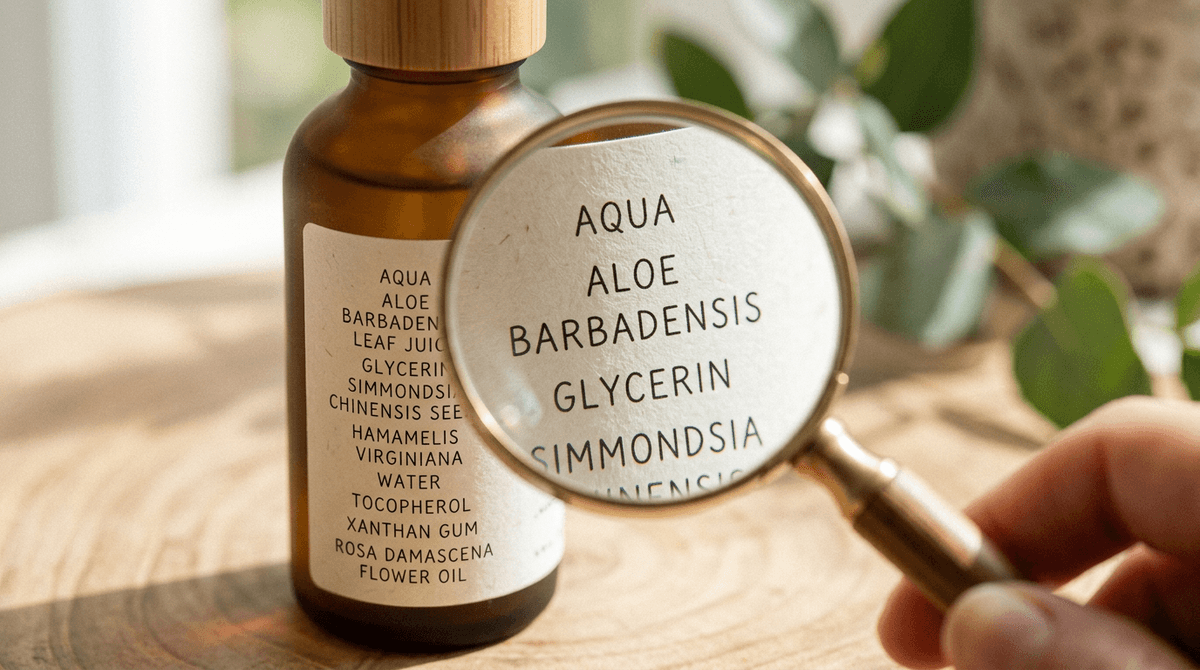
The International Nomenclature of Cosmetic Ingredients governs the listing order but doesn't require a manufacturer to disclose the percentage of each component. Above 1%, ingredients must appear in descending order of weight; below 1%, they may be listed in any order. UK Cosmetics Regulation, Article 19 This means that even the most advanced language AI, after "reading" a label, only sees the structure of the list — it has no access to the brand's actual formula figures.
Most consumer-facing AI analyzers and bots that parse a cream's ingredient list from a photo of the packaging are working with exactly this text list — with no access to the actual percentage concentrations in the formula. This is confirmed by the fact that such services were designed for qualitative analysis and personalized recommendations, not for engineering-grade dosage calculations.
The difference between "it's in the ingredient list" and "it works at this dosage"
Azelaic acid in an ingredient list can mean anywhere from a fraction of a percent up to about 10% (w/w, active matter) in a cosmetic — and the 15–20% strengths studied in dermatology are prescription medicines, not cosmetics Elewski et al., Arch Dermatol, 2003 — so these are fundamentally different products with very different skin tolerability. We covered in detail how the dosage of this acid determines its effect and the risk of pilling in the article on formulating with azelaic acid. Without access to the real formula, AI simply cannot give a correct answer about the "working" concentration — it can only cite a typical industry range and present it as a fact about a specific product.
Three common AI mistakes in calculating concentrations
When users ask AI not just to describe a formula but to calculate it — for example, "how much xanthan gum do I need per 100 g of emulsion" — systematic distortions start to appear. Here are the three most common patterns.
Confusing qualitative and quantitative composition
The neural network is trained on text — articles, forum posts, patents — where figures are mentioned in fragments and often out of context for a specific phase of the formula. As a result, AI can conflate "the typical recommended preservative concentration per the manufacturer's data" with "the concentration that's safe specifically in your emulsion, at a given pH and water content." These are not the same thing: preservative efficacy depends on its partnership with the buffer system, as we discussed in the article on the gluconolactone-based buffer for an emulsion.
Extrapolating "safe" percentages without accounting for synergy
AI tends to average data from different sources and present a "safe range" as a universal constant. But ingredient synergy is exactly what tables don't capture. Incompatibilities are documented per raw material, not per ingredient pair. For Niacinamide PC, the manufacturer states that the material is incompatible with strong acids, strong bases and oxidising agents, which may cause hydrolysis to nicotinic acid, and recommends a final-formulation pH of 4.0–8.0 and a use level of 1–10% as supplied — adding that compatibility always depends on the complete final formulation, so the formulator has to monitor it during storage (dsm, Niacinamide PC formulation guidelines, manufacturer’s document, 2023). Note what that is and is not: it is one supplier’s statement about one grade, and it does not establish the popular blanket claim that niacinamide and vitamin C destabilise each other in any formula — a claim a chatbot will produce on demand and which no document cited here supports. Surfactants of different ionicity likewise interact unpredictably in terms of foam and irritation potential, as covered in detail in the breakdown of surfactants in cosmetics. A model trained on text data doesn't recalculate the chemical interaction of components in real time — it predicts the most probable continuation of a phrase, not the outcome of a reaction.
Ignoring pH, temperature, and stability when scaling up
Often the error isn't in the percentage figure itself, but in the context of its application. AI will quote a preservative percentage with nothing behind it. A defensible figure always names the material it belongs to: for euxyl PE 9010, the Ashland technical data sheet gives a recommended use level of 0.5–1.0% of the product as supplied (w/w) — and it is worth being precise about what kind of document that is. A technical data sheet is the manufacturer’s recommendation for its own raw material; it is neither an independent study nor a guarantee that your emulsion is preserved, and the number does not transfer to a different preservative system. Whether 0.5–1.0% holds in your formula still depends on pH, water activity, the absence of cationic surfactants and the phase-addition temperature, and the question is settled by a preservative challenge test, not by a percentage. The regulatory ceiling is a separate constraint again: phenoxyethanol is limited to 1.0% as a preservative under Annex V of the UK Cosmetics Regulation (Annex V, entry 29). Calculating a concentration without accounting for the formula's technological context is like naming the correct drug dose without asking about body weight or compatibility with other medications. To check whether a finished emulsion actually behaves stably, basic at-home tests are collected in the guide "Formula stability: tests worth running at home".
Why there's still almost no scientifically validated data
Let's be honest here: by peer-reviewed research standards for 2020–2026, there are still very few dedicated studies on the accuracy of AI-calculated cosmetic formula concentrations — not enough data to call the reliability of such calculations a proven fact. AI services in cosmetics today are used mainly for qualitative composition analysis, predictive modelling and personalized recommendations, and their ability to safely calculate working ingredient dosages hasn't been scientifically confirmed. Kee et al., Curr Pharm Des, 2026
- Models are trained on open text sources — patents, blogs, forums — where actual production concentrations are rarely published outright.
- There's no independent regulatory standard that tests the accuracy of AI formula calculations the way, for example, preservative efficacy is tested.
- Most services don't disclose their methodology: it's unclear whether the model extrapolates from regulators' safe ranges (CIR, SCCS) or from random sources.
This makes any figure produced by an unverified chatbot more of a hypothesis to test than a ready engineering solution. We covered a similar issue in the context of hair-care formulation in the article "AI in cosmetic chemistry: how neural networks are changing hair-care formulation" — which also shows that neural networks are better at generating hypotheses than at final dosage verification.
Where AI is actually useful — and where it isn't
To be fair, it's too early to write neural networks off entirely. They solve real pain points — for instance, saving hours on literature searches for a peptide's mechanism of action, or helping you quickly scan through dozens of competitors' INCI lists. We covered how machine learning is changing peptide complex development in the article on neuropeptides in cosmetics.
Tasks where AI is already reliable
- Fast qualitative composition review: spotting whether a product contains potential allergens, fragrance, or high-concentration alcohol based on its position in the list.
- Searching scientific literature and patents for the mechanism of action of a specific molecule.
- Generating hypotheses for testing — a draft list of actives for a goal like "calm the skin" or "improve elasticity."
- Systematizing data on preservative compatibility with different systems, which a chemist then verifies manually.
Tasks where trusting AI's calculations is risky
- The exact percentage of an active ingredient in a specific finished formula, without access to the real recipe.
- Calculating the final preservative concentration accounting for buffer capacity and water content in a specific emulsion.
- Predicting stability when scaling up from a lab-scale batch to an industrial batch.
- Assessing the synergy or antagonism of several actives simultaneously at high concentration.
Checklist: how to verify a calculation if AI proposed the formula
If you formulate at home or test hypotheses with AI — don't throw the tool out, but add verification. Here's a minimal verification protocol that reduces the risk of AI errors in calculating cosmetic formula concentrations.
- Cross-check the proposed percentage of the active substance against the raw-material supplier's recommendations (technical data sheet, not the marketing sheet) — that's where the real working ranges are listed.
- Check the pH of the finished formula after adding the actives: many acids and buffer systems only work within a narrow window, as with the GDL buffer.
- Make a 50–100 g trial batch and observe it for 4 weeks — one jar at room temperature, one at 40 °C — recording pH, appearance, colour, odour and separation at least weekly, in the same container each time. Read it for what it is: preliminary observation in a teaching setting. Surviving four weeks is not a safety assessment, does not replace a preservative challenge test, and is not a basis for printing a shelf life.
- Check the preservative's compatibility with the final formula — especially if it includes an anhydrous phase, where different rules apply, as described in the article on preserving anhydrous products.
- Don't trust a single chatbot answer — ask for the source of the figure and cross-check it against an independent database (CosIng, CIR, SCCS publications).
What this means if you formulate at home
Home creammaking is booming, and AI has become just another "handy consultant" in the amateur chemist's kitchen. But a cream isn't a text genre — it's a physicochemical system where what matters at the end is exact grams, not an averaged "about 2%." If you're only just starting to put formulas together on your own, it's wiser to first understand the basic logic of emulsions and active-ingredient selection — that's where you should start before relying on AI percentage calculators — and the "How to make cream at home" guide can be a good entry point.
FAQ

Can AI read the exact percentage of an ingredient from a photo of the label?
No — a photo only reveals the INCI list order, and by EU/UK labelling rules manufacturers are never required to publish the actual percentage of any ingredient, so any number an AI states from a photo is inferred, not read.
Is a chatbot's cited "safe range" the same as a validated regulatory limit?
Not necessarily — regulatory bodies such as CIR and SCCS publish safety margins for individual ingredients, but a chatbot's "safe range" is usually an average pulled from mixed text sources and may not reflect a specific formula's pH, water content, or ingredient synergy.
How long should you monitor a home-mixed batch before trusting the formula?
As a teaching protocol: 4 weeks on a 50–100 g trial batch, one jar at room temperature and one at 40 °C, recording pH, appearance, odour and separation weekly. Treat that as preliminary observation only — a shelf life and a safety decision need preservative challenge testing and a stability study on the finished pack, not a four-week look at two jars.
Precisely so that AI doesn't feed you pretty but wrong numbers, the AI Chemist works inside the Walker Formulation Academy Club — an assistant built on a verified INCI/CosIng knowledge base (RAG): it answers from sources instead of hallucinating. Plus a real chemist on hand to catch what no algorithm will notice.
Sources
- UK Cosmetics Regulation — Regulation (EC) No 1223/2009 as retained in UK law, Article 19 Labelling, legislation.gov.uk
- The Cosmetic Products Enforcement Regulations 2013 (SI 2013/1478), legislation.gov.uk
- UK Cosmetics Regulation — Regulation (EC) No 1223/2009 as retained in UK law, Annex V: preservatives allowed in cosmetic products (entry 29, phenoxyethanol, 1.0%), legislation.gov.uk
- dsm, Niacinamide PC — Formulation Guidelines, September 2023 (manufacturer’s technical document, not an independent study)
- Cosmetic Ingredient Review (CIR), published ingredient safety assessments
- European Commission, Scientific Committee on Consumer Safety (SCCS)
- Elewski B.E. et al., A comparison of 15% azelaic acid gel and 0.75% metronidazole gel in the topical treatment of papulopustular rosacea, Arch Dermatol, 2003 (PMID 14623704)
- Kee P.E. et al., Emerging Technologies and Current Trends in Cosmeceutics: Exploring Nanotechnology and Artificial Intelligence-Aided Approaches, Curr Pharm Des, 2026 (PMID 41919428)