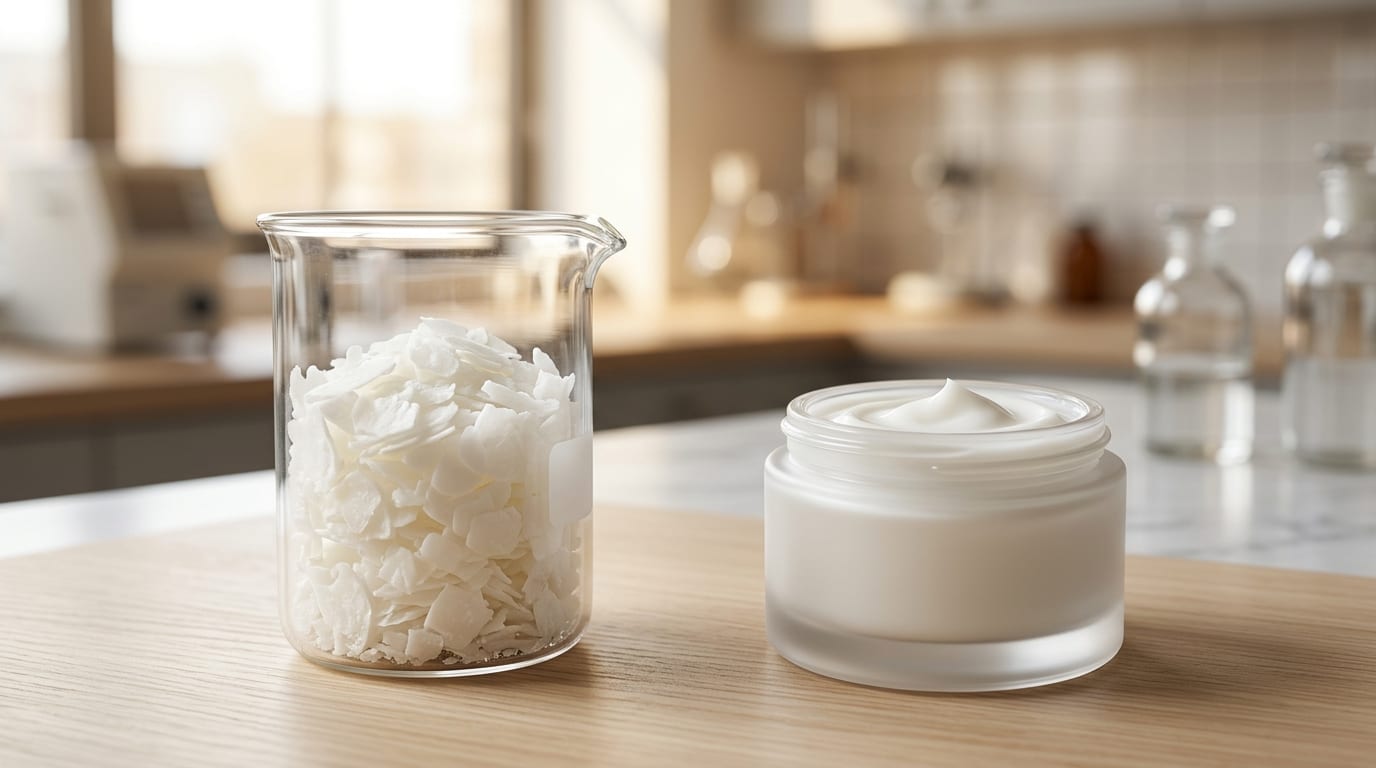
Have you ever applied a cream and thought: why is it like this? Not "good" or "bad" — but specifically like this: slightly greasy, or almost weightless, or one that vanishes in three seconds, leaving a silky sensation. Behind this is not marketing and not a "unique formula." Behind this is one class of ingredients to which cosmetic chemists dedicate entire careers — emulsifiers. And they are exactly what determines everything you feel with your fingertips.
Why oil doesn't want to be friends with water — and what is done about it
Basic physics: oil and water do not mix. This is not a metaphor or a simplification — it is thermodynamics. Water molecules are polar, oil molecules are not. They literally repel each other at the molecular level. If you simply shake the mixture, it will separate in a matter of minutes.
An emulsifier is a molecule with a split personality. One end loves water (hydrophilic), the other loves oil (lipophilic). It stands at the interface of the two phases and holds them together, reducing surface tension. The result is a stable emulsion that does not separate in a week or even two years.
HLB: the number that explains everything
Every emulsifier has a so-called HLB number (Hydrophilic-Lipophilic Balance) — from 0 to 20. The higher the number, the more "water-loving" the molecule is. Emulsifiers with an HLB of 4–6 create "water-in-oil" (W/O) emulsions — dense, occlusive, and rich. Emulsifiers with an HLB of 8–18 form "oil-in-water" (O/W) emulsions — light, fast-absorbing, with that very weightless texture that summer formulas love so much.
A classic example: Cetearyl Alcohol + Ceteareth-20 — a pair with a total HLB of about 15, which provides stable O/W emulsions. Glyceryl Stearate SE with an HLB of about 5.8 is your choice for rich, "oily" creams. This isn't a matter of taste, it's mathematics.
Why one emulsifier is almost never enough
Professional formulators rarely work with a single emulsifier. Combinations are the norm. The reason: different molecules stabilize different parts of the interfacial boundary and work in different temperature and pH ranges. For example, a combination of Cetearyl Alcohol (a fatty alcohol, co-emulsifier) and Polysorbate 60 (the main emulsifier, HLB ~14.9) provides a more stable and pleasant texture than each of them individually. This is synergy, not playing it safe.

Texture is not an accident, it is a variable
When a cosmetic chemist says "we need a lighter texture," they aren't guessing. They change specific parameters of the formula: the type of emulsifier, the ratio of phases, the viscosity of the water phase, and the droplet size of the dispersed phase. Each of these factors is a lever.
Droplet size and the sensation on the skin
Ordinary creams contain oil phase droplets with a diameter of 1–10 microns. Microemulsions are less than 100 nanometers. The difference in sensation is colossal: nano-sized droplets make the product practically transparent and provide that "weightless" application that is so difficult to replicate at home. This is precisely why expensive serums with an "invisible" texture require high-energy equipment — high-pressure homogenizers or ultrasonic dispersers.
Fatty alcohols: unfairly forgotten texture builders
Cetearyl Alcohol, Cetyl Alcohol, Stearyl Alcohol — these are often confused with "ordinary" alcohols and feared. In vain. These are long-chain fatty alcohols that do not dry out the skin, but do the exact opposite: they are co-emulsifiers and structurants at the same time. At a concentration of 2–5%, they form a crystalline gel network in the emulsion — a so-called "lamellar gel network" — which is responsible for that creamy, slightly dense texture you feel in a good moisturizing cream.
If you want to understand how the tribological properties of the skin surface are related to what these molecules do upon application, take a look at our article on tribology, gums, and gelling agents — it is analyzed in detail there.
Modern emulsifiers: from synthetics to "green" chemistry
Over the last ten years, the industry has been actively moving towards biodegradable and plant-based emulsifiers. And this is not just "clean beauty" marketing — it is a real technological shift.
Olivem 1000 and its relatives
Cetearyl Olivate (and) Sorbitan Olivate is perhaps the most famous "green" emulsifier of the last decade. It mimics the structure of the skin's lipid barrier, forming lamellar structures similar to those found in the stratum corneum of the epidermis. The usage concentration is 2–8%. The texture is soft, non-comedogenic, and has a good skin feel. The downside is that it is more sensitive to pH and processing temperature than classic synthetic emulsifiers.
Sugar-based emulsifiers
Sucrose Stearate, Methyl Glucose Sesquistearate — sucrose esters with fatty acids. The HLB varies from 3 to 15 depending on the degree of esterification, which makes them versatile. They are well tolerated by sensitive skin, have a good safety profile, and provide a creamy, non-sticky texture. They are popular in baby cosmetics and products for atopic skin for this very reason.
By the way, if you are formulating for animals, the principles of emulsification work the same way, although the requirements for pH and preservation differ. More details can be found in our material on shampoo for dogs and cats.

What breaks an emulsion — and how to prevent it
An emulsion is a thermodynamically unstable system by nature. It strives to separate. The formulator's task is to make this process slow enough so that the product survives two years on the shelf at temperatures from –5 to +40°C.
- Creaming — droplets gather at the top but do not merge. Reversible. Treated by increasing the viscosity of the water phase (xanthan gum, carbomer).
- Flocculation — droplets stick together into aggregates, but the shell remains intact. Partially reversible. A signal of insufficient stabilization of the interface.
- Coalescence — droplets merge into larger ones. Irreversible. The emulsion is "dead."
- Phase inversion — O/W turns into W/O or vice versa. Happens during overheating or adding too many electrolytes.
- Ostwald ripening — small droplets dissolve in favor of larger ones. Critical for microemulsions.
pH as a silent destabilizer
Many emulsifiers are sensitive to pH. Anionic emulsifiers (for example, sodium stearates) lose effectiveness at low pH. Cationic ones — at high pH. If you add an acid (AHA, ascorbic acid, azelaic acid) to a cream formula and do not consider the impact on the emulsifying system, you risk getting an unstable emulsion in a couple of months. Read more about pH control in our guide to pH in cosmetics.

Practical formulation: what to choose and in what quantities
Here is an honest cheat sheet for those who are already standing at the stove with scales and a thermometer:
- Light day cream (O/W, fast absorption): Glyceryl Stearate (and) PEG-100 Stearate — 3–5%, oil phase 10–15%, add Carbomer 0.3–0.5% for extra viscosity.
- Rich night cream (O/W with lamellar structure): Cetearyl Alcohol 3% + Ceteareth-20 1.5%, oil phase 25–35%. The texture will be dense and occlusive.
- Natural cream without PEG: Cetearyl Olivate (and) Sorbitan Olivate — 5–7%, oil phase 15–25%, be sure to control the pH of the finished emulsion (5.0–6.0).
- Light emulsion for oily skin: Sucrose Stearate (HLB 15) — 3–4%, oil phase 8–12%, add Niacinamide 5% to the water phase.
An important point: the temperature at which the phases are combined. Most classic emulsifiers require heating both phases to 70–75°C before mixing. "Cold-process" emulsifiers — for example, Montanov 68 or Emulium Mellifera — allow you to work at room temperature, which is especially valuable when adding thermolabile actives like peptides or vitamin C. Peptides and how to properly incorporate them into a cream formula is a separate story that we have already covered.
If you are just starting your journey in formulation and want to understand how curiosity grows into a real profession, take a look at the stories of people who have walked this path: how to become a cosmetic chemist and formulator.

The future of emulsification: biomimetics and smart systems
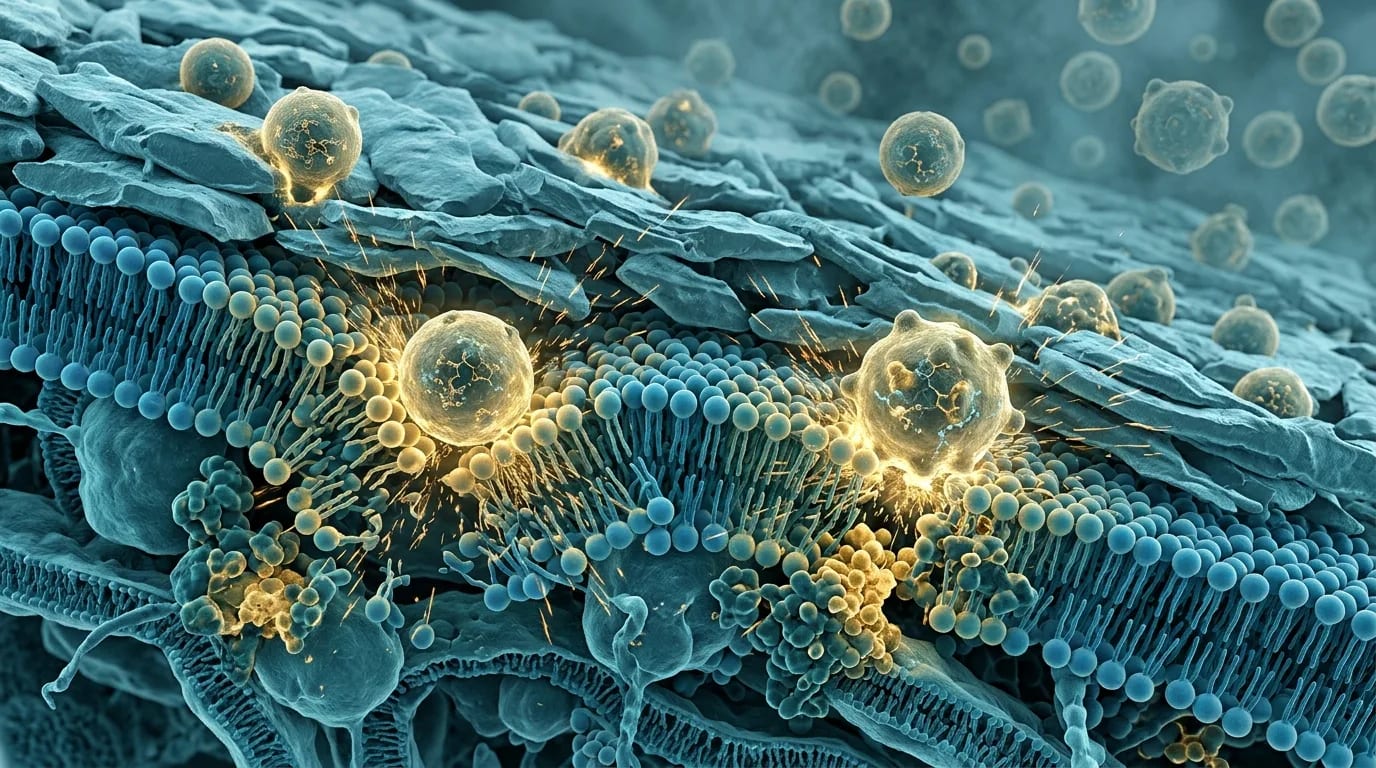
The most interesting thing happening in this field right now is the attempt to replicate the structure of the skin itself. The stratum corneum is, in essence, an ideal emulsion: alternating layers of lipids and proteins that retain water with incredible efficiency. New-generation emulsifiers — phytosterols, ceramide-like molecules, phospholipids (Lecithin, Phosphatidylcholine) — attempt to integrate into this structure rather than simply holding oil and water together.
At a concentration of 1–3%, Phosphatidylcholine forms liposomes and lamellar structures that penetrate the stratum corneum and deliver actives deeper. This is no longer just an emulsifier — it is a delivery system. The boundary between "carrier" and "active" is becoming increasingly blurred, and this is perhaps the most exciting aspect of modern cosmetic chemistry.
If you are interested in how oils and butters behave in such systems and how to choose the right lipid profile for your cream formula, check out our guide on how to choose oils and butters for your skin type.
Is it possible to make a stable emulsion without synthetic emulsifiers?
Technically, yes, but with caveats. Beeswax (Cera Alba), lanolin, and certain plant waxes have co-emulsifying properties. Lecithin is a natural emulsifier that works through phospholipids. However, completely "natural" emulsions are generally less stable, have a shorter shelf life, and require careful selection of preservatives. For home use, this is acceptable; for commercial production, additional stability tests are required.
Why does my cream "pill" on the skin — and is the emulsifier to blame?
"Pilling" is most often caused not by the emulsifier, but by an incorrect combination of polymers or an excess of thickeners based on carbomer/xanthan gum. However, if the emulsifier creates a film that is too "dry" (for example, with an excess of cetyl alcohol), this can exacerbate the problem. Solution: reduce the concentration of fatty alcohols to 2–3%, check the compatibility of the water-phase thickeners, and add silicones or jojoba esters to improve slip.
How can I tell if an emulsion is unstable without waiting for it to separate?
There are several early signs: a change in color (yellowing, darkening), a change in odor, the appearance of "graininess" upon application, and a change in viscosity during storage. Express test: place a sample in an incubator at 40–45°C for 4 weeks and, in parallel, in a refrigerator at 5°C. If the emulsion remains homogeneous after the "heat-cold" cycle, basic stability is achieved. We have written separately about home stability tests in more detail.
Emulsifiers are not an auxiliary class of ingredients. They are the architects of the formula. They determine what the first touch on the skin will feel like, how quickly the product will absorb, and whether it will feel like a luxury product or a pharmacy ointment. Understanding their chemistry is not an academic exercise; it is a practical tool that changes what you create. If you want to learn how to formulate consciously — from choosing an emulsifier to the final stability test — in the Walker Formulation Academy Club, we break this down step by step.