When a formulator first attempts to formulate an anti-ageing product, the initial impulse is to add everything that sounds convincing to the formula: retinol, peptides, vitamin C, hyaluronic acid, niacinamide. The result is predictable: an unstable emulsion, irritated skin, and a complete lack of understanding of what exactly worked and what didn't. An anti-ageing cream whose formula is built consciously, rather than on the "the more, the better" principle, is a balance between active chemistry, skin biology, and emulsion technology. In this article, the Oksana Walker online school breaks down key groups of anti-ageing ingredients, their mechanisms of action, compatibility, and practical guidelines for concentrations — so that you can build formulas with understanding, rather than intuition.
Why "anti-ageing" is not marketing, but chemistry
Skin aging is a multifactorial process. Collagen and elastin synthesis decreases, cell renewal slows down, barrier function is impaired, glycation products accumulate, and oxidative stress increases. No single ingredient is capable of influencing all these mechanisms simultaneously — which is why a competent anti-ageing cream always works as a system, not as a mono-product.
Understanding the mechanisms of aging allows the formulator to choose actives not based on the principle of "it's trendy," but on the principle of "it solves a specific problem." Retinoids stimulate cell turnover. Peptides signal fibroblasts to synthesize collagen. Antioxidants neutralize free radicals. Moisturizing agents restore the barrier. Each of these levels requires its own approach to formulation.

Chronological aging and photoaging: different enemies — different tools
Chronological aging is an internal biological process that we influence by stimulating matrix synthesis and accelerating cell renewal. Photoaging is the result of accumulated UV damage, where antioxidants, metalloproteinase inhibitors, and depigmenting agents come to the fore. You can mix these tasks in one product, but you need to clearly understand which mechanism is the priority for your target audience.
Anti-aging cream: formula by active ingredient groups
A professional approach to formulation involves breaking down ingredients into functional groups. This simplifies control over the formula and helps avoid conflicts between actives.
Retinoids: the gold standard with a personality
Retinol and its derivatives are the most studied group of anti-ageing actives. Mechanism of action: binding to RAR and RXR nuclear receptors, activation of genes responsible for the synthesis of type I and III collagen, acceleration of desquamation, and reduction of matrix metalloproteinase activity.
Effective retinol concentrations in home-use cosmetics range from 0.1–1%. Anything above 1% falls into the territory of dermatological preparations, and such concentrations require medical supervision. The key challenge when creating a cream formula is that retinol is extremely unstable when exposed to light, oxygen, and high temperatures. This means:
- Addition during the cooling phase (below 40°C)
- Use of opaque packaging with minimal air contact (pump, tube)
- Mandatory presence of antioxidants in the formulation (vitamin E, BHT, ferulic acid)
- Control of the emulsion pH in the 5.0–6.0 range
Alternatives for sensitive skin include retinyl palmitate (milder, but requires conversion in the skin) and retinaldehyde (an intermediate form that is more active than retinol but less irritating than retinoic acid). For more on how pH affects the stability of actives, read our detailed article pH in cosmetics: a basic guide for formulators.
Peptides: signaling chemistry of collagenogenesis
Peptides in anti-ageing cosmetics work through several mechanisms: signal peptides (e.g., Matrixyl — palmitoyl pentapeptide-4) mimic collagen fragments and stimulate fibroblasts; neuropeptides (argireline — acetyl hexapeptide-3) reduce muscle contractions; carrier peptides deliver trace elements (copper) into the dermis.
Concentrations: signal peptides — 2–10% of the supplied solution (usually supplied as 5–10% aqueous solutions, with the actual peptide content being 0.0005–0.005%); neuropeptides — 3–10% of the solution. Peptides are compatible with most actives, but they should be added during the cooling phase, and combinations with aggressive acids at low pH should be avoided.
Antioxidants: protection against the oxidative cascade
Vitamin C (L-ascorbic acid) is the most studied antioxidant in cosmetics. The effective concentration is 10–20%. It is stable only at a pH below 3.5, which creates a technological challenge: such a pH irritates the skin and is incompatible with most other actives. Solutions: stabilized derivatives (ascorbyl glucoside, ascorbyl tetraisopalmitate, sodium ascorbyl phosphate) — these are less active but significantly easier to use in a cream formula.
Ferulic acid at a concentration of 0.5% synergistically enhances the effect of vitamins C and E — this combination is well-documented in the literature. Resveratrol, astaxanthin, and ubiquinone (CoQ10) are promising antioxidants, but their bioavailability through the skin requires special delivery systems (nanoemulsions, liposomes).

Hydration as an anti-ageing strategy
The skin's barrier function declines with age: ceramide content decreases, and the synthesis of the natural moisturizing factor (NMF) is disrupted. Restoring the barrier is not just a cosmetic task, but a physiological necessity, and it directly affects the visibility of wrinkles.
Hyaluronic acid: molecular weight matters
High-molecular-weight HA (>1000 kDa) creates a film on the skin's surface, instantly smoothing wrinkles and retaining moisture. Low-molecular-weight HA (<50 kDa) penetrates the epidermis and provides a deeper moisturizing effect. Working concentrations are 0.1–2%. Using a mixture of fractions with different molecular weights is a professional technique that provides an effect both on the surface and deep within the epidermis.
Ceramides and cholesterol: restoring the lipid barrier
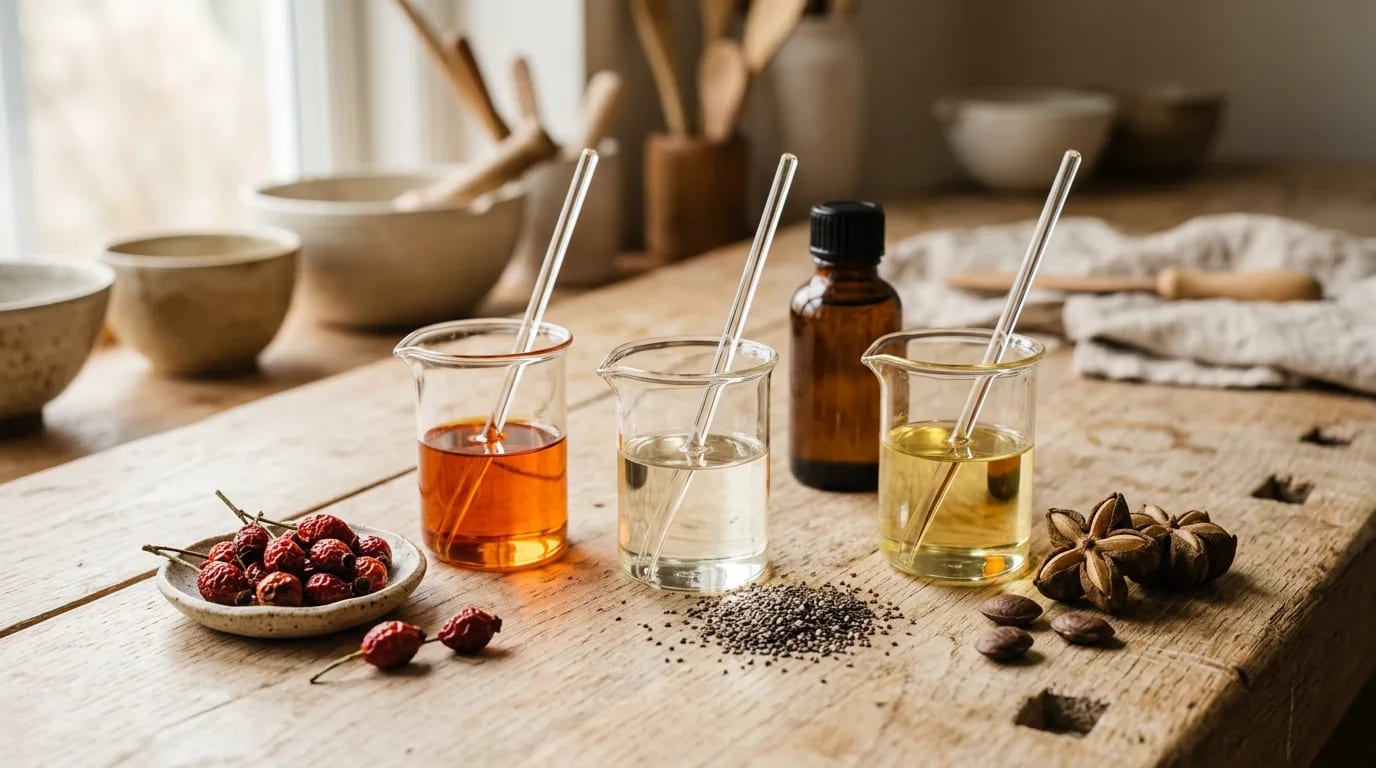
The optimal ratio of ceramides : cholesterol : fatty acids is 3:1:1 or 1:1:1 — these are findings from studies on epidermal barrier restoration. They are introduced into the oil phase of the formula at a concentration of 0.5–3%. The choice of base oils is also critical: oils with a high linoleic acid content (rosehip, raspberry, hemp) replenish the deficiency of essential fatty acids characteristic of aging skin. Read more about choosing oils in our guide How to choose oils and butters for your skin type: a beginner's guide for formulators.
Emulsion technology: how not to lose actives during production
Even a perfectly selected anti-ageing cream whose formula includes all the necessary actives can prove ineffective if the preparation technology is violated. Temperature control is a critical parameter.
- Phase A (aqueous): heat to 70–75°C to dissolve hydrophilic ingredients and ensure microbiological safety. Xanthan Gum is introduced into the aqueous phase at a concentration of 0.2–0.3%: it is pre-dispersed in water with intensive stirring until a homogeneous mixture without lumps is obtained, after which the phase is heated to the working temperature
- Phase B (oil): heat to 70–75°C to melt waxes and butters and activate the emulsifier
- Phase C (cooling, 40°C and below): retinol, peptides, vitamin C (in stabilized forms), fragrances, unstable extracts, preservative
- Final pH: adjustment after complete cooling; the target range for most anti-ageing formulas is 5.0–6.0
How to build emulsions from scratch is described in detail in our material How to make a cream at home: a complete guide to formulating at home. The texture of an anti-ageing cream also affects the perception of efficacy: a base that is too greasy creates occlusion but reduces comfort; one that is too light does not provide the necessary contact with the skin. The recommended type is a light O/W emulsion with the addition of 3–8% silicones or jojoba esters for a silky finish and improved tribological characteristics. Read about the tribology of cosmetic textures in the article Tribology, gums, and gelling agents.

Active ingredient compatibility: what you shouldn't mix and why
One of the most frequent questions when developing anti-ageing formulas is ingredient compatibility. Incompatibility can manifest immediately (separation, color change) or during storage (reduced activity, formation of by-products).
Conflicting pairs and how to resolve them
Retinol + Vitamin C (L-ascorbic acid): a pH conflict. Retinol requires a pH of 5–6, while L-ascorbic acid requires a pH below 3.5. Solution: use stabilized Vitamin C derivatives with a neutral pH, or separate the actives by time of application (morning/evening) — and reflect this in the product positioning.
Niacinamide + Vitamin C: scientific literature occasionally mentions the risk of niacin acid formation when used together, which can cause redness. Modern data shows that at working concentrations and correct pH, this effect is minimal; however, caution is justified when niacinamide concentrations are above 5% and L-ascorbic acid is above 15%.
Peptides + low-pH acids: many peptides lose their structural integrity at a pH below 4.0. If the formula requires an acidic pH, choose peptides that have been stabilized by the manufacturer for acidic environments, or adjust the pH after introducing the peptide phase.
Synergistic combinations that work
- Retinol + niacinamide: niacinamide reduces irritation from retinol while simultaneously enhancing ceramide synthesis
- Vitamin C + Vitamin E +