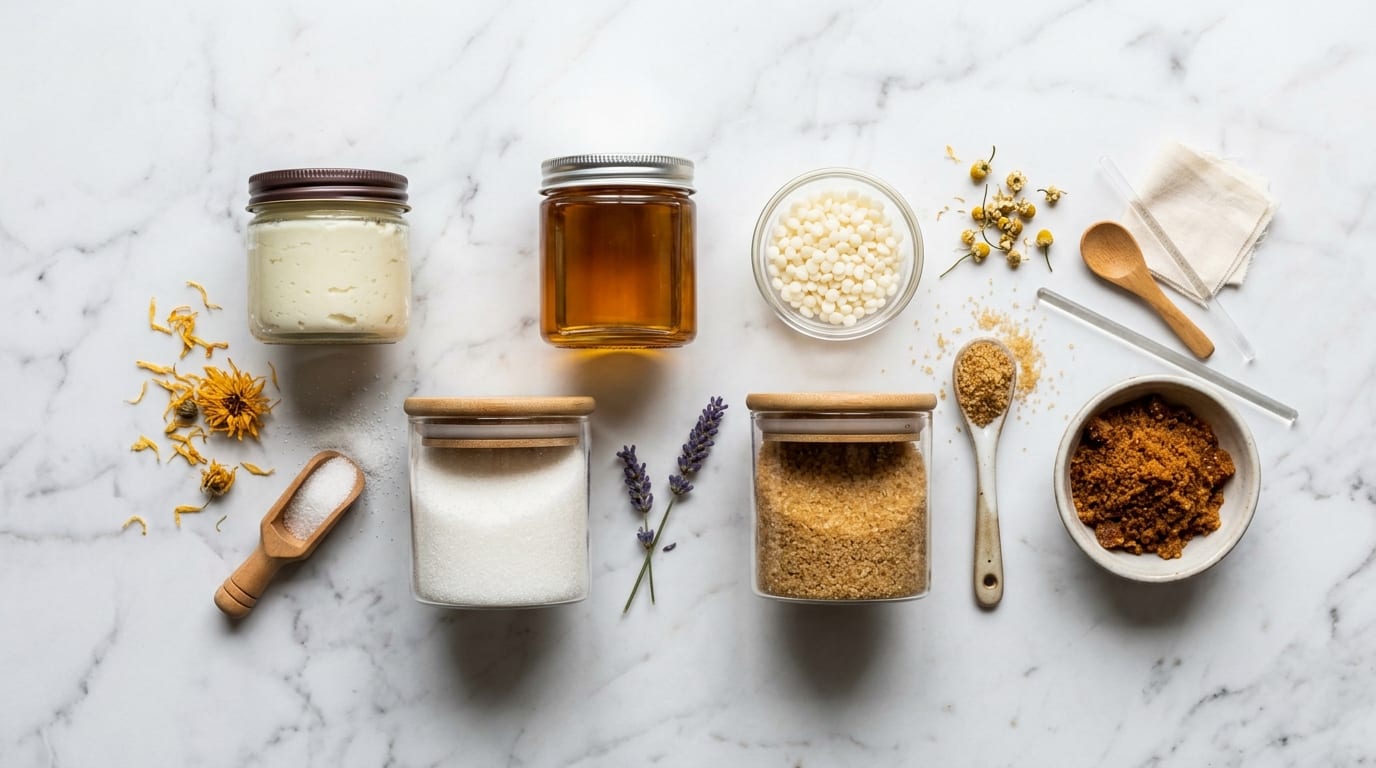
DIY lip balm is one of the first projects most home formulators start with. It seems simple enough: melt the wax, add the oil, and pour it into jars. But that is exactly where the trap lies: without an understanding of the chemistry of the ingredients, you end up with either a wax candle that is impossible to apply or a liquid mass that melts at the first touch of warmth. In this article, the Oksana Walker online school “Walker Formulation Academy” breaks down the physics and chemistry of anhydrous lip products — from choosing waxes and oils to managing melting points and skin feel.
Why lip balm is a special kind of anhydrous emulsion
Technically, lip balm belongs to the class of anhydrous systems — formulas that lack an aqueous phase. This fundamentally distinguishes it from creams and lotions: no water means no risk of microbial growth, no need for traditional preservatives, and no risk of emulsion separation. However, it is the absence of water that makes formulating non-trivial: all properties — texture, melting point, slip, and depth of nourishment — are determined solely by the ratio of solid to liquid lipid components.
If you are just starting to work with anhydrous systems, we recommend first studying our material Anhydrous products: A complete guide for beginners — it describes in detail the logic behind building such formulas.
The role of solid and liquid fractions
The structure of a balm is determined by two types of components:
- Solid fraction — waxes and butters. They form the matrix, maintain the shape of the stick or the density of the mass in the jar, and create an occlusive barrier on the surface of the lips.
- Liquid fraction — oils, fatty acid esters, and silicones (in conventional cosmetics). They determine the slip during application, the nutritional profile, and the feeling of comfort after the wax film dries.
The balance between these fractions is a key technological parameter. A typical ratio for a classic stick is: 20–35% solid fraction, 65–80% liquid. For a balm in a jar, the solid fraction is reduced to 10–20%.

Waxes: the main architects of texture
Wax is not just a "thickener." Each wax has a unique crystalline structure, melting point, and behavior upon cooling. This is precisely why replacing one wax with another at the same concentration almost always changes the final texture.
Comparison of key waxes for lip products
Let's look at the most common options:
- Beeswax — a classic. Melting point 62–65 °C, good occlusivity, natural origin. Provides a slightly matte finish to the stick. The downside is a specific scent that is difficult to mask with fragrances.
- Carnauba Wax — the hardest of the plant waxes, Tm = 82–86 °C. Used in low concentrations (1–3%) to increase the melting point and add gloss.
- Rice Bran Wax — Tm = 77–86 °C, brittle, creates a crystalline structure. When combined with soft waxes, it creates an interesting "melting" application effect.
- Candelilla Wax — Tm = 68–73 °C, a vegan alternative to beeswax. More brittle, requires combination with plasticizers.
- Synthetic Wax (Polyethylene Wax) — stable, odorless, excellent for viscosity control. Popular in professional formulations.
An important nuance that beginners often overlook: waxes behave like crystalline polymers. The cooling rate affects crystal size and, consequently, the transparency and smoothness of the surface. Rapid cooling results in small crystals and a matte surface. Slow cooling results in large crystals, and graininess is possible. This same principle is the basis for butter polymorphism, which we wrote about in detail using cocoa butter as an example.
How to calculate the melting point of a mixture
The melting point of a wax mixture is approximately calculated using the rule of additivity:
Tm(mixture) ≈ Σ (fraction of component × Tm of component)
For example: 10% carnauba wax (Tm 84 °C) + 20% beeswax (Tm 63 °C) + 70% jojoba oil (liquid, Tm −7 °C) will result in a mixture with a calculated Tm of about 21–22 °C — too soft for a stick. Increasing the solid fraction to 35% will raise the Tm to 35–38 °C, which provides a stable stick at room temperature.

Oils and butters: nutritional profile and skin feel
The liquid fraction of a balm is responsible not only for the softness of the texture but also for the actual effectiveness of the care. Lip skin is thin, lacks sebaceous glands, and is particularly vulnerable to transepidermal water loss (TEWL). The right selection of oils solves several tasks at once: it restores the lipid barrier, reduces TEWL, and ensures comfortable glide.
Oils with high oleic acid content
Oleic (omega-9) acid penetrates the stratum corneum well and softens it. Especially good for lip products are:
- Sweet almond oil — ~70% oleic, light texture, neutral scent.
- Avocado oil — rich in sterols and vitamin E, dense and nourishing. Works well at a concentration of 10–20%.
- Castor oil — unique: it contains ricinoleic acid (~90%), which provides high viscosity, gloss, and excellent pigment retention in tints. Typical concentration in balms is 5–30%.
Butters as plasticizers
Butters occupy an intermediate position between liquid oils and hard waxes. Shea butter (Tm 28–45 °C depending on the polymorphic form) is a classic choice: it plasticizes the wax matrix, reduces the feeling of "waxiness," and adds nourishing unsaturated fatty acids. Mango butter (Tm 34–38 °C) provides a denser and less greasy texture — it works well in summer formulas.
For more details on how to choose oils and butters for a specific skin type and task, read our article How to choose oils and butters for your skin type.

Basic DIY lip balm formulas
Below are two proven formulas — one for a stick and one for a jar. Both are calculated for 100 g of the finished product.
Formula 1: Classic stick
- Beeswax — 18 g
- Carnauba wax — 2 g
- Shea butter — 15 g
- Castor oil — 20 g
- Sweet almond oil — 40 g
- Vitamin E (tocopherol) — 1 g
- Food-grade flavoring — 4 g
Technology: Melt the waxes in a water bath at 75–80 °C. Add the shea butter and stir until uniform. Lower the temperature to 65 °C and add the castor and almond oils. At 55 °C, add the tocopherol and flavoring. Pour into molds at 50–52 °C and let set at room temperature without cooling in the refrigerator (to prevent condensation and white bloom).
Formula 2: Soft balm in a jar with SPF potential
- Candelilla wax — 8 g
- Mango butter — 20 g
- Avocado oil — 25 g
- Raspberry seed oil (contains natural UV filters) — 15 g
- Castor oil — 25 g
- Sea buckthorn oil — 5 g
- Vitamin E — 1 g
- Flavoring — 1 g
Note: Raspberry seed oil contains natural antioxidants and, according to some data, provides SPF 28–50; however, this does not replace certified UV filters. Use this argument as a marketing highlight, but not as a medical claim.
Typical defects and how to fix them
Understanding the causes of defects is what distinguishes a technologist from an amateur. Below are the most common problems when making DIY lip balm and their solutions.
White bloom (blooming)
A white film on the surface of a stick is a result of polymorphic transition of waxes or butters during slow cooling or temperature fluctuations during storage. Solutions: increase the proportion of carnauba wax by 1–2%, accelerate cooling (place molds in a cool place at +15–18 °C immediately after pouring), reduce the proportion of shea butter or replace it with mango butter, which has more stable polymorphic behavior.
Grainy texture
Graininess occurs when butters (especially shea butter) recrystallize into an unstable form. This is the same problem described in the article on butter polymorphism. Solution: cool the mass quickly after pouring, avoiding slow passage through the 20–25 °C range.
Consistency too soft or too hard
If the stick deforms when pressed with a finger, increase the proportion of hard waxes by 3–5%. If the stick does not apply without effort, reduce the proportion of carnauba wax or replace part of the beeswax with candelilla wax. Remember: the climate in your region directly affects the behavior of the formula — summer formulations require 2–5% more solid fraction than winter ones.
Active ingredients: what really works in an anhydrous environment
Unlike creams, a balm has no water phase, so water-soluble actives — hyaluronic acid, peptides, niacinamide — do not work in it. However, an anhydrous environment is ideal for oil-soluble actives:
- Tocopherol (vitamin E) — an antioxidant that protects oils from oxidation and nourishes the skin. Recommended concentration: 0.5–1%.
- Retinyl palmitate — a mild form of retinol, stable in anhydrous systems. Concentration: 0.1–0.5%.
- Squalane — an emollient with high biocompatibility that does not weigh down the texture. Concentration: 5–15%.
- Unrefined shea butter — contains triterpene alcohols with anti-inflammatory effects.
- Rosehip oil — rich in trans-retinoic acid (a natural retinoid), works well at a concentration of 5–10%, but reduces the stability of the formula — add tocopherol.
It is important to consider that the fatty acid profile of oils depends on the geography and climate where the plant is grown. Read more about this in our article How climate affects the composition of fatty acids and essential oils in plants.

FAQ: frequently asked questions about creating lip balm
Do I need to add a preservative to lip balm?
A classic anhydrous balm does not require a preservative: without water, bacteria and mold cannot multiply. However, if you add water-containing components (for example, hydrolats or aqueous extracts) — even in small amounts — the system becomes vulnerable to microbial contamination. In such a case, a broad-spectrum preservative compatible with a low pH and an oily environment is necessary. Read more about the logic of preservation in our materials on the Formula cream website.
Why does my stick leave white streaks when applied?
White streaks during application are a sign of an excess of hard waxes or too high a concentration of carnauba wax. Carnauba creates a rigid crystalline lattice that "scrapes off" the surface of the lips instead of melting smoothly. Reduce the proportion of carnauba to 1–1.5% and increase the proportion of castor oil by 5–10% — this will improve glide and adhesion to the skin.
Can I use food-grade flavorings in lip balm?
Yes, food-grade flavorings are the optimal choice for lip products because they are certified for contact with mucous membranes. Cosmetic fragrances are technically not intended for application on the lips. Essential oils can be used in a concentration of no more than 0.5–1% — higher concentrations irritate the delicate skin of the lips. Peppermint oil is a popular choice, but it can cause a burning sensation in people with sensitivity to menthol.
Stability and storage of the finished product
Anhydrous systems are stable in terms of microbiological parameters but are vulnerable to the oxidation of fatty acids. Oils with a high content of polyunsaturated fatty acids (flaxseed oil, rosehip oil, sea buckthorn oil) have a short shelf life — 6–12 months. To extend stability:
- Always add tocopherol (0.5–1%) or a mixture of tocopherols.
- Store finished products in a dark, cool place.
- Use opaque or dark packaging.
- Avoid oils with a very short shelf life in formulas intended for sale.
To understand the general principles of stability testing for cosmetic formulas, we recommend our article Anhydrous products: A complete guide for beginners, which describes accelerated aging methods in detail.
It is also worth remembering that the textural properties of a balm — glide, tactile sensation, adhesion — are described by the laws of tribology. If you are interested in a deeper understanding of how molecular interactions affect the feel of cosmetics on the skin, study our material Tribology, gums, and gelling agents.
Creating a high-quality lip balm is not about intuition, but systematic knowledge: understanding the crystal chemistry of waxes, the fatty acid profile of oils, the behavior of butters at different temperatures, and oxidation mechanisms. Each of these aspects can be mastered sequentially — and then, instead of random results, you will get reproducible, professional formulas. Do you want to build this understanding from scratch and reach the level of a formulator? Learn more about our courses at the Walker Formulation Academy Club — here, theory is immediately supported by practice.