When it comes to anti-ageing cosmetics, essential oils for facial skin to combat wrinkles hold a special place: they simultaneously attract with their "naturalness" and raise questions for those who understand chemistry. Are volatile aromatic compounds truly capable of influencing collagen synthesis, neutralizing free radicals, and accelerating cellular renewal — or is this a marketing myth? The answer, as always, lies in molecular structure, concentration, and skillful incorporation into the formulation. In this article, the Oksana Walker online school “Walker Formulation Academy” breaks down the mechanisms of action, the evidence base, and the practical rules for working with essential oils in anti-ageing formulas — without oversimplifications and without exaggerations.
Why essential oils affect skin aging at all
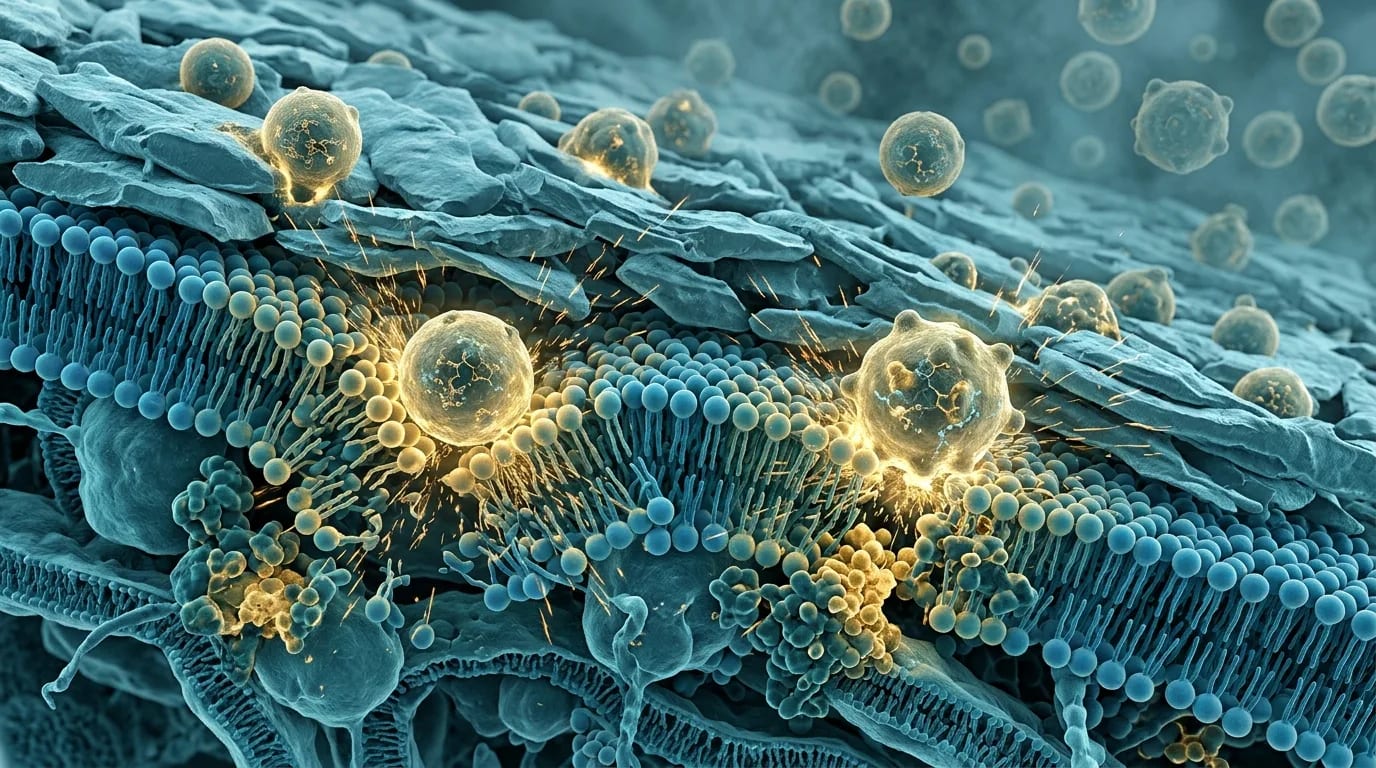
Essential oils are concentrated mixtures of volatile organic molecules: terpenes, terpenoids, phenylpropanoids, aldehydes, and ketones. It is their low molecular weight (most components are between 100 and 250 Da) that provides a key advantage over many active ingredients: the ability to penetrate the stratum corneum without special delivery systems.
Skin aging is triggered by several parallel processes: chronic oxidative stress, decreased fibroblast activity, degradation of the extracellular matrix under the action of matrix metalloproteinases (MMPs), and weakening of the barrier function. Components of essential oils are capable of interfering with several of these pathways at once — which makes them an interesting tool in the hands of a cosmetic formulator who understands chemistry.
Terpenes and antioxidant protection
Monoterpenes (limonene, α-pinene, linalool) and sesquiterpenes (β-caryophyllene, farnesol) act as free radical scavengers. β-caryophyllene, present in black pepper, copaiba, and ylang-ylang oils, is additionally a CB2 receptor agonist and reduces the inflammatory background — one of the main drivers of photoaging. In vitro studies show that extracts rich in β-caryophyllene inhibit the expression of MMP-1 and MMP-3 by 30–45% at a concentration of 0.01–0.05%.
Phenylpropanoids and collagen synthesis
Eugenol (clove, basil oil), trans-cinnamaldehyde (cinnamon bark), and carvacrol (oregano, thyme) stimulate fibroblast proliferation and increase the synthesis of type I procollagen. An important nuance: these same compounds become potential sensitizers and irritants at concentrations above 0.5%. The line between "active" and "aggressive" is very thin here — and that is precisely why the concentration in the formula is critical.

Essential oils for facial skin to combat wrinkles: top components with an evidence base
Not every essential oil is equally useful in an anti-ageing context. Below are components for which there is in vitro research or clinical data, rather than just traditional use.
- Rose oil (Rosa damascena). Contains geraniol, citronellol, and nerol. Inhibits elastase and hyaluronidase, supports turgor. Recommended concentration in the finished product: 0.01–0.05%.
- Frankincense oil (Boswellia carterii/sacra). α-pinene and incensole acetate reduce inflammation and stimulate regeneration. Especially effective when combined with carrier oils (jojoba, squalane). Concentration: 0.5–1%.
- Neroli oil (Citrus aurantium var. amara). Rich in linalool and linalyl acetate. Accelerates keratinocyte renewal, improves microcirculation. Concentration: 0.1–0.3%.
- Geranium oil (Pelargonium graveolens). Geraniol + citronellol. Antibacterial and antioxidant profile, balances sebum regulation. Concentration: 0.1–0.5%.
- Rosemary oil (Rosmarinus officinalis, CT camphor). 1,8-cineole stimulates microcirculation and collagen synthesis. Concentration: 0.2–0.5%. Contraindicated during pregnancy and for those with epilepsy.
- Patchouli oil (Pogostemon cablin). Patchoulol stimulates regeneration, reduces transepidermal water loss (TEWL). Concentration: 0.5–1%.
Understanding how climate affects the fatty acid and essential oil composition in plants helps explain why frankincense oil from Oman and Ethiopia will yield different chemotypes and different therapeutic effects — this is important when choosing a supplier.
Chemotypes: why "one oil" is not just one oil
Rosemary exists in three main chemotypes: CT camphor, CT cineole, and CT verbenone. The latter — CT verbenone — is the most interesting for anti-ageing cream formulas: verbenone stimulates cell regeneration and is significantly milder than camphor. When purchasing raw materials, always request a GC/MS certificate (gas chromatography / mass spectrometry) and verify the main marker components. Without this document, you do not know exactly what you are adding to your formulation.

Concentrations, safety, and regulations
One of the most common mistakes made by beginner formulators is transferring concentrations from aromatherapy guides directly into cosmetic formulations. Aromatherapy and cosmetic chemistry work with different delivery systems and different contact areas.
IFRA recommendations and facial skin restrictions
IFRA (International Fragrance Association) publishes standards for each ingredient, broken down by application category. Facial skin is category 4 (leave-on, face). For bergamot without bergapten (FCF), the maximum is 0.4% in a leave-on facial product. Limonene in pure form is 0.7%. Eugenol is 0.5%. Cinnamaldehyde is 0.05%. These are not "discretionary recommendations" — these are limits, and exceeding them creates a real risk of sensitization.
Additional note: 26 allergenic aromatic molecules under EU regulation (1223/2009 as amended in 2023) must be declared on the packaging if their concentration exceeds 0.001% in rinse-off products and 0.0001% in leave-on products. If you sell cosmetics, this is not an option; it is a requirement.
Photosensitization: the hidden danger of citrus oils
Cold-pressed citrus oils (bergamot, grapefruit, lime, lemon) contain furanocoumarins—psoralen and bergapten—which cause phytophotodermatitis when exposed to UVA radiation. In an anti-ageing formula for daytime use, this does not just mean "less effectiveness," but direct DNA damage to keratinocytes. Use only steam-distilled versions of citrus oils or variants labelled FCF (furanocoumarin-free)—and always specify this in your formulation sheet.
Formulating: how to incorporate essential oils into an anti-ageing formula
Essential oils are lipophilic substances, and their solubility determines the choice of phase and the incorporation technique. In anhydrous products, they are added directly to the oil phase and distribute evenly without extra effort. In emulsions, the situation is more complex.
Emulsions: temperature and order of addition
Most essential oils are thermolabile: at temperatures above 40°C, the evaporation of light fractions (primarily monoterpenes) begins, and at 60°C, losses can reach 30–50% of the original composition. The formulator's rule: essential oils should be added to the finished emulsion at a temperature no higher than 35–38°C, after the main emulsification, at the final stage.
If the formula requires a precise pH (for example, when using acids), adjust the pH first, then add the essential oils. Some components are sensitive to the pH environment: linalyl acetate hydrolyzes in an alkaline environment, and aldehydes can undergo condensation reactions. Read more about working with pH in our article pH in cosmetics: a basic guide for formulators.
Example of an anti-ageing serum with essential oils
Below is an educational formula for an oil serum (anhydrous base) with an anti-ageing profile. This is not a commercial formula, but an illustration of the principles of dosage and synergy.
- Squalane (plant-derived) — 50%
- Jojoba oil (Simmondsia chinensis) — 25%
- Rosehip oil (Rosa canina, cold-pressed) — 15%
- Bakuchi oil (Psoralea corylifolia) — 5%
- Frankincense oil CT α-pinene (Boswellia sacra) — 0.8%
- Neroli oil (Citrus aurantium var. amara) — 0.2%
- Patchouli oil (Pogostemon cablin) — 0.5%
- Tocopherol (vitamin E) — 0.5%
- Total essential oils: 1.5% — within IFRA safe concentration limits
Bakuchi oil acts here as a plant-based retinol alternative (containing bakuchiol), and the essential oils enhance the antioxidant and regenerating effect of the base formula. Read about the principles of choosing base oils in the article How to choose oils and butters for your skin type.

Synergy and antagonism: how components interact in a mixture
Essential oils for facial skin to combat wrinkles work significantly more effectively in synergistic combinations than individually. This is confirmed by research: a mixture of linalool + β-caryophyllene + geraniol demonstrates higher antioxidant activity than the sum of the activities of each component individually (synergistic effect according to the DPPH test).
However, there are also antagonistic pairs. Linalool oxide (a product of linalool oxidation) reduces the anti-inflammatory activity of β-caryophyllene. This means that the freshness of raw materials and proper storage (a dark place, temperature of 5–15°C, without exposure to air) are not an aesthetic preference, but a chemical necessity.
The role of carriers in enhancing penetration
Squalane and jojoba are not just "diluents": they form an occlusive film that slows down the evaporation of volatile components and extends the contact time with the skin. Jojoba oil (technically a liquid wax) has structural similarities to skin sebum and acts as a penetration enhancer for terpenoid molecules. This is another argument in favor of choosing the right base — read more about this in our complete guide How to make a cream at home.
If you are interested in how the texture and rheological properties of a base affect the distribution of actives on the skin, take a look at our article Tribology, gums, and gelling agents — it provides a detailed breakdown of the mechanics of slip and the distribution of the cream formula on the skin surface.

Testing and stability of anti-ageing cream formulas with essential oils
Essential oils are one of the most unstable classes of cosmetic ingredients. Their presence in a formulation requires an expanded testing protocol compared to standard formulas.
- Organoleptics in dynamics. Evaluate the smell, color, and consistency of samples immediately after production, after 2 weeks, and after 1 and 3 months. A change in smell is the first indicator of oxidation or hydrolysis.
- Oxidation test. Use the peroxide value (PV) for base oils and the DPPH test to evaluate the antioxidant potential of the mixture over time.
- Temperature stress test. 4°C / 40°C cycles for 48 hours each, minimum 3 cycles. Essential oils can cause emulsion separation during thermal cycling — especially if they are added to the wrong phase.
- Patch test. Mandatory before using any new formula with essential oils — even if each individual component is safe.
- pH control. Some essential oil components shift the pH of an emulsion. Measure the pH immediately after incorporation and again after 24 hours.
Frequently Asked Questions
Can essential oils be applied to the face undiluted to fight wrinkles?
No. Applying undiluted essential oils to the face is one of the most common mistakes. Even "gentle" oils (lavender, tea tree) can cause sensitization and damage the barrier function when used systematically in their pure form. All essential oils for facial wrinkles must be incorporated into a base — oil, emulsion, or gel — at concentrations that comply with IFRA standards for the leave-on category.
How long do I need to use an anti-ageing formula with essential oils to see results?
The minimum evaluation period is 8–12 weeks of daily use. This is due to the keratinocyte renewal cycle (28–40 days in adults) and the time required to stimulate collagen synthesis by fibroblasts. Expecting a visible lifting effect in 2 weeks is unrealistic; expecting improvements in tone, texture, and hydration is entirely reasonable.
Are essential oils compatible with retinol and acids in the same formula?
Technically, yes, provided the pH and temperature of incorporation are observed. Practically, this is a complex combination with a high risk of irritation. It is recommended to separate their use: retinol/acids in the evening, and the formula with essential oils in the morning or as a separate step in your skincare routine. If you are still formulating a combined product, start with the minimum concentrations of all actives and conduct an extended patch test.
Summary and Next Step
Essential oils for facial wrinkles are neither a marketing gimmick nor a universal solution. They are a class of complex, multi-component mixtures with real antioxidant, anti-inflammatory, and regenerative mechanisms — provided there is a knowledgeable choice of chemotype, adherence to concentrations, and correct incorporation into the formula. Knowledge of the GC/MS profile of raw materials, IFRA standards, temperature limitations, and synergistic effects is what distinguishes a professional cosmetic chemist from someone who simply mixes ingredients by intuition.
If you want to systematically master working with essential oils, carrier oils, and active ingredients in anti-ageing formulas, the Walker Formulation Academy Club provides access to recipe breakdowns, an ingredient database, and a community of practising formulators. And if you are just starting your journey in cosmetic chemistry, see how to become a cosmetic chemist and build a professional formulation practice from scratch. Learn more in our courses — and turn your interest in cosmetics into an exact science.