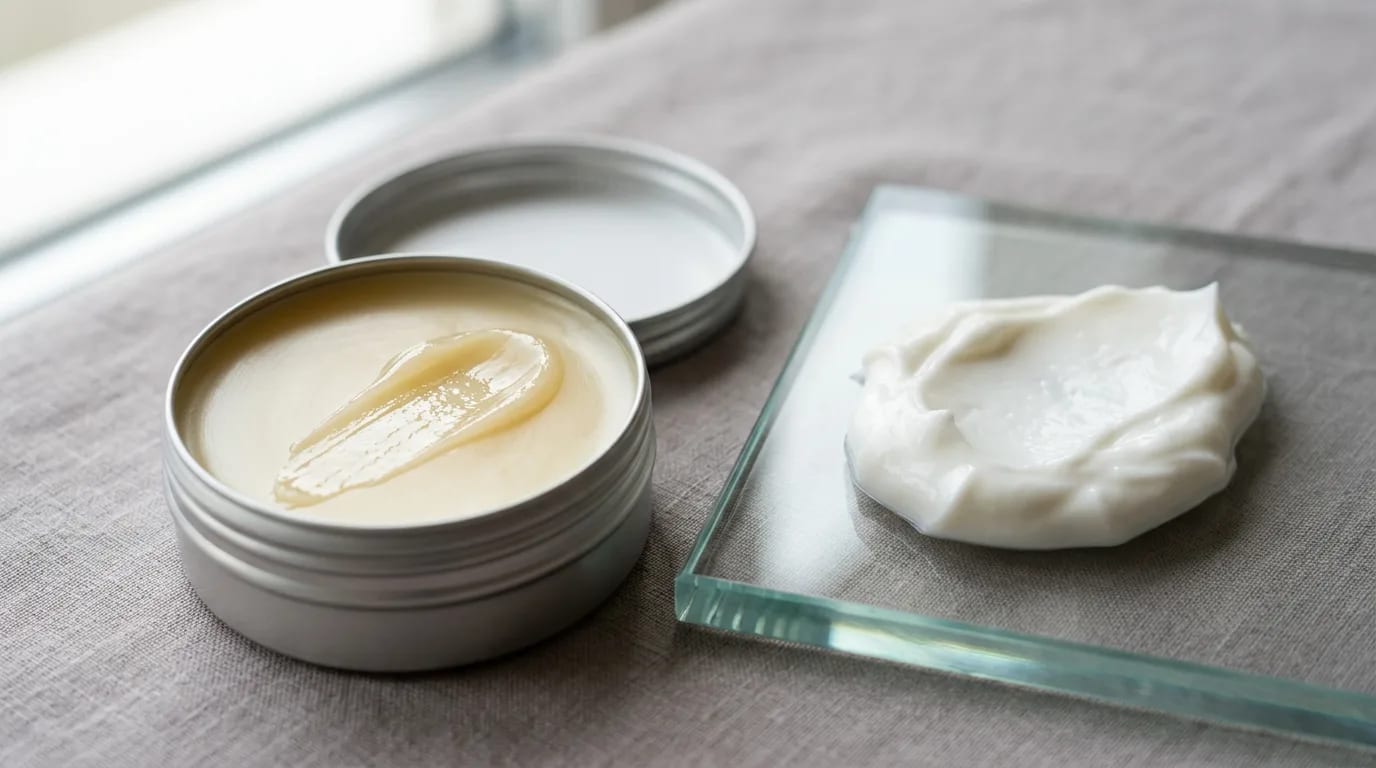
Apply hyaluronic acid serum to damp skin, then seal with a moisturiser or oil within 60 seconds — HA is a humectant that pulls water from the air or from deeper skin layers, and without an occlusive on top, low humidity can leave skin feeling tighter than before. Use a blend of low- and high-molecular-weight HA at 0.1–2% active concentration, at pH 4.5–7, and pair it with a ceramide or ester-rich cream.
- Cosmetic-grade hyaluronic acid is typically formulated at 0.1–2% active substance in finished serums (PMC review, 2021)
- High-molecular-weight HA (above 1000 kDa) sits on the skin surface and forms a film, while low-molecular-weight HA (below 50 kDa) can penetrate into the upper epidermis (PMC, 2021)
- Sodium hyaluronate is stable across roughly pH 4.5–7, and stability drops sharply below pH 4 (ScienceDirect, 2020)
- A 2% HA solution can hold water many times its own weight, which is why it must be layered under an occlusive in dry climates (PMC, 2021)
- IFRA and UK Cosmetics Regulation (retained EU 1223/2009) do not cap hyaluronic acid usage — it is not on the restricted-substance annexes, so concentration is a formulation choice, not a legal ceiling (EU CosIng framework)
Here's the part nobody puts on the bottle: the same molecule, sodium hyaluronate, can either plump your skin or leave it papery-dry by evening — and the difference isn't the brand, it's the molecular weight distribution and what you put on top of it. Most people are using hyaluronic acid wrong, and it has nothing to do with how many pumps they use.
How to Use Hyaluronic Acid on Damp Skin — and Why Timing Matters
Hyaluronic acid is a humectant, not an emollient. It doesn't manufacture moisture — it grabs whatever water is nearby, whether that's from your damp skin after cleansing, from the air, or, if there's nothing else available, from the deeper layers of your own epidermis. This is why the golden rule among formulators is: apply HA serum to slightly damp skin, never bone-dry skin, and never in a low-humidity room without sealing it in.
The dermis itself is largely responsible for this behaviour. It's a dense mesh of collagen and elastin suspended in a gel-like ground substance where hyaluronic acid, alongside urea and lactic acid, helps hold water and keep the tissue plump and resilient. When you apply topical HA, you're essentially borrowing from the same water-binding logic the dermis already uses — you're just doing it from the outside, in the stratum corneum, where the effect is more superficial but still measurable.
The Damp-Skin, Then Seal Rule
- Mist or cleanse first — damp skin gives HA local water to bind immediately
- Apply serum within 60–90 seconds while skin is still slightly damp
- Follow with an occlusive: a ceramide cream, squalane, or an oil-based balm
- In humidity below roughly 40%, skip HA-only routines — always layer a barrier product on top
Molecular Weight: The Detail Every Label Hides
Almost no consumer-facing serum tells you the molecular weight (MW) of the hyaluronic acid inside, yet this single variable decides whether the ingredient sits on the surface, penetrates slightly, or does almost nothing at all. Research grouping HA by weight class shows consistently different skin behaviour (PMC, 2021).
| Molecular weight | Where it acts | Sensory effect |
|---|---|---|
| High MW (>1000 kDa) | Skin surface, forms a breathable film | Instant plumping, smoothing, slight occlusion |
| Medium MW (50–1000 kDa) | Upper stratum corneum | Balanced hydration, less tack than high MW |
| Low MW (<50 kDa) | Penetrates into upper epidermis | Deeper hydration signal, can feel less immediately "plumped" |
| Oligo-HA (<10 kDa) | Reaches viable epidermis | Associated with signalling effects, still under active research |
This is exactly why a well-designed serum blends two or three molecular weights rather than relying on a single one — the high-MW fraction gives you the immediate visual plump, while the lower-MW fraction supports hydration a little deeper in the tissue. If you're building or evaluating a formula, this layering logic is very similar to how we approach actives like niacinamide, where percentage alone tells you almost nothing without knowing where and how it's delivered — something we unpack in Niacinamide for Facial Skin: How to Formulate Without the Mistakes That Kill Its Activity.
What Concentration Actually Means on an INCI List
When a brand claims "2% hyaluronic acid," that almost always refers to the finished sodium hyaluronate raw material as diluted into the formula — not 2% of pure, isolated HA acid, which would be nearly unworkable at that level due to viscosity. Cosmetic-grade sodium hyaluronate used in serums is typically incorporated at 0.1–2% active substance in the finished product, a range confirmed across formulation reviews (PMC, 2021). Above roughly 1%, especially with high-MW fractions, texture becomes noticeably gel-like and can feel tacky as it dries — which is a texture choice, not necessarily a sign of higher efficacy.
pH: The Variable That Silently Breaks Formulas
Sodium hyaluronate is most stable in a pH window of roughly 4.5 to 7; below pH 4, hydrolysis accelerates and the polymer chain degrades faster, shortening shelf life and reducing the water-binding capacity you're paying for (ScienceDirect, 2020). This matters directly for how to use hyaluronic acid at home: layering an HA serum directly under a very low-pH exfoliating acid (think pH 2–3 glycolic or lactic acid toners) can degrade the HA and irritate skin simultaneously. The safer sequence is exfoliating acid first, a short wait, then HA serum, then moisturiser.
Building a Routine Around Hyaluronic Acid
Hyaluronic acid doesn't work in isolation, and treating it as a stand-alone "miracle step" is where most routines go wrong. It performs best as the hydration bridge between active treatments and barrier-repair products.
- Cleanse — leave skin slightly damp, don't towel-dry completely
- Treatment actives — niacinamide, peptides, or exfoliating acids, allowed to absorb
- Hyaluronic acid serum — applied while skin still holds some moisture
- Moisturiser or facial oil — locks the water HA has just bound, preventing evaporation
Peptide serums in particular pair well in this sequence, since peptides work on collagen signalling deeper in the dermis while HA manages surface and near-surface hydration — two different jobs that complement rather than compete, as explained in How Peptides Work: Collagen, Cell Signaling, and Anti-Aging Effects. If you're formulating rather than shopping, the same logic — matching molecular weight and delivery to the layer of skin you're targeting — applies to designing a full anti-ageing regimen, covered in more formulation depth in Anti-aging cream: a formula that actually works.
Common Mistakes That Undo the Benefit
- Applying HA serum as the very last step with nothing occlusive on top, in a dry room or aeroplane cabin
- Using only high-molecular-weight HA and expecting deep hydration — it physically cannot penetrate past the surface
- Combining HA with strongly acidic actives (pH under 4) in the same layer without buffering time between them
- Assuming a higher percentage on the label always means more hydration — texture and MW blend matter more than the raw number
Regulatory Status in the UK and EU
Hyaluronic acid and its salts (sodium hyaluronate, potassium hyaluronate) are listed in the EU CosIng database as skin-conditioning and humectant ingredients and are not subject to a maximum-concentration restriction under the UK Cosmetics Regulation (retained EU 1223/2009) or its restricted-substance annexes (EU CosIng framework). That means the 0.1–2% range formulators use is a practical, sensory and cost decision rather than a legal ceiling — always check CosIng directly for the specific INCI variant and any cross-linked or hydrolysed derivatives before finalising a formula, since some newer HA derivatives may carry separate listing conditions.
FAQ
How do you use hyaluronic acid serum correctly, step by step?
Apply it to slightly damp skin (right after cleansing or misting), wait about a minute, then seal it in with a moisturiser or facial oil. Skipping the sealing step in dry air can make HA pull moisture out of your skin rather than into it.
Can you use hyaluronic acid every day, morning and night?
Yes — hyaluronic acid at 0.1–2% active concentration is generally suitable for twice-daily use for most skin types, since it's a humectant rather than an exfoliating acid, and it isn't restricted under UK Cosmetics Regulation or EU CosIng usage limits.
Why does hyaluronic acid serum make my skin feel tighter or drier?
This usually happens when HA is applied without an occlusive on top in low-humidity conditions — the humectant pulls water from the air, but if there's none available, it can draw moisture from the skin itself. Always layer a cream or oil over HA serum, especially in winter or air-conditioned rooms.
Should you mix hyaluronic acid with niacinamide or peptides?
Yes, they layer well since they work on different parts of the skin — HA manages surface hydration while niacinamide and peptides act on barrier function and collagen signalling respectively. Apply thinner, water-based actives first, then HA, then your moisturiser.