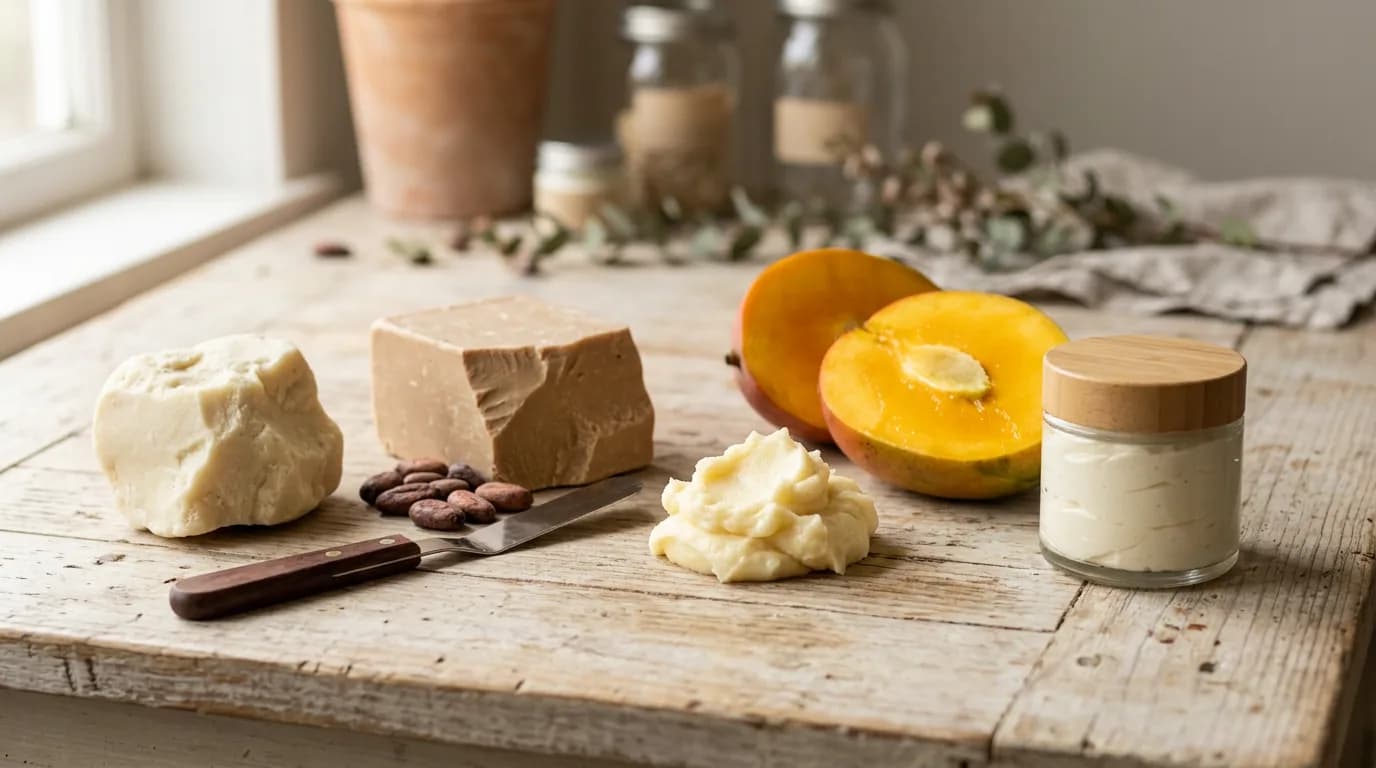
Shea, cocoa or mango: which butter makes the balm you want
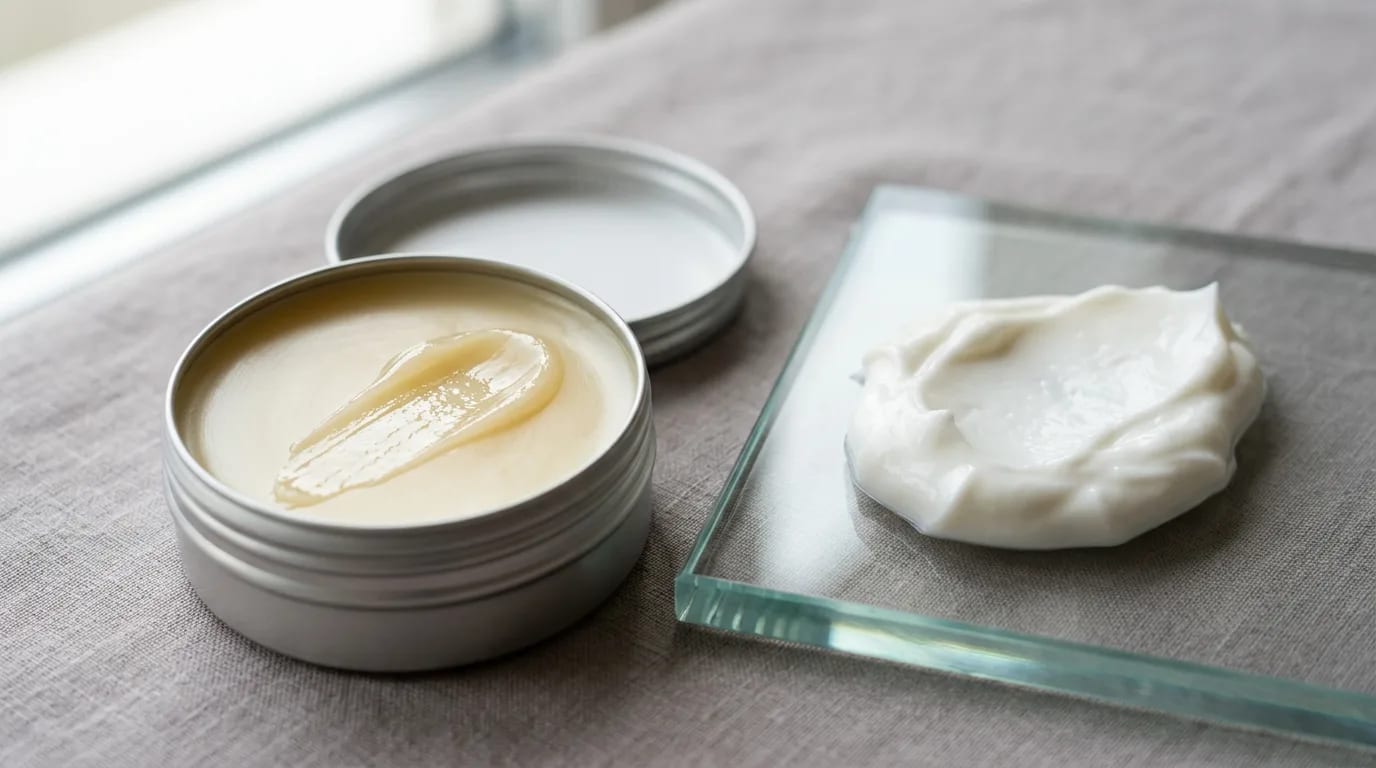
You made a body butter in March and it was exactly right: firm in the tin, soft under a thumb, spread without dragging. In July you opened the same tin and found a puddle with a skin on it. In January you opened it again and had to gouge at it with a fingernail.
Nothing went wrong. You made a fat, and a fat has a melting range, and the room changed.
This is the part of butter formulating that nobody writes down, because the recipes are written in kitchens that happen to be at a comfortable temperature on the day. What actually decides whether your balm behaves is the proportion of two saturated fatty acids in the fat you chose, and the temperature of the room it ends up in. This article — part of our series on plant oils by fatty-acid group — is about choosing and dosing butters for structure and feel.
One thing it is deliberately not about. If your problem is grittiness — a body butter that has gone sandy in the tin — that is a crystallisation problem with its own mechanism and its own fix, and it is covered properly in polymorphism of butters. Hardness and grittiness are different failures with different causes, and treating one as the other is why so many "fixes" do not work.
Why saturated chains stand up
A saturated fatty acid has no carbon-carbon double bonds and therefore, unlike a cis-unsaturated chain, no fixed bend in it. Straight chains pack closely against each other and hold together more strongly; the triglycerides they build melt higher. Three other things matter alongside chain length and saturation — the symmetry of the triglyceride, which positions on the glycerol the saturated chains occupy, and which crystal form the fat settles into — but the first-order rule is simple and it holds:
More stearic (C18:0) and palmitic (C16:0) acid, firmer fat. More oleic acid mixed in, softer and lower-melting fat.
That is why these three are butters and sunflower oil is not. It is also why a butter in a cold stockroom is a brick and the same butter in a warm one is a paste: the melting ranges of these fats sit close to the temperatures that rooms, vans and shop shelves actually reach.
Saturation buys one more thing. Lipid oxidation runs chiefly through unsaturated chains, so a fat that is two-thirds saturated simply has fewer sites for it than a polyunsaturated oil. That reduces susceptibility; it does not remove the need for a stability study, because every one of these butters still carries oleic acid, and shelf life also depends on antioxidants and pro-oxidants present, on processing, on packaging and on storage.
At the bench: when a balm is too hard or too soft, the first number to look at is not the wax percentage. It is the stearic-plus-palmitic figure of the butter, on the certificate for the lot you actually used.
The British problem is the opposite of the tropical one
Here is where most recipes from the internet mislead a British formulator, and it is worth being precise about it.
The Met Office 1991–2020 averages for Heathrow put the mean daily maximum at 23.89 °C in July and 23.40 °C in August, and the mean daily minimum at 2.68 °C in January. Indoors, the UKHSA-affiliated systematic review of minimum indoor temperature thresholds for English homes concluded that "a recommendation of at least 18 °C for the whole population… can be made" (Jevons et al., Public Health, 2016) — a recommendation precisely because a great many English rooms in winter are colder than that.
Now put a measurement beside it. The four Thai mango kernel fats studied by Sonwai and Ponprachanuvut in the Journal of Oleo Science (2014) showed high solid fat content at 20 °C and below, melted slowly as the temperature rose, and became complete liquids as the temperature approached 35 °C.
A tropical formulator is working against the top of that range: the whole problem is a butter that will not hold its shape at 32 °C. A British formulator is working against the bottom of it. Most of the British year, in most British rooms, these fats are sitting in the region where their solid fat content is high — and an unheated bedroom in January, or a coat pocket at the January mean minimum of 2.68 °C, is well below anything the recipe's author had in mind.
The consequence is a real and avoidable mistake: a recipe engineered not to melt will not spread. Take a tropical body-butter formula that was hardened with extra stearic-rich fat so it would survive a hot delivery van, make it in Manchester in February, and you get a block that a customer cannot get out of the tin.
At the bench: decide which failure you are actually designing against before you pick the butter. Write down the two temperatures the product has to work at — the coldest room it will be used in and the warmest place it will be stored — and test at both. For most British products sold direct to British customers, "spreads at 16 °C" is the harder constraint, not "holds at 30 °C".
Who is in the group, by the numbers
Cocoa butter — the firm one, and the best characterised
Cocoa butter is the reference member of the family. In a 2017 study in Foods by Azir and colleagues (PubMed 29120362) that used authentic cocoa butter as the baseline for detecting adulteration with lard, the pure fat came out at 33.74 per cent total unsaturated fatty acids — so roughly two-thirds saturated, dominated by palmitic and stearic acid.
Its triglycerides are unusually uniform, and that uniformity is why it behaves the way it does. Three species account for almost ninety per cent of the fat:
| Triglyceride | Per cent of cocoa butter |
|---|---|
| POS — palmitoyl-oleoyl-stearoyl-glycerol | 41.67 |
| SOS — stearoyl-oleoyl-stearoyl | 28.47 |
| POP — palmitoyl-oleoyl-palmitoyl | 19.13 |
In each of them the oleic acid sits at the middle (sn-2) position with palmitic or stearic on the outer positions. Cocoa butter crystallises in several polymorphic forms and its melting profile depends on both that composition and the form present — which is the subject of the polymorphism article, not this one.
For quality, the public yardstick is Codex CXS 86-1981, which defines cocoa butter by two limits: free fatty acid content, expressed as oleic acid, not more than 1.75 % m/m, and unsaponifiable matter not more than 0.7 % m/m, or 0.35 % for press cocoa butter. Read the scope before you lean on it: that standard "applies exclusively to cocoa butter used as ingredient in the manufacture of chocolate." It is a food specification. It is also the only public number most suppliers will be measured against, and a cocoa butter that fails it is a question.
At the bench: cocoa butter is the structuring fat of the three and the one that melts latest on skin. It is right for lip products and for the firm end of balms; it is wrong as the only fat in anything that has to spread on a cold morning.
Shea — the variable one, and the variation has a postcode
Shea is where "shea butter" stops being a useful specification.
A 2010 survey in the Journal of Oleo Science (PubMed 20513968) analysed 36 samples of shea (Vitellaria paradoxa) from seven sub-Saharan countries and found stearic acid ranging from 28 to 56 per cent and oleic acid from 34 to 61 per cent. West African provenances were generally higher in both stearic acid and triterpene alcohols than East African ones, and both were significantly correlated with the latitude and elevation of the source population — the authors read that as higher levels at higher ambient temperatures.
Di Vincenzo and colleagues in the Journal of Agricultural and Food Chemistry (2005), working with 150 samples from Mali, Burkina Faso, Nigeria and Uganda, found the same split from the other direction: stearic acid dominant in West African shea, oleic acid dominant in Ugandan shea, with country means for acetyl and cinnamyl polycyclic triterpenes from 3.69 to 12.57 per cent, highest in Nigerian provenances, and enough separation between the chemical profiles to track the geographic distance between populations.
Take the extremes of that stearic range seriously. A 56-per-cent-stearic shea and a 28-per-cent-stearic shea are, for your purposes, two different raw materials sharing a name. In a balm they will give you two different products from the same recipe, and neither certificate will be wrong.
Shea's unsaponifiable fraction is also unusually large for a fat — the 2010 survey put the non-saponifiable lipids at 2–12 per cent of the fat, with triterpene alcohols making up 22–72 per cent of that fraction, against cocoa butter's Codex ceiling of 0.7 per cent. It carries its own tocopherols too: Maranz and Wiesman (2004) measured 102 samples from 11 countries and found total tocopherol from 29 to 805 micrograms per gram, mean 220, with alpha-tocopherol the principal form at an average 64 per cent — hot, dry N'Djamena in Chad averaging 414 µg/g and cool highland northern Uganda 29 µg/g. What that fraction is and why it matters is the subject of refined or unrefined; here it is one more reason two drums labelled shea are not interchangeable, worked through in why your shea butter acts differently.
At the bench: ask your British supplier for the country of origin of the shea lot, and for the stearic and oleic figures on that lot — not the range on the product page. If they change origin between deliveries, treat it as a change of raw material: re-check the profile and re-test the product. This is the single question most likely to explain why a repeat batch came out different.
Mango — the middle one, decided by cultivar
The four Thai cultivars in the 2014 study had oleic and stearic as their main fatty acids in every case, with stearic content varying by cultivar — Nam-Dokmai highest, Aok-Rong lowest — and correspondingly different slip melting points and solid fat contents. All four melted fully as the temperature approached 35 °C, and X-ray diffraction showed β′ as the predominant polymorph.
That is a study of Thai mango kernel fat, not of the commercial mango butter on a British supplier's shelf, which may be a different cultivar mix and a different process. It is enough to place mango in the stearic-rich group and to say that where a particular lot sits has to come from its own certificate.
At the bench: mango is the butter to try when shea is right in structure but wrong in feel. Swap it in at the same percentage, then re-check hardness at both of your target temperatures — the stearic content is not the same and the firmness will move.
Palm and its fractions — the industrial member
Palm oil has the most complete public data of any fat here, and its fractions are the clearest illustration of what saturated content does. From Codex CXS 210-1999:
| Material | Palmitic acid | Oleic acid | Iodine value | Slip point (Codex §3.3) |
|---|---|---|---|---|
| Palm oil | 39.3–47.5 % | 36.0–44.0 % | 50.0–55.0 | — |
| Palm stearin (solid fraction) | 48.0–74.0 % | 15.5–36.0 % | ≤ 48 | not less than 44 °C |
| Palm olein | — | — | ≥ 56 | not more than 24 °C |
| Palm superolein (most liquid fraction) | 30.0–39.0 % | 43.0–49.5 % | ≥ 60 | not more than 19.5 °C |
One raw material, three structuring options, and the slip points tell you what they are for. Palm stearin, at not less than 44 °C, will not soften at any indoor temperature a British home reaches — which is exactly why it appears in commercial balms and body butters, and exactly why it is the wrong lever if the complaint is "won't spread". Palm superolein, at not more than 19.5 °C, is liquid at room temperature in summer and borderline in winter.
Where a brand makes a sustainability statement about palm, it should identify the certification scheme and the certified material or supply chain it refers to.
At the bench: if you need a fat that holds shape in the post in August without touching the feel in January, a small percentage of palm stearin does that more predictably than more shea. If the problem is the opposite, palm stearin is what to take out.
Hardness, melting and feel: what the numbers do and do not predict
Firmness follows saturated content, broadly. Cocoa butter, at about two-thirds saturated, is the firmest of the three as a raw material; a stearic-rich shea is firm; an oleic-rich shea is soft enough to spread straight from the tub; mango sits between, depending on cultivar. Feel tracks the same axis: cocoa butter melts late on the skin and can feel waxy until it does, shea melts earlier and leaves a richer film, and mango is often described as drier than shea at the same percentage. Those last observations are sensory judgements from formulating work rather than measurements, and they move with everything else in the formula. Composition suggests the direction to expect; it does not tell you how far, and it establishes nothing about hardness, origin, authenticity or refining on its own.
Two things composition definitely does not predict, and you have to test for both:
- Crystal form. The same triglycerides can pack in several arrangements with different melting points and textures. That is why cocoa butter products bloom, shea balms turn grainy and a mango butter can set differently batch to batch. Mechanism and tempering: polymorphism of butters.
- Behaviour at the temperatures the product will actually meet. Not the bench temperature. The two you wrote down at the start.
At the bench: keep a cheap thermometer in the room you formulate in and write the temperature on every trial sheet. Half the "it worked last time" mysteries in butter work are a five-degree difference in the room that nobody recorded.
Dosing butters for structure
Practice, to be validated on each product. Treat the butters as structurants first and emollients second.
- In anhydrous balms and body butters, the butter is the structure. The share of stearic-rich butter — cocoa, West African shea, palm stearin — sets the firmness; oleic-rich butters and liquid oils soften it. Add a wax only when the butter alone cannot hold the shape at the target temperature, and read the polymorphism article before you combine the two.
- In water-in-oil emulsions, butters in the outer phase give the rich, cushioning feel that defines the format. Their share is limited by how heavy the product may feel and how well it spreads.
- In oil-in-water creams, butters are a minority of the oil phase, used for feel and for a fuller film. Too much makes the cream drag on application and can let it grain in the jar. The emulsion's own structure holds the product, not the butter — which is also why changing the butter is rarely the fix for a greasy cream; that is worked through in why does my cream feel greasy.
- Refined or unrefined is a formulation decision, not a virtue. Refining gives a paler, less odorous fat; what a given process does to the unsaponifiable fraction is a question for the supplier, and a refined and an unrefined shea are not interchangeable in feel even when their fatty-acid profiles look alike.
At the bench: change one butter at a time and re-measure at both target temperatures before changing anything else. Two simultaneous swaps in a fat blend cannot be untangled afterwards.
Reading a certificate of analysis for a butter
- Stearic and oleic percentages. For shea these two numbers place the lot inside the wide published ranges (28–56 and 34–61 per cent) and are your first indication of firmness. For mango they show where the cultivar sits. For cocoa they can be compared against the well-characterised pattern.
- Origin. For shea above all. The published surveys show composition tracking provenance; a change of origin between batches is a reason to re-check the profile and re-test the product.
- Unsaponifiable matter. High for shea (2–12 per cent of the fat in the 2010 survey), low for cocoa by the food standard (not more than 0.7 % m/m). A shea certificate far below the published range is a question about the material and its processing.
- Free fatty acids. Codex caps cocoa butter at 1.75 % m/m as oleic acid. For palm products the vegetable-oil standard's quality factors apply: acid value 0.6 mg KOH per gram for refined fats and 4.0 for cold pressed and virgin ones. Shea and mango are not covered by a Codex standard at all, so the supplier's specification is the only reference — which is a reason to read it, not a reason to skip it.
- Slip melting point, or a melting profile, where the supplier offers one. For a structurant this is the number that matters most in use, and it is the one most often missing from a British retail listing. Ask.
Where the group belongs
| Format | What the butter is doing | What the evidence supports |
|---|---|---|
| Anhydrous balms, sticks, body butters | The structural fat, sometimes with a wax | Saturated-rich fats hold a solid structure at room temperature; the mango fats studied had high solid fat content at 20 °C and below and were fully liquid approaching 35 °C |
| Lip products | Cocoa butter and stearic-rich shea for snap and hold | Cocoa butter's POS/SOS/POP composition and polymorphism govern its melting; tempering has to be managed |
| Water-in-oil creams | Outer-phase richness | Cushioning feel reported by formulators; share limited by heaviness |
| Oil-in-water creams | A minority of the oil phase | Structure comes from the emulsion; excess drags and can grain |
| Products posted in a British summer | Stearic-rich butters or a little palm stearin; tested at the target temperature | Palm stearin's Codex slip point is not less than 44 °C |
| Products used in an unheated British room | Oleic-rich shea, mango, liquid oil; tested at 16 °C or lower | The January mean daily minimum at Heathrow is 2.68 °C; the recommended indoor minimum is 18 °C and many rooms are below it |
The butters are the one group in this series where composition is on your side for oxidation and against you for consistency. Saturated-rich fats resist oxidation and hold a shape — and they also crystallise in more than one way and melt at temperatures products actually meet. Read the stearic and oleic figures, know where your shea came from, treat the melting profile as a specification rather than a curiosity, and hand the crystallisation question to the polymorphism article. Composition informs those choices. It does not predict the stability or the feel of a finished product, which have to be validated on each formulation and each production batch.
Sources
- Azir M. et al. Detection of lard in cocoa butter: its fatty acid composition, triacylglycerol profiles, and thermal characteristics. Foods 6(11), 98, 2017. PubMed 29120362 — triglyceride figures read from Table 2 of the full text.
- Akihisa T. et al. Triterpene alcohol and fatty acid composition of shea nuts from seven African countries. Journal of Oleo Science 59(7), 351–360, 2010. PubMed 20513968
- Di Vincenzo D. et al. Regional variation in shea butter lipid and triterpene composition in four African countries. Journal of Agricultural and Food Chemistry 53(19), 7473–7479, 2005. PubMed 16159175
- Maranz S., Wiesman Z. Influence of climate on the tocopherol content of shea butter. Journal of Agricultural and Food Chemistry 52(10), 2934–2937, 2004. PubMed 15137838
- Sonwai S., Ponprachanuvut P. Studies of fatty acid composition, physicochemical and thermal properties, and crystallization behavior of mango kernel fats from various Thai varieties. Journal of Oleo Science 63(7), 661–669, 2014. PubMed 24919475
- Codex Alimentarius. Standard for Cocoa Butter, CXS 86-1981 (Rev. 1-2001). FAO PDF — consulted 22 September 2026.
- Codex Alimentarius. Standard for Named Vegetable Oils, CXS 210-1999 (amended 2015): §3.3 slip points, Table 1 fatty-acid ranges, Table 2 iodine values, Appendix §1 acid values. FAO PDF — consulted 22 September 2026.
- Met Office. Location-specific long-term averages, Heathrow, 1991–2020. metoffice.gov.uk — consulted 22 September 2026.
- Jevons R., Carmichael C., Crossley A., Bone A. Minimum indoor temperature threshold recommendations for English homes in winter — a systematic review. Public Health, 2016. UKHSA research portal