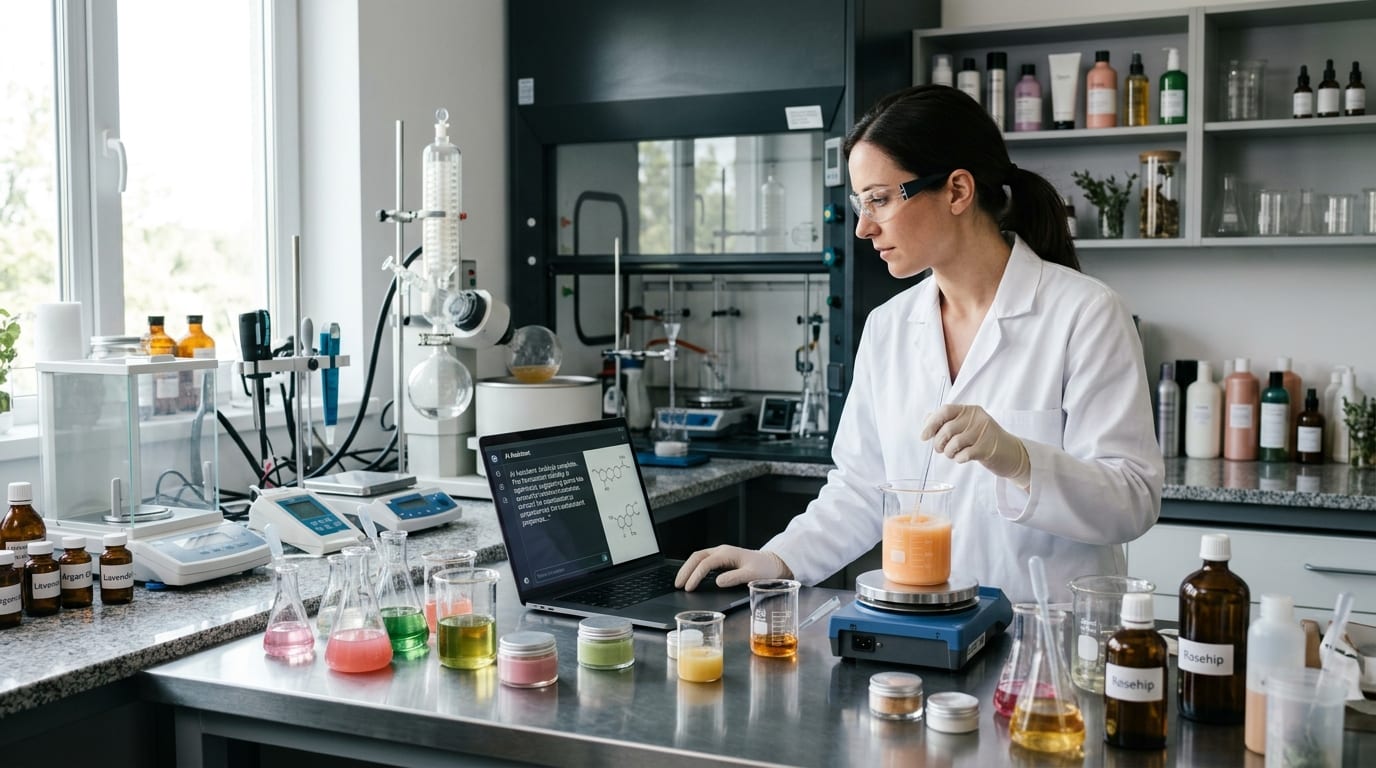
In reality, this topic is much broader than what can fit into a short post. And much more serious than it might seem. This article is the culmination of a series of posts in which we will break down everything: from filter types and product formats to the architecture of professional formulations. And we will honestly answer the question — is it worth making a sunscreen at home?
Physical and chemical filters: what is the difference
As we know, there are “chemical” and “physical” filters. Of course, all filters are chemical, but for some reason, it is customary to call organic filters, which absorb energy in the ultraviolet range, “chemical,” and those filters that block, scatter, reflect, and, by the way, can also absorb the same energy, “physical.”
Let’s talk about physical, inorganic filters. These include titanium dioxide and zinc oxide.
The ultraviolet spectrum that affects us includes UVA (320–400 nm) and UVB (290–320 nm). It is important for us to have broad-spectrum protection. UVA penetrates the deepest and damages cell DNA, causing premature ageing. UVB is responsible for skin cancer caused by the sun.
Filter | Protection | Spectrum |
|---|---|---|
Titanium dioxide (TiO₂) | Predominantly UVB | Narrow |
Zinc oxide (ZnO) | UVA + UVB | Broad spectrum ✅ |
Rotate your phone to see the full table
Home formulators often use these filters in their sunscreens. We will talk about which sunscreen format is preferable and why. And afterwards, we will discuss what to look out for during production and whether it is worth doing at home.
Which sunscreen format to choose

We have many variations: oil-in-water emulsion, water-in-oil, liquid crystal, oil spray, sticks, gels, aerosol, etc. Let’s talk about the products that we could theoretically make ourselves at home.
Format | Protection | Water resistance | At home? | Verdict |
|---|---|---|---|---|
Oil spray | ⚠️ Low | ❌ No | ❌ | Unreliable protection |
Aerosol | ⚠️ Uneven | ❌ | ❌ | Impractical |
Sticks and balms | ✅ Thick layer | ⚠️ Medium | ⚠️ | Works, but unpleasant |
Water-based gel | ⚠️ Washes off | ❌ No | ⚠️ | Only with water-soluble filters |
Silicone gel | ✅ Good | ✅ | ⚠️ | Practically perfect |
Emulsion (cream) | ✅ Best option | ✅ (water-in-oil) | ⚠️ With reservations | Industry standard |
Rotate your phone to see the full table
Emulsions: oil-in-water, water-in-oil, and liquid crystal
Most sunscreens are formulated as emulsions. Why? Because emulsions offer efficacy, a pleasant user experience, and cost-effective production.
Oil-in-water emulsion (O/W)
Easier to produce and stabilise. They apply pleasantly and feel lighter on the skin. The downside: it is difficult to make them water-resistant, as the hydrophilic emulsifier washes off with water later.
Water-in-oil emulsion (W/O)
Naturally water-resistant: the oil phase is external, forming a continuous film. High SPF with a lower percentage of filters. The downside: they are perceived as heavy and greasy.
Liquid crystal
The best of both worlds. An O/W emulsion that transforms into a W/O emulsion upon application to the skin, becoming water-resistant. The correct choice of film-former and emulsifier is critically important.
Why the sunscreen base is more important than the filters

The sunscreen base is of paramount importance. Even perfectly selected filters will not work well if the base itself is formulated incorrectly.
If the filters are not dispersed and there are clusters in some places and gaps in others, ultraviolet radiation will penetrate through those gaps. Unfortunately, this creates a false sense of security — if we weren't using any protection, we would behave more cautiously.
A false sense of security is the worst thing a bad sunscreen can provide. You think you are protected and behave carelessly. This is more dangerous than using no protection at all.
Film uniformity
A well-designed base correctly disperses UV filters for a continuous, even film — the key to true SPF.
Resistance to friction
The film is worn away by friction (towels, clothing, sand), creating gaps. A cohesive, flexible film with low tackiness is the solution.
Water resistance
We sweat and go into the water. Without the right base, all protection will wash off.
Preventing flocculation
Proper wetting and dispersion of ZnO and TiO₂ prevents the filters from clumping into “fluffy flakes”.
Why vegetable oils are a bad idea in sunscreens

Many beginners (and even experienced!) home formulators love adding vegetable oils to their creams. It makes sense: they sound “natural”, provide pleasant skin care, and contain vitamins and antioxidants. But there is one important nuance: under the sun, oils behave in ways we don't expect.
The more unsaturated fatty acids an oil contains, the faster it degrades under UV light. Flaxseed or hemp oil can oxidise in literally a few hours in the sun. Even olive oil — a “stable long-liver” among oils — loses up to a third of its protection after a couple of hours of UV exposure.
Chatelain & Gabard study (2001): creams with oxidised oils lost 40–60% of their SPF in just 2 hours in the sun. You applied SPF 30, but after a couple of hours, it is working like SPF 12 — at best.
Under the influence of light, lipid peroxides form in oils. These aggressive molecules destroy UV filters, especially the “delicate” avobenzone. Protection drops, the texture degrades, and a rancid smell develops. Deflandre & Lang (1988) proved that oil oxidation products reduce the photostability of all organic filters without exception.
UV filters are rigid, flat molecules. Fatty acids are flexible and twisting. They don't get along: the mixture separates, the cream applies patchily, and the protection on the skin ends up “full of holes.” In practice: the bottle says SPF 30, but you actually get SPF 15–18. And that is immediately upon application!
Base | SPF loss after 2 hours | Dispersion | Uniformity |
|---|---|---|---|
Sunflower oil | −40% | Poor | Patchy |
Olive oil | −33% | Average | Uneven |
C12-15 alkyl benzoate | −13% | Excellent | Uniform ✅ |
Rotate your phone to see the full table
I believed this myself and talked about it a few years ago. I even had a table somewhere showing which oil provides which SPF. Alas, it is a myth. Scientific tests show that raspberry, sesame, and coconut oils provide SPF 2–3 at most — about the same as a light day cream. These are nourishing oils, not sunscreen filters.
Conclusion: if your goal is reliable protection, choose synthetic esters (C12-15 alkyl benzoate, isohexadecane, etc.) and use oils only as an addition in very small doses (1–2%). Naturalness should not compromise efficacy. Sunscreen is a safety product, not just skincare.
Myth: 1% zinc oxide = SPF 1
The most common and dangerous myth: “1% zinc oxide = SPF 1”. This mathematical fantasy has spread through chats and forums, leading people to believe that 20% zinc oxide automatically creates SPF 20.
SPF is a complex, non-linear function. It is influenced by: particle size, dispersion quality, film uniformity, interaction with the base, photostability, and many other factors.
Fact: 25% zinc oxide can provide anywhere from SPF 4 to SPF 30 — depending on the production method. The same percentage in home-formulated creams usually provides a maximum SPF of 2–4, regardless of concentration.
Parameter | Professional ZnO | DIY ZnO |
|---|---|---|
Particle size | 30–100 nm, controlled | 200–5000 nm, random |
Coating | Uniform, no gaps | Gaps → UV transmission |
Result | SPF matches the claim | SPF 2–4 maximum |
Rotate your phone to see the full table
Film-formers — the unsung heroes of SPF
Professional sunscreens contain 2–5% film-forming polymers. They create a continuous, water-resistant film that holds UV filters in place. Without them, zinc oxide is just expensive white paint that wipes off easily.
Acrylates/C10-30 alkyl acrylate crosspolymer — flexible network
VP/Eicosene copolymer — water resistance
Styrene/Acrylates Copolymer — a quick-drying, transfer-resistant film
Silicone elastomers — flexibility and comfort
Film formers increase SPF by 30–50% by: ensuring uniform thickness, preventing filter aggregation, improving water resistance, and reducing filter penetration into the skin.
Without film formers: zinc oxide migrates into skin creases, protection vanishes within 30 minutes, water and sweat create immediate gaps, and reapplication fails to restore protection. This is an essential ingredient.
Equipment: kitchen vs. laboratory

Stage | Laboratory | At home |
|---|---|---|
Particle size analysis | Laser diffraction (~$50,000) | “Looks smooth” |
Dispersion | Three-roll mill (5 µm grind) | Manual stirring |
SPF testing | UV spectrophotometer + SPF analyzer | “I didn't get burnt” |
Temperature control | Precise, automatic | Approximate |
Rotate your phone to see the full table
Even if you have professional-grade zinc oxide, kitchen equipment cannot: break down nanoparticle aggregates, create a uniform distribution, achieve proper viscosity, or maintain temperature control.
High-speed blender? It introduces air bubbles — windows for UV rays. Magnetic stirrer? It creates a vortex that concentrates particles in the centre, leaving the edges unprotected.
What professional testing of home recipes reveals: Claimed SPF 30 → actual SPF 2–4. Coverage uniformity: 10–15% of claimed. Water resistance: practically zero. Photostability: up to 50% degradation in 2 hours. Broad spectrum: usually completely ineffective.
Sunscreen architecture: how professional formulations are built
Sunscreen is not just UV filters suspended in a cream. It is a complex system where every component plays a critical role. Professional sunscreens are structured like buildings — each component supports the other, and removing any element can lead to a collapse.
A typical SPF 30+ formulation contains 15–25 ingredients combined into functional systems. The difference between SPF 15 and SPF 30 is not in doubling the amount of filters, but in optimizing every structural element.
System | % of formula | Key ingredients | Role |
|---|---|---|---|
UV filters | 20–30% | ZnO 10–25%, TiO₂ 2–10% | Primary protective barrier |
Dispersants | 2–5% | Polyhydroxystearic acid, triethoxycaprylylsilane | Molecular frameworks |
Film formers | 3–7% | Acrylate crosspolymers, VP/eicosene copolymer | Retention, water resistance, +30–50% SPF |
Emulsion system | 50–60% | Water phase 30–45%, oil phase 15–25% | Transport and application |
Photostabilisers | 1–3% | Ethylhexyl methoxycrylene, octocrylene | Prevention of filter degradation |
Antioxidants | 0.5–2% | Multi-level system | Protection against UV-induced oxidation |
Sensory modifiers | 5–10% | Silicones, starch derivatives, humectants | Pleasant application |
Stabilisation | 1–3% | pH buffers 6.5–7.5, rheology modifiers | Storage stability |
Rotate your phone to see the full table
All of this is a system. Remove one element, and the “building” collapses. A home crafter can replicate 2–3 components from this list. A professional formulation requires all 8.
Why you shouldn't make sunscreen at home

When I started writing this article, I thought about sharing tips at the end on how to try making sunscreens at home. But I decided against it; I don't want that on my conscience. Because I advocate for using tested, approved sunscreens. Even the cheapest commercial options are infinitely superior to homemade ones.
DIY sunscreen is not a fun project. It is a dangerous misconception that can lead to skin damage and cancer. The gap between what people think they have (SPF 30) and what they actually get (SPF 2–4 with gaps) leads to the long-term accumulation of UV damage.
Every summer, thousands of people trust their health to recipes from Pinterest and YouTube, created by people who understand nothing about photoprotection. If they did understand, they wouldn't be suggesting their recipes. Sunscreens are probably the only thing you cannot make at home.
Never make
sunscreen at home
Never use
homemade sunscreen
Never share
DIY SPF recipes
Please, continue to enjoy the amazing world of DIY cosmetics. Make beautiful natural creams, sugar scrubs, lip balms, shampoos, and hair masks. But when it comes to sun protection, invest your trust and money in a properly formulated, thoroughly tested product from a reputable brand. Your skin health is worth it.
Read also: Preservation in cosmetics • Climate and plant oils

Oksana Walker
Cosmetic chemist, founder of the Walker Formulation Academy
IFSCC • SCS • IAA • IAC