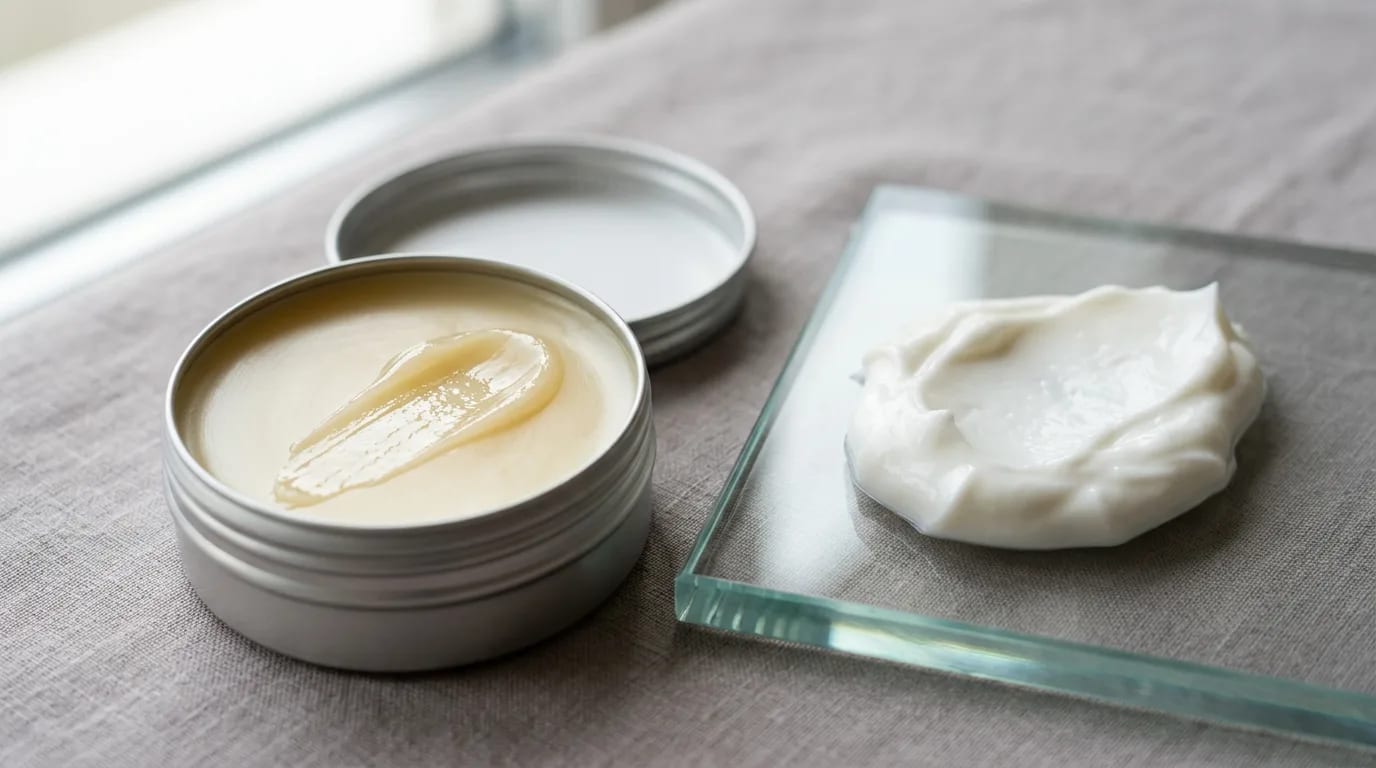
The benefits of face serums come from high active-ingredient concentration (often 5–20% actives), low-viscosity carriers that aid penetration, and minimal filler content compared to creams. Serums deliver niacinamide, peptides, vitamin C, or hyaluronic acid closer to the skin barrier, targeting specific concerns like dullness, fine lines, or dehydration faster than a moisturiser alone, typically within 4–12 weeks of consistent use.
- Niacinamide is commonly formulated at 2–5% in serums, the range studied for reducing hyperpigmentation and improving barrier function (PMC, 2015)
- Hyaluronic acid solutions can hold water at levels equal to roughly 1000 times their own molecular weight, which is why even 0.5–1% in a serum changes skin surface hydration measurably (PMC, 2017)
- L-ascorbic acid (vitamin C) is stable and active mainly at pH 3.5 or below, a formulation detail most jars never disclose (PMC, 2017)
- Serum textures generally run under 500 cPs viscosity, versus creams often above 20,000 cPs, changing how fast actives reach the stratum corneum
- UK cosmetic products are regulated under the retained EU Regulation 1223/2009, which governs permitted actives, concentration caps, and labelling (legislation.gov.uk)
Here's an uncomfortable truth I tell every student who walks into formulation class convinced serums are just "thin creams": most of what makes a serum work has nothing to do with the hero ingredient printed in bold on the front label. It's the vehicle, the pH, the preservation system, and the concentration math happening quietly behind INCI line four or five. Get those wrong, and your 10% niacinamide serum behaves like flavoured water.
What Actually Separates a Serum From a Cream
A serum is not a category defined by law — UK Cosmetics Regulation 1223/2009 doesn't have a legal definition for "serum" the way it does for, say, a UV filter. It's a formulation choice: low oil-phase or oil-free systems, often water- or humectant-based, sometimes stabilised with a light gel network from xanthan gum or a carbomer at concentrations as low as 0.1–0.3% (product, as supplied). That thin, fast-absorbing texture isn't accidental — it's engineered so actives reach the skin surface with minimal occlusive drag from emollients and waxes sitting on top.
Why Concentration Matters More Than Marketing Copy
The biggest genuine advantage among the benefits of face serums is that formulators can push active concentrations higher than a cream base would tolerate without destabilising the emulsion. A moisturiser carrying 10% niacinamide alongside shea butter, cetyl alcohol, and three emulsifiers is a much harder balancing act than a lightweight aqueous gel doing the same job. That's why many potent actives — niacinamide, azelaic acid derivatives, peptide complexes — debut in serum format first. For a deeper look at how one of these molecules performs at different pH and concentration ranges, see Niacinamide for Skin: The Molecule That Does It All — Without Irritation.
The Real Science Behind Penetration Claims
"Penetrates deeper" is the most overused phrase in serum marketing, and it deserves scrutiny. The stratum corneum is roughly 10–20 micrometres thick and its primary job is to keep things out, not let them in. What a well-formulated serum actually improves is partition and diffusion rate — how readily a molecule leaves the vehicle and enters the upper skin layers — governed by molecular weight, log P (lipophilicity), and vehicle pH.
Peptides Need the Right Delivery System
Peptides are a textbook case. Most signal peptides used in anti-ageing serums have molecular weights well above 500 Da, which classically limits passive diffusion through intact skin. Formulators compensate with penetration enhancers, encapsulation, or simply accept that the peptide's job is surface signalling rather than deep dermal delivery. If you want the mechanism explained properly, How Peptides Work: Collagen, Cell Signaling, and Anti-Aging Effects breaks down what these molecules can and can't realistically do once they're on skin.
pH Is the Silent Deciding Factor
Vitamin C serums fail more often from pH mistakes than from dosage mistakes. L-ascorbic acid needs an acidic environment, generally cited around pH 3.5, to stay in its active, unionised form capable of crossing the skin barrier efficiently (PMC, 2017). A serum sitting at pH 5 with 15% vitamin C on the label may still be technically accurate — but a large fraction of that vitamin C could be sitting in a less bioavailable ionised state. This is exactly the kind of detail buried under the marketing gloss, and exactly why reading an INCI list critically matters more than reading the front-of-pack claim.
Comparing Common Serum Actives
Not every active behaves the same way, and lumping them together is where most consumer confusion (and disappointment) starts. Here's a working comparison I use in class:
| Active | Typical serum concentration | Optimal pH range | Primary mechanism |
|---|---|---|---|
| Niacinamide | 2–5% (active substance) | 5–7 | Barrier support, reduces hyperpigmentation via melanosome transfer inhibition (PMC, 2015) |
| L-ascorbic acid | 10–20% (active substance) | ≤3.5 | Antioxidant, cofactor for collagen synthesis |
| Hyaluronic acid (low MW blend) | 0.5–2% (raw material, as supplied) | 4–7 | Humectant, surface and mid-layer hydration (PMC, 2017) |
| Signal peptides | 2–8% of peptide raw material (active fraction usually far lower) | 4–6 | Cell signalling for collagen/elastin production |
Notice the percentage column carefully — a raw material listed at "8%" in a formula is almost never 8% pure peptide. It's 8% of a supplier's carrier solution where the active peptide fraction might be 2–10% of that. This distinction is exactly why two serums can list the same INCI order and perform completely differently. For more on how these active fractions are calculated in real formulations, Peptides and Anti-Aging Skincare: The Complete Guide for Cosmetologists walks through the maths.
Where the Benefits of Face Serums Actually Show Up on Skin
Set expectations by mechanism, not marketing timeline:
- Hydration response: humectant-led serums (hyaluronic acid, glycerin, betaine) show measurable improvement in skin surface hydration within hours, based on corneometry studies (PMC, 2017).
- Tone and texture: niacinamide-based serums generally need 4–8 weeks of consistent twice-daily use before visible changes in hyperpigmentation or pore appearance (PMC, 2015).
- Fine lines and firmness: peptide serums are typically evaluated over 8–12 week clinical windows because collagen remodelling is a slow biological process, not a topical event.
- Antioxidant defence: vitamin C serums work cumulatively, protecting against daily UV and pollution-driven oxidative stress rather than reversing existing damage overnight.
Why Layering Order Changes Everything
A serum applied over a heavy occlusive cream simply sits on top — it can't diffuse through a wax and silicone barrier already on the skin. The correct order is thinnest-to-thickest: cleanse, serum (lowest viscosity, often lowest pH first if using vitamin C), then moisturiser to seal. Applying a niacinamide serum after a rich butter-based cream is a common mistake I see even in advanced students' routines, and it wastes a genuinely well-formulated product.
Reading a Serum Label Like a Chemist
- Check INCI order — actives listed after preservatives and thickeners are present at lower concentrations, generally under 1%.
- Look for pH-sensitive actives (vitamin C, AHAs) and ask whether the brand discloses pH — most in the UK market don't, which is a formulation transparency gap worth noting.
- Understand that "serum" isn't a regulated term under UK Cosmetics Regulation 1223/2009 (legislation.gov.uk) — the safety assessment and permitted ingredient list apply regardless of texture claims.
- Cross-check any novel active or colourant against the EU CosIng database and IFRA standards if fragrance is present, since allowed concentrations and restrictions are listed there, not on marketing pages.
If a serum genuinely differs from a cream, it's rarely the ingredient — it's the formulation decisions that let that ingredient stay stable, bioavailable, and at a meaningful dose. That's the whole craft. If you're curious how these same principles apply to a full moisturiser build rather than a lightweight serum, Anti-aging cream: a formula that actually works is a useful companion read, and Niacinamide in Cosmetics: What the Label Hides and How to Read the Ingredient List goes deeper into label literacy for this specific active.
FAQ
What are the main benefits of face serums compared to moisturisers?
Serums typically carry higher concentrations of active ingredients (often 2–20% depending on the molecule) in a lighter, fast-absorbing base with fewer occlusive agents. This lets targeted actives like niacinamide or vitamin C reach the skin surface with less interference from waxes and emollients, making serums better suited to addressing specific concerns rather than general barrier maintenance.
Do face serums actually penetrate deeper than creams?
Not necessarily deeper — mostly faster and more efficiently at the surface and upper epidermis. Penetration depends on molecular weight, pH, and the vehicle's ability to release the active, not on the word "serum" itself. Large molecules like many peptides act mainly as surface signallers rather than penetrating the dermis.
How long does it take to see results from a face serum?
It depends on the active: hydration effects from humectants like hyaluronic acid can appear within hours, while niacinamide's effect on tone typically needs 4–8 weeks and peptide-driven firmness changes are usually assessed over 8–12 weeks due to the pace of collagen remodelling.
Can I use more than one face serum at once?
Yes, if pH compatibility is considered — for example, layering a low-pH vitamin C serum directly under a niacinamide serum can reduce both actives' effectiveness. Spacing them by time of day (vitamin C in the morning, niacinamide at night) is a more reliable approach.