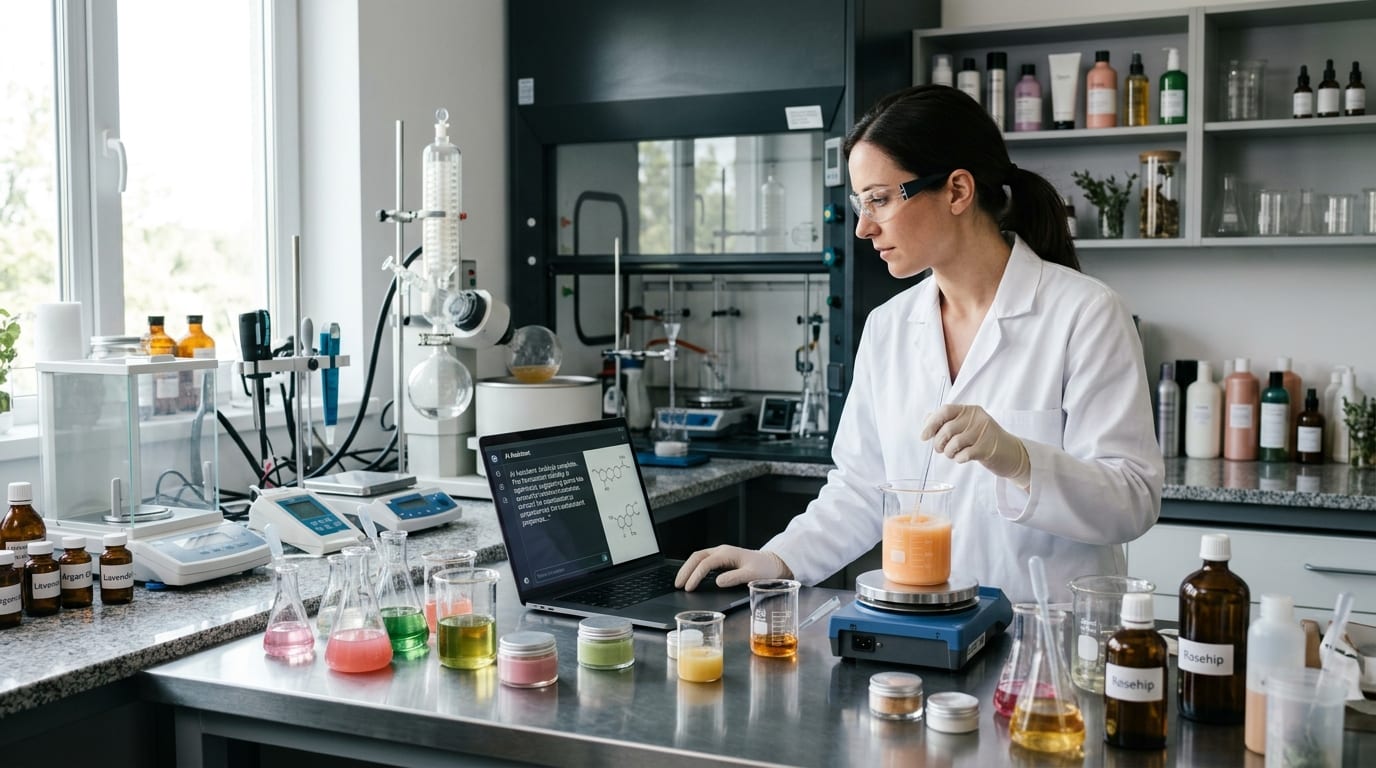
When a customer picks up a bottle labelled "organic," they expect something clean, safe, and close to nature. But for a formulator, this word represents an entire system of standards, restrictions, and technological solutions that cannot be ignored. Organic cosmetics — what are they from the perspective of chemistry and regulation, how do they differ from simply "natural" products, and why is creating such products more difficult than it seems? The "Walker Formulation Academy" online school will tell you about this in detail. If you are a formulator who wants to work in this segment consciously, rather than just sticking on green labels, this article is for you.
Organic cosmetics: what it means in terms of standards
The main problem in the organic cosmetics market is the lack of a single, legally binding definition. Unlike food products, where the word "organic" is regulated by law in many countries, in cosmetics, this term remains voluntary. This is precisely why independent certification bodies have emerged, each with its own criteria.
The most common standards that a formulator encounters are:
- COSMOS Organic / COSMOS Natural — a European standard developed by a consortium of ECOCERT, BDIH, Cosmebio, Soil Association, and ICEA. It is one of the strictest and most recognized in the world.
- ECOCERT — a French certification that forms the basis of COSMOS; it is often mentioned as a synonym, although technically it is a certification body, not a standard.
- NATRUE — a German standard with a three-level system: natural cosmetics, natural cosmetics with organic ingredients, and organic cosmetics.
- NSF/ANSI 305 — an American standard for products containing organic ingredients.
- Soil Association Organic — a British standard, one of the oldest.
The key point: none of these standards require 100% of the composition to be organic. COSMOS Organic, for example, stipulates that at least 95% of plant-based ingredients must be certified as organic, and the total share of organic components in the finished product must be at least 20% (at least 10% for rinse-off products). Water, minerals, and synthetically permitted ingredients are not included in the calculation of the organic share.

What is prohibited in an organic formula
Restrictions are what make formulating organic cosmetics a truly difficult task. The standards prohibit a wide list of ingredients that are common in conventional cosmetics:
- Synthetic fragrances and most isolated synthetic aromatic molecules
- Silicones (dimethicone, cyclopentasiloxane, and their derivatives)
- Parabens and most synthetic preservatives
- PEG derivatives (polyethylene glycols)
- Synthetic colorants
- Petroleum derivatives (petrolatum, mineral oil, ceresin)
- Genetically modified ingredients (GMOs)
- Ingredients tested on animals
This list immediately changes the approach to emulsification, preservation, and texturizing. This is exactly where the real work of a formulator begins.
Natural and organic cosmetics: what is the fundamental difference
These two concepts are often confused, but for a professional formulator, there is a significant difference between them. Natural cosmetics is a broader category: it implies the use of ingredients of natural origin, but not necessarily grown according to organic farming standards. Organic cosmetics — what is it, to be more precise — is a subcategory of natural, where raw materials have undergone organic production certification: without synthetic pesticides, herbicides, fertilizers, and GMOs.
A vegetable oil can be natural but not organic if it is obtained from a crop grown using agrochemicals. Conversely, an organically certified oil is automatically considered natural. For a formulator, this means the need to work with suppliers who provide certificates for each batch of raw materials.
Natural origin vs. naturalness: a nuance that beginners miss
COSMOS introduces the concept of "natural origin" — these are ingredients obtained from natural raw materials through permitted chemical transformations. For example, the emulsifier Olivem 1000 (cetearyl olivate / sorbitan olivate) is obtained from olive oil, but through a chemical reaction — nevertheless, it is permitted by COSMOS because the transformation is on the list of allowed processes. Ethoxylation (obtaining PEG derivatives), however, is not.
The list of permitted chemical processes according to COSMOS includes hydrogenation, esterification, hydrolysis, fermentation, and a number of other reactions. Understanding this logic allows a formulator to competently choose emulsifiers, thickeners, and actives without violating the standard. By the way, the role of thickeners and gelling agents in formulations is described in detail in our article Tribology, gums, and gelling agents — it also analyzes how they affect the tactile properties of a product.

Key ingredients of organic formulations: what to use instead of the usual
The transition to an organic formulation is not just about replacing one ingredient with another. It is a restructuring of the formulation logic. Let's look at the key functional groups.
Emulsifiers
The main pain point of organic emulsions is the limited choice of emulsifiers. Instead of the usual PEG derivatives, the following are used:
- Olivem 1000 (Cetearyl Olivate, Sorbitan Olivate) — a mild olive oil-based emulsifier that creates a creamy texture
- Sucragel — based on sucrose esters and vegetable oils
- Montanov 68 (Cetearyl Glucoside, Cetearyl Alcohol) — a glucoside emulsifier
- Emulsan / plant-based emulsifying wax
- Lecithin (sunflower or soy) — for liquid emulsions
Each of these requires an understanding of HLB, temperature regimes, and compatibility with active ingredients. Organic emulsions are often less stable than conventional ones — and this is a direct consequence of the limited toolkit.
Preservatives
Preservation is one of the most difficult tasks in organic formulation. Parabens, phenoxyethanol in high concentrations, and DMDM hydantoin are all off the table. Permitted alternatives include:
- Levulinic acid + glycol (e.g., pentylene glycol) — broad-spectrum activity
- Benzyl alcohol + dehydroacetic acid — permitted by COSMOS in limited concentrations
- Grapefruit seed extract — controversial efficacy, requires independent testing
- Natural antioxidants (tocopherol, rosemary extract) — protect against oxidation, but not against microbial contamination
Important: any organic formula must pass a challenge test (microbiological stability test) regardless of how "natural" the preservatives seem. Read more about stability testing in our article on pH in cosmetics: a basic guide for formulators — pH directly affects the efficacy of preservatives.
Oils, butters, and actives
This is the area where organic formulation wins over conventional: the choice of vegetable oils and butters is vast, and with proper selection, they provide excellent care. How to choose suitable oils for a specific skin type is described in detail in the article How to choose oils and butters for your skin type: a guide for beginner formulators. And if you are working with cocoa or shea butter, be sure to study butter polymorphism — without this knowledge, the product texture can present unpleasant surprises.

Typical mistakes when formulating organic cosmetics
The experience of Walker Formulation Academy shows that beginner formulators working in the organic segment regularly make the same mistakes.
Mistake 1: "Natural" does not mean "standard-approved"
Many ingredients of natural origin do not pass COSMOS or NATRUE certification — either due to the extraction method or the supplier's lack of organically certified raw materials. For example, some essential oils derived from crops grown with agrochemicals are formally "natural" but not organic. Always request a COSMOS certificate for a specific ingredient from your supplier.
Mistake 2: Ignoring stability
Organic emulsions based on plant-derived emulsifiers are sensitive to pH, storage temperature, and the ionic strength of the solution. A formulator who does not conduct accelerated stability tests (40°C/75% humidity for 8 weeks, freeze-thaw cycles) risks having the product separate while still on the customer's shelf. Anhydrous formats are simpler in this regard — read about them in our guide Anhydrous Products: A Complete Guide for Beginners.
Mistake 3: Marketing claims without certification
Writing "organic" on a label without undergoing certification is not just a marketing liberty, but also a legal risk in a number of jurisdictions. In Europe, regulators are increasingly cracking down on greenwashing. If you are not ready for full certification, it is more honest to use phrases like "contains organically certified ingredients" and specify their percentage.
Practical start: how to build an organic formula from scratch
Formulating an organic cream differs from a standard one primarily at the ingredient selection stage. Here is a working algorithm:
- Define your target standard. COSMOS, NATRUE, or another — this sets the list of permitted ingredients and suppliers.
- Compile a list of permitted ingredients. Most certification bodies publish databases of approved raw materials.
- Choose an emulsifier. Test several options for stability at different pH levels and temperatures.
- Select a preservative system. Do not rely on a single preservative — combinations work better.
- Conduct a challenge test and stability tests before launching the product.
- Collect documentation for every ingredient (certificates, CoA, COSMOS status).
- Submit an application for certification through an accredited body.
The journey from the first prototype to a certified product takes from 3 to 12 months, depending on the complexity of the formula and the chosen standard. This is normal — and it is an investment in customer trust. If you are just starting this journey, take a look at how to become a cosmetic chemist and build a professional formula — it describes the logic of developing from curiosity to systematic work with formulas.

Frequently Asked Questions
Is it possible to certify organic cosmetics independently in Russia?
There is no direct equivalent to COSMOS currently established in Russian legislation. However, Russian manufacturers can obtain international ECOCERT or COSMOS certification through accredited bodies—some of which operate remotely. For the domestic market, a number of manufacturers use voluntary GOST R certification or their own declarations; however, these are not equivalent to international standards and do not grant the right to use COSMOS or ECOCERT logos.
Organic cosmetics — what does it offer the skin compared to conventional products?
From a dermatological perspective, no direct link between organic status and clinical efficacy has been established. Organic certification guarantees the origin and production method of the raw materials, not the biological activity of the final product. However, the absence of PEG derivatives, synthetic fragrances, and certain preservatives may reduce the risk of irritation for people with sensitive skin. The actual effect is determined by the concentration and quality of the active ingredients in a specific cream formula.
Can essential oils be used in organic cosmetics?
Yes, provided they are certified as organic. The COSMOS standard permits essential oils as aromatic components of natural origin, but their use is limited by IFRA (International Fragrance Association) safety standards regarding specific allergens. Synthetic aromatic molecules, even those identical to natural ones, are generally not permitted.
Organic cosmetics — what is it, ultimately? It is not just a marketing label, nor is it a synonym for "safety." It is a system of production, traceability, and restrictions that requires the formulator to have a deeper understanding of ingredient chemistry than when working with conventional compositions. This is precisely why mastering this segment is more difficult—and why specialists who know how to work competently with organic formulations are in high demand in the market.
If you want to build your cream formulas consciously—from choosing an emulsifier to passing certification—come study at the Walker Formulation Academy Club. Learn more about our programmes on the school's homepage—it features courses for various skill levels, from your first creams to professional formulation under organic certification standards.