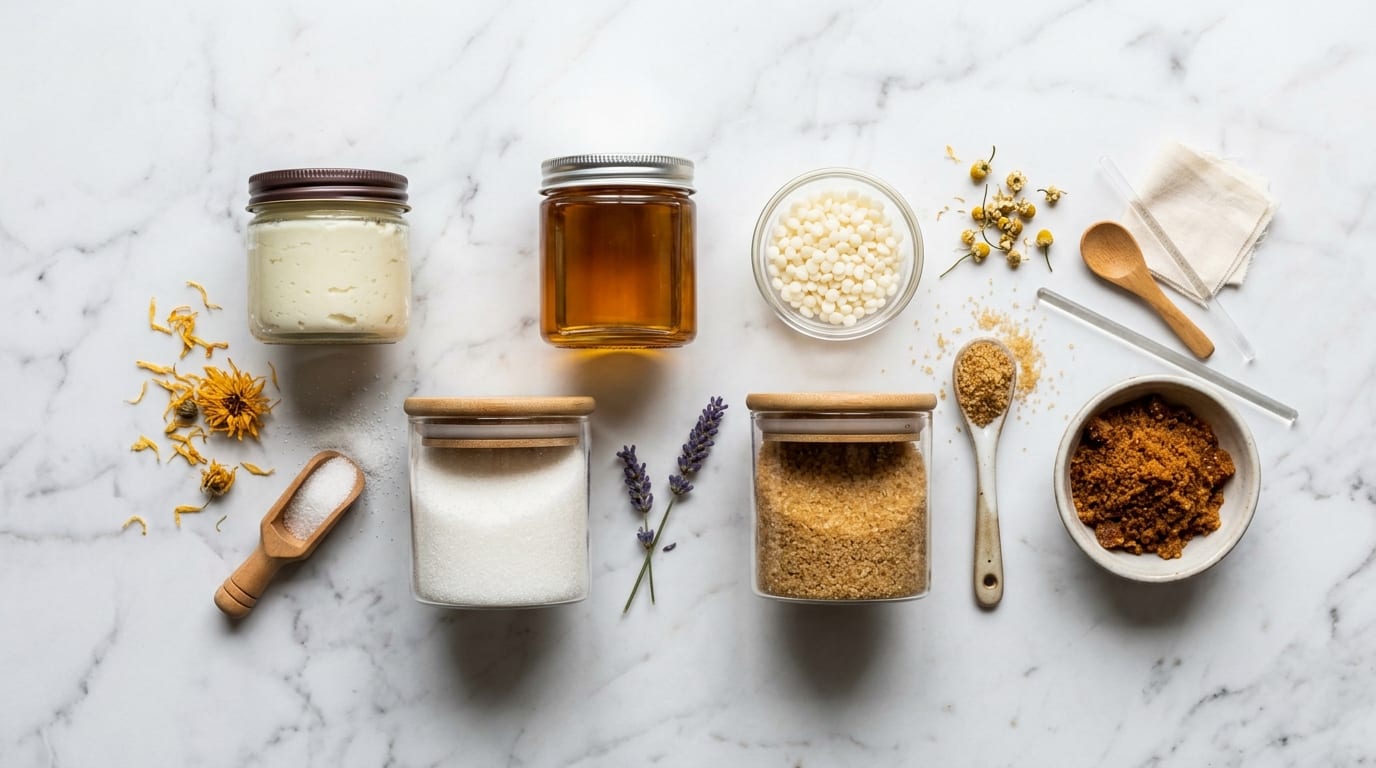
DIY Body Scrub: What Cosmetic Chemistry Thinks of Your Kitchen Recipes
At the Walker Formulation Academy school, we are convinced that understanding the chemistry behind every ingredient is what distinguishes a conscious formulator from someone who simply follows other people's recipes.
Every week, thousands of people Google how to make a body scrub at home and get roughly the same answer: mix sugar with oil, add an essential oil — and you're done. Technically, it works. But if you have ever noticed that after such a scrub your skin either dries out, turns red, or feels like you haven't so much exfoliated it as offended it — that is no accident. It is chemistry that no one explained.
Let's be honest: a homemade scrub is not just "mix and apply." It is a small formula with a physical and chemical mechanism of action, with rheology, with ingredient interaction, and, most importantly, with your specific skin type. And this is exactly where most internet recipes fall silent.
An abrasive is not just "something hard"

Physical exfoliation works through the mechanics of friction: abrasive particles remove corneocytes — dead cells of the stratum corneum — mechanically. But here is what is important: not all abrasives are the same, and their choice directly affects what happens to the skin barrier after the procedure.
Particle size, shape, and hardness
Three parameters determine how aggressive an abrasive is:
- Particle size. Fine granulated sugar (~300–500 µm) works more gently than coarse sea salt (~1000–2000 µm). Coffee grounds occupy an intermediate position (~400–700 µm depending on the grind).
- Particle shape. Salt and sugar crystals have sharp edges — if applied aggressively, they can create micro-injuries. Coffee grounds and ground nuts are more rounded and less traumatic.
- Solubility. Sugar and salt dissolve in water and on the skin — this means that the abrasiveness decreases during application. This is a plus for sensitive skin, but a minus for those who want an intense effect.
Walnut shells and apricot pits are a separate story. Under a microscope, their shape resembles shards of glass, which is why they have long been questioned in professional cosmetology: irregular sharp edges create micro-tears that are invisible to the naked eye but provoke inflammation. This is not a horror story — it is simply surface physics.
What happens to the barrier after a scrub
The stratum corneum is not just "dead cells." It is a structured matrix of corneocytes and intercellular lipids (ceramides, cholesterol, and free fatty acids in a ratio of approximately 1:1:1) that retains water and protects against pathogens. Mechanical exfoliation partially disrupts this structure — and that is exactly why it is so important to apply something after a scrub that will help the barrier recover.
If you are formulating anhydrous products or oil bases for scrubs, this is especially relevant: the oil in a scrub formula doesn't just "soften," it creates an occlusive layer that temporarily reduces transepidermal water loss (TEWL) after mechanical exfoliation.
The chemistry of sugar, salt, and honey: what these ingredients actually do

A popular DIY honey body scrub is not just a nice combination. Honey performs several functions here simultaneously, and none of them are accidental.
Honey as a functional ingredient
Natural honey is a complex mixture: ~80% sugar (mainly fructose and glucose), ~17–18% water, plus enzymes (glucose oxidase, catalase), organic acids, flavonoids, and trace elements. What does this provide in a scrub?
- Humectancy. Fructose and glucose are hygroscopic compounds; they attract water from the air to the skin's surface. This is the same principle as glycerin, just less concentrated.
- Mild acidity. The pH of honey is about 3.9–4.5, which is close to the natural skin pH (4.5–5.5). This helps maintain the acid mantle that we work so hard to protect.
- Antimicrobial effect. The hydrogen peroxide released by glucose oxidase and the high osmotic activity create an environment unfavorable for bacteria. This explains the historically high stability of honey without preservatives.
- Texturizing properties. Honey increases the viscosity of the mixture and helps keep abrasive particles in suspension.
If you are interested in how food ingredients work in cosmetics at a chemical level, there are many overlaps with what we are discussing here.
Sugar vs. salt: when to choose which
Sugar (sucrose) is gentler, dissolves faster, and is less irritating. It is suitable for the face (if you are making a facial scrub) and for sensitive body skin. Sea salt is a more intense abrasive and contains minerals (magnesium, potassium, calcium), but it causes stinging when applied to damaged or irritated skin. The classic rule: salt for feet and rough areas, sugar for everything else.
An important nuance: both sugar and salt create a hyperosmotic environment in an aqueous medium, which can theoretically draw water out of the upper layers of the skin. This is precisely why oil in the formula is not an option, but a necessity: it creates a barrier and compensates for this effect.
The oil phase: it doesn't just "soften"

Most DIY scrubs are built on an "abrasive + oil" scheme. But choosing an oil is a science in itself, and this is where real cosmetic chemistry begins.
Fatty acid profile and comedogenicity
Oils differ in their fatty acid composition, and this determines how they behave on the skin:
- Coconut Oil (Cocos Nucifera Oil) — high lauric acid content (C12, ~48%), creates a dense occlusive layer. Comedogenicity — 4/5. Excellent for dry body skin, but not for oily skin.
- Sunflower Oil (Helianthus Annuus Seed Oil) — rich in linoleic acid (C18:2, ~65%), absorbs easily, comedogenicity — 0/5. A versatile choice.
- Jojoba Oil (Simmondsia Chinensis Seed Oil) — technically a liquid wax, mimics skin sebum, non-comedogenic. Good for stabilizing the mixture.
- Almond Oil (Prunus Amygdalus Dulcis Oil) — rich in oleic acid (C18:1, ~70%), nourishing, comedogenicity — 2/5.
If you want to understand how to systematically choose an oil for your skin type, this is a separate, extensive topic that we covered in our guide to oils and butters.
Stability of the oil base
Here lies a problem that culinary blogs keep quiet about: oils oxidize. Oils with a high content of polyunsaturated fatty acids (PUFAs) oxidize especially quickly: flaxseed, hemp, and rosehip oils. Upon contact with air, light, and heat, they go rancid — and applying rancid oil to the skin means applying oxidation products that provoke inflammation.
Practical solution: add tocopherol (Vitamin E, Tocopherol) to the oil base at a concentration of 0.1–0.5% — this is an antioxidant that slows down oxidation. The scrub should be stored in a dark container in a cool place and used within 2–4 weeks.
By the way, regarding the stability of formulas — if you are interested in how to test homemade products for stability, we have a separate article specifically on this.
pH and the skin barrier: what all homemade recipes forget
Skin has a slightly acidic pH — on average 4.5–5.5. This is not just a number: the acid mantle is an active protective environment where desquamation enzymes (kallikreins) work, commensal bacteria live, and barrier integrity is maintained.
Most homemade scrubs have a neutral or slightly alkaline pH — especially if they contain baking soda (a popular ingredient in DIY recipes). Soda has a pH of about 8.3 — this means that after application, it temporarily alkalizes the skin surface, disrupts enzyme function, and creates conditions for the growth of pathogenic flora.
Honey, in this sense, is one of the few "kitchen" ingredients that works in the correct pH range. Read more about why pH is so important in any cosmetic formulation in our guide: pH in cosmetics: a basic guide for formulators.
Preservation and microbiology of a homemade scrub
This is a topic that almost all DIY blogs avoid. If your scrub contains water — and it appears as soon as you apply the product with wet hands or add a water-based ingredient — you have an environment for microorganisms to grow.
Anhydrous scrubs: a relatively safe zone
A classic "abrasive + oil" scrub without water is an anhydrous system. Bacteria do not multiply without water, so such a product is relatively stable without preservatives. But "relatively" is the key word: as soon as you reach into the jar with wet hands, you introduce water and contamination. The solution is a spoon or a spatula.
Read more about how anhydrous systems work and why they require a special approach: Anhydrous products: A complete guide for beginners.
Scrubs with a water phase: you need a preservative
If you add aloe vera gel, hydrosol, milk, or any other water-based component to a scrub, you need a preservative. Without one, the product may look fine but can contain a dangerous microbial load in as little as 3–5 days at room temperature. The topic of preservation is complex and multifaceted — we covered it in relation to clay masks: Preserving clay masks.
Basic formulation: how a cosmetic chemist thinks
When a professional chemist develops a DIY body scrub, they don't think in terms of recipes, but in terms of functions. Each ingredient plays a specific role in the formula:
- Abrasive (50–70%) — the main working fraction. Sugar, salt, coffee grounds. The size and shape of the particles determine the intensity.
- Carrier oil (25–40%) — creates slip during application, reduces friction, and nourishes the skin afterward. Choose based on skin type.
- Functional additives (up to 10%) — oil-soluble actives, essential oils (0.5–2%, no more), tocopherol (antioxidant, 0.1–0.5%), extracts.
- Texturizing components (optional) — waxes (beeswax, carnauba) to stabilize the suspension if you want a thicker texture.
An example of a basic anhydrous formula (% of total mass):
- Sucrose (fine sugar) — 59%
- Helianthus Annuus Seed Oil — 30%
- Cocos Nucifera Oil — 10%
- Tocopherol — 0.3%
- Parfum / essential oil — 0.7%
This is not an "internet recipe" — it is a functional formula with a justification for every component. This is exactly how a cosmetic chemist thinks: not "what should I add," but "why is this here and at what concentration."
Answers to frequently asked questions
Can I make a body scrub with essential oils, and at what concentration?
Yes, but with limitations. Essential oils in body scrubs are used at a concentration of 0.5–2% of the total mass. It is important to consider phototoxicity: citrus essential oils (bergamot, lime, grapefruit) contain furocoumarins, which can cause pigmentation and burns when exposed to sunlight on the skin. If you are making a scrub with citrus, use only "bergapten-free" versions or apply the scrub in the evening. Peppermint at a concentration above 1% can irritate sensitive skin. Lavender, geranium, and ylang-ylang are safer choices for beginners.
Why does skin sometimes get red and dry after a DIY scrub?
There are usually three reasons for this. The first is an abrasive that is too large or sharp (sea salt with sharp edges, nut shells), which creates micro-tears. The second is overly intense mechanical action: you don't need to "scrub" hard; light circular motions are sufficient. The third is not enough oil in the formula or rinsing it off with hot water immediately after application: the barrier remains unprotected. After a scrub, it is recommended to apply oil or a cream to damp skin — this helps to "seal in" moisture.
How long does a DIY scrub last, and does it need to be stored in the refrigerator?
An anhydrous scrub (abrasive + oil + honey only) will last for 3–4 weeks at room temperature and up to 2 months in the refrigerator if stored correctly. Its main enemies are moisture, light, and heat. Use dark glass containers and always scoop the product out with a clean, dry spoon, not your hands. If the formula contains water-based ingredients without a preservative, use it within 5–7 days and store it only in the refrigerator. The appearance of an off-odor, a change in color, or separation is a sign to discard the product.
Conclusion: From a kitchen recipe to a conscious formula
A homemade scrub is an accessible and effective skincare tool. But the difference between a scrub that works and one that irritates is an understanding of chemistry: choosing an abrasive based on particle size and shape, selecting an oil for your skin type, controlling pH, protecting against oxidation, and proper storage. Each of these parameters can be learned—and this is exactly what turns DIY cosmetics from a lottery into a conscious practice.
If you want to learn how to formulate in this way—with an understanding of the mechanisms, rather than just following someone else's recipes—take a look at the Walker Formulation Academy Club. There, we analyse formulations from the basics to advanced techniques.
And you can start diving into the topic right now with our editorial article: Body scrub at home: what cosmetic chemistry thinks about your kitchen recipe.