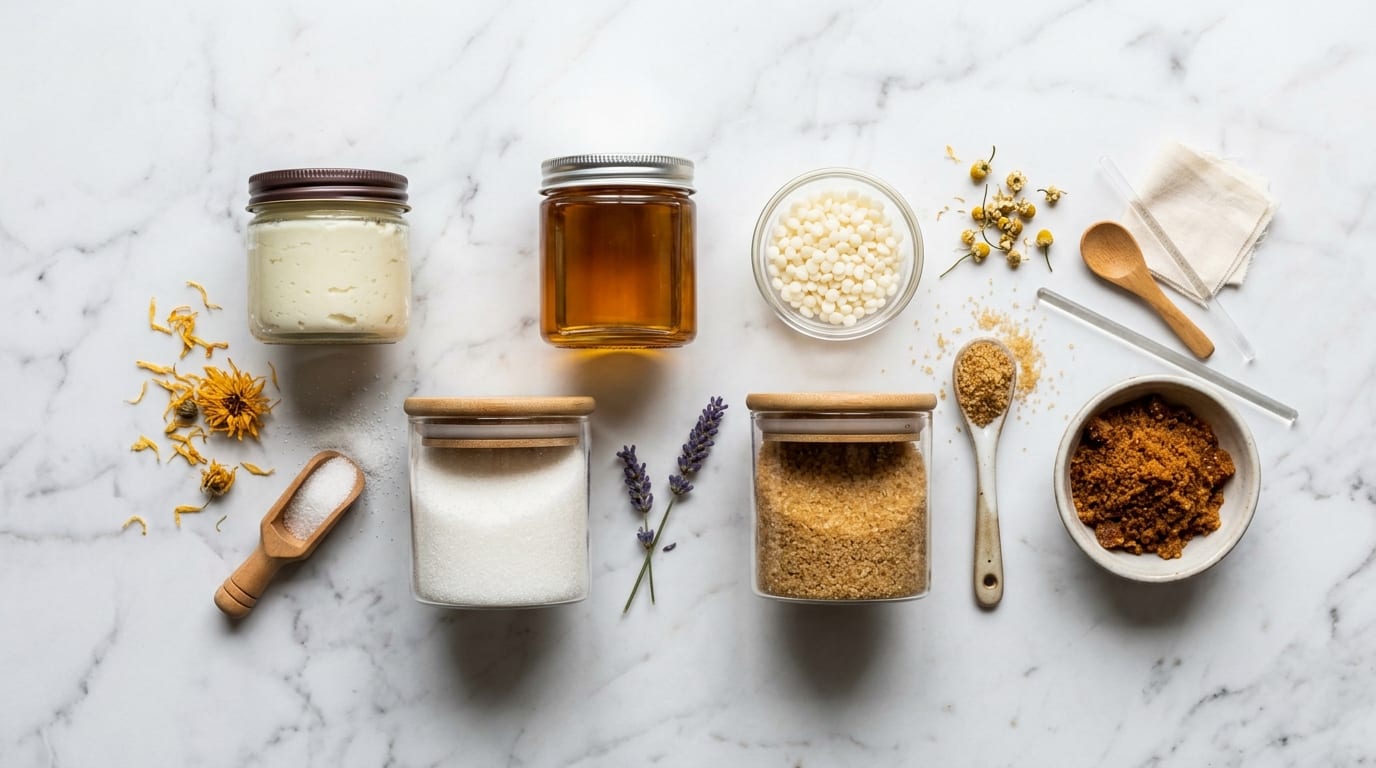
Creating a homemade lip balm from scratch is a task that seems simple: melt the wax, add the oils, pour into tubes. But it is precisely this apparent simplicity that hides several serious risks that are rarely mentioned in recipe articles. Oils oxidize. Essential oils, which are harmless on the skin, become toxic when regularly ingested via the mucous membrane. Improper storage turns a neat balm into a breeding ground for mold. In this article, we break down the exact part of working with anhydrous lip products that is usually left behind the scenes: diagnosing spoilage, ingredient safety, and realistic shelf life without preservatives.
Oil oxidation: how to tell if your balm has already gone bad
Anhydrous products do not spoil in the same way as emulsions—without water, bacteria cannot multiply. But that does not mean they last forever. The main enemy of lip balm is the oxidative degradation of fatty acids, which happens slowly, imperceptibly, and irreversibly.

Which oils oxidize the fastest
The rate of oil oxidation is directly related to its fatty acid profile. The more polyunsaturated fatty acids (PUFAs) in the composition, the shorter the product's lifespan. This is why choosing oils for a balm is not just a matter of texture and nourishment, but also a matter of formula stability.
- High risk of oxidation (shelf life up to 6 months): rosehip oil, flaxseed oil, hemp oil, evening primrose oil — rich in linoleic and linolenic acids.
- Medium risk (6–12 months): sweet almond, apricot kernel, sunflower — oleic acid predominates with a mixture of linoleic acid.
- Low risk (12–24 months): castor oil, coconut oil, jojoba oil (technically a liquid wax) — saturated or monomolecular structures.
If you want to delve deeper into how climate and growing conditions affect the fatty acid composition of vegetable oils, we recommend the article How climate affects the composition of fatty acids and essential oils in plants — this issue is analyzed there from a scientific point of view.
Sensory signs of rancidity
You can identify oxidation without laboratory equipment — an organoleptic assessment is sufficient. Rancid oil produces a characteristic odor: it is described as "waxy," "cardboard-like," "similar to old varnish," or "metallic." The taste becomes bitter and astringent. Visually, yellow or brownish spots may appear on the surface, and the texture sometimes becomes uneven — grainy or sticky where it was previously smooth.
Important: a rancid balm is not just unpleasant. Oxidation products — aldehydes, ketones, and free radicals — have an irritating effect on the lip mucosa and can provoke inflammation. You must not use such a product.
Antioxidants as a tool for extending shelf life
To slow down oxidation, oil-soluble antioxidants are added to anhydrous formulas. The most common options are:
- Tocopherol (Vitamin E, T-50): added at 0.1–0.5% of the formula weight. It works as a free radical scavenger. Do not confuse it with tocopheryl acetate — it does not possess antioxidant activity in the oil phase.
- Rosemary Extract (ROE): concentration of 0.02–0.1%. Contains carnosic acid and carnosol; effectively stabilizes oils with a high content of PUFAs.
- Astaxanthin: a powerful carotenoid antioxidant, but it dyes the product orange — it is rarely used.
Read more about the logic of working with anhydrous systems in our article Anhydrous Products: A Complete Guide for Beginners.
Safety for the mucosa: which essential oils are toxic if ingested
Lips are not skin. More precisely, the skin of the lips lacks a normal-thickness stratum corneum, and some of the balm inevitably gets into the mouth. According to dermatologists' estimates, a person swallows about 24 mg of lipstick or balm per day on average. This is not much — but with daily use of a product containing unsuitable essential oils, the cumulative effect becomes significant.

Essential oils that must not be used in a balm
Regulatory bodies — in particular, IFRA and FDA — set restrictions on the use of essential oils in products that come into contact with mucous membranes. For a home manufacturer, the following risk categories serve as a guide:
- Prohibited or strictly limited for lip products:
- Clove oil (eugenol is a strong sensitizer and mucosal irritant; oral LD50 in rats is 1930 mg/kg, but chronic exposure is dangerous).
- Cinnamon oil (cinnamaldehyde is one of the most frequent allergens according to SCCS data).
- Camphor oil — neurotoxic if ingested even in small doses, especially dangerous for children.
- Eucalyptus oil (1,8-cineole) — toxic to children under 2 years old if it comes into contact with mucous membranes, causes respiratory depression.
- Pennyroyal oil (pulegone) — hepatotoxic.
- Used with restrictions (no more than 0.1–0.5% in lip products):
- Peppermint — contains menthol, which is safe in small doses, but at concentrations above 1% it causes mucosal irritation in sensitive individuals.
- Lemon, orange, grapefruit — furocoumarins cause photosensitization, although this is less critical for lips than for skin.
- Relatively safe at recommended concentrations:
- True lavender (up to 1%).
- Blue chamomile oil (up to 0.5%).
- Vanilla (extract, not essential oil — up to 1%).
A special case: lip balms for children
If you are making a homemade lip balm for a child, there is one rule: no essential oils at all. A child's mucous membrane is significantly more permeable, and their metabolism cannot cope with the loads that an adult body tolerates without consequences. For a children's balm, use only food-grade flavorings certified for use in lip cosmetics, or skip fragrance entirely.
Shelf life without preservatives: storage and sterilization rules
Since a lip balm is an anhydrous system, traditional preservatives (phenoxyethanol, parabens, natamycin) are neither necessary nor effective: they are water-soluble and protect the aqueous phase specifically from microbial contamination. But this does not mean that hygiene can be ignored.

Actual shelf life depending on the formula
The shelf life of an anhydrous balm is determined by the most unstable ingredient in the formula. If you added 5% rosehip oil with a peroxide value of 15 meq/kg, your product will start to go rancid in 3–4 months, regardless of the fact that the other components could have lasted for two years.
Estimated shelf life for typical formulas:
- Beeswax base + coconut oil + castor oil + tocopherol: 12–18 months when stored correctly.
- Beeswax base + jojoba oil + sweet almond oil + ROE: 10–14 months.
- Base with the addition of rosehip or hemp oil (more than 5%): 4–6 months — we recommend making small batches.
- Vegan version using carnauba or candelilla wax with coconut and castor oils: 12–18 months, provided all components are stable.
Sterilization of equipment and packaging
Mold in an anhydrous product is rare, but not impossible. It appears when moisture gets into the packaging: from hands, from the air through condensation, or via contaminated equipment. To avoid this:
- Wash all equipment and tools with hot soapy water, then treat with 70% isopropyl alcohol and let them dry completely — residual moisture in the containers is critical.
- Before pouring, warm your tubes and jars with a hairdryer or in an oven at 60°C for 10 minutes — this destroys mold spores.
- Never use damp spatulas or pipettes when working with the finished product.
- If you are making balm in jars (tins), use a spatula or a cotton swab for application — fingers introduce moisture and microflora.
- Store the finished product in a cool, dark place, away from direct sunlight and heat sources.
Diagnosing and fixing defects in finished balm
Even when following all the rules, a DIY lip balm can show defects — whether textural, visual, or functional. The ability to diagnose and, where possible, correct them is a sign of a true cosmetic formulator.

Surface bloom and graininess
A white film or grainy texture on the surface is most often a polymorphic transition of hard fats or waxes. Beeswax is relatively stable, but if the formula contains cocoa butter or other butters with pronounced polymorphism, they can recrystallize during temperature fluctuations. You can read more about this phenomenon in the article Butter polymorphism: why cocoa butter acts up and how to work with it.
Solution: slowly melt the balm in a water bath until it is completely liquid, stir thoroughly, and pour again. To prevent this, cool the product slowly and evenly, and avoid sharp temperature changes during storage.
Cracks and separation
Cracks in the stick appear when the product cools too quickly — especially in a cold room or in cold containers. This is a purely physical defect, not related to spoilage. Separation (visible layers of different density) indicates that components with different melting points were not mixed sufficiently before pouring.
Solution: remelt and pour again, having pre-warmed the containers. Work in a warm room and do not rush the cooling process.
When a defect cannot be fixed
If the balm has gone rancid, remelting will not help. Oxidation products do not disappear when heated, and the rancid smell becomes even more pronounced after melting. The only solution is to discard the batch and analyse which ingredient caused the result: check the peroxide value of your oils before the next use or replace the unstable oil with a more resistant one.
Understanding how oils and butters work in different types of formulas helps you make more informed decisions. If you are just starting to learn about ingredients, take a look at the article How to choose oils and butters for your skin type: a beginner's guide for formulators.
Labelling and documenting home batches
A professional approach to home production is not just about the quality of the formula, but also about the discipline of documentation. Each batch must have a label with the date of manufacture, ingredients, and the calculated shelf life (PAO — Period After Opening, if the product is in a jar). This is especially important if you are making a balm as a gift or for several family members.
Keep a notebook or spreadsheet to record: the production date, the source of each oil (brand, lot), the peroxide value if you tested it, and the date of first use. Such a log will allow you to track which batch developed a defect and why — an invaluable experience for improving future formulas.
If you want to go beyond home experiments and understand how professional cosmetic formulation works, read about how to become a cosmetic chemist: the path from curiosity to professional formulation.
FAQ: questions about the safety of homemade lip balm
Can I use a balm if it has changed its smell slightly, but there is no mold?
A change in smell is the first and main sign of oxidation. Even if the product looks normal visually, a changed smell means that oxidation products of fatty acids — aldehydes, ketones, and peroxides — are already present in the formula. They irritate the lip mucosa and can provoke inflammation with regular contact. It is better to discard such a balm.
How long does a homemade lip balm last if it only contains beeswax and coconut oil?
Such a minimalist formula is one of the most stable. Coconut oil is rich in saturated fatty acids (lauric acid — about 48%), which makes it resistant to oxidation. Beeswax also has natural antioxidant properties. When stored in a cool, dark place and with hygienic application, such a balm will maintain its quality for 12–18 months. Adding 0.3% tocopherol will extend the shelf life by another 3–6 months.
Do I need to add a preservative to lip balm?
Classic water-soluble preservatives do not work in an anhydrous formula and are not needed — bacteria do not multiply without water. However, if you add water-containing components to the balm (for example, hydrolats, aloe vera gel, or water-based extracts), the formula is no longer anhydrous and requires a full preservation system. In that case, we recommend studying the principles of working with pH and preservatives in our article pH in cosmetics: a basic guide for formulators.
The safety of homemade cosmetics is not paranoia, but professional responsibility. Understanding the mechanisms of spoilage, making informed ingredient choices, and maintaining storage discipline turn a hobby into a conscious practice. If you want to systematically master the formulation of safe and effective products — from balms to complex emulsions — we invite you to join the Walker Formulation Academy Club courses. Learn more in our courses and start formulating with confidence.