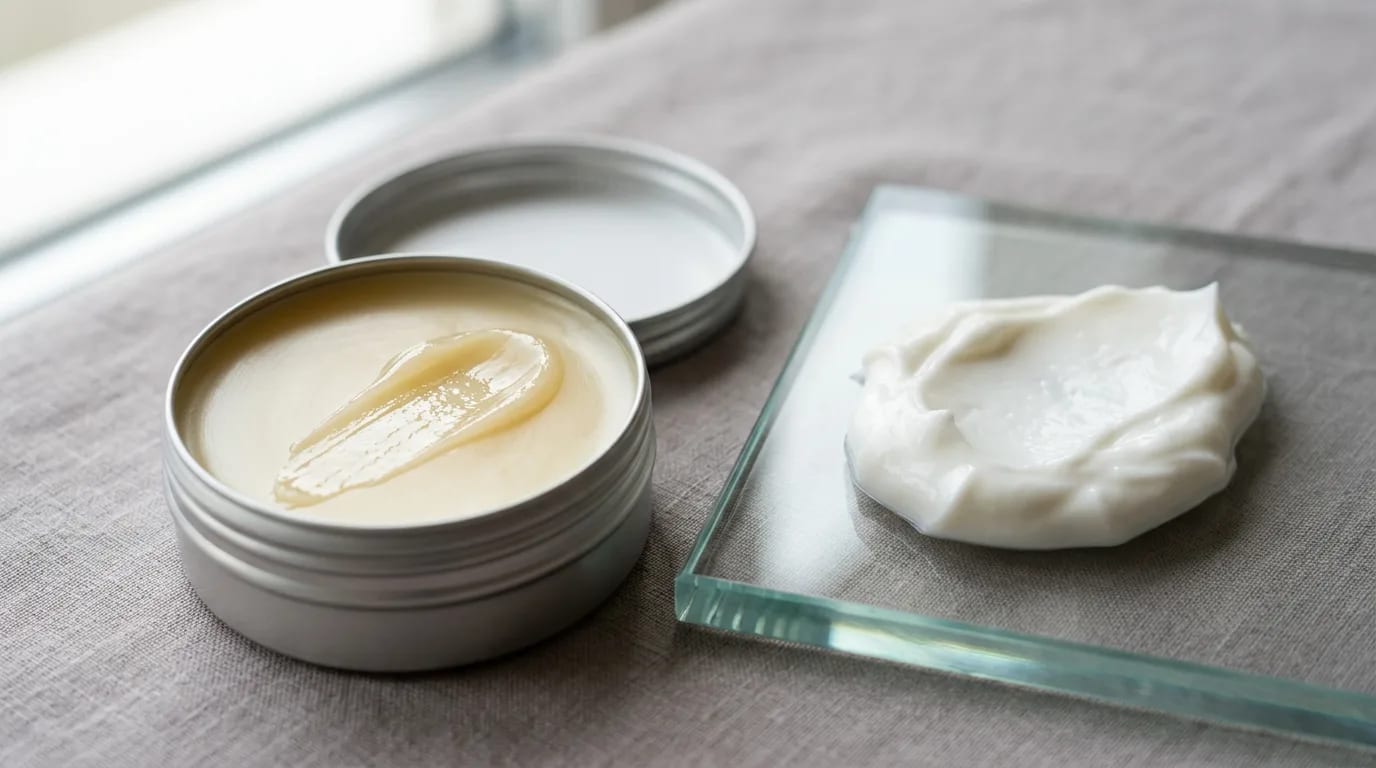
Imagine: you are holding a cream that melts perfectly into the skin, leaves a silky feeling, and doesn't pill under foundation. Who created it? The answer isn't as obvious as it seems. Behind every successful cream formula stands not just one person, but an entire chain of specialists — and confusing them is much like confusing an architect with a builder. Both are needed, both are important, but they do fundamentally different things.
Two worlds in one laboratory
The beauty industry is a 430 billion dollar global market, and behind every product on the shelf stands at least one of two specialists: a cosmetic chemist or a cosmetic formulator. They are often referred to interchangeably, which annoys professionals about as much as the confusion between a dermatologist and a cosmetologist annoys doctors.
Cosmetic chemist: science as the foundation
A cosmetic chemist is usually a person with a specialized education: a degree in chemistry, biochemistry, chemical engineering, or a specialized programme in cosmetic science. Their work begins long before anyone even opens a jar of emulsifier. They research the interaction of ingredients at the molecular level, develop new active delivery systems, evaluate the safety and efficacy of formulas, and work with regulatory documentation.
To be specific: a cosmetic chemist can calculate why an emulsion separates at a pH below 5.5 when both Carbomer and a cationic conditioning agent like Polyquaternium-10 are present in the composition. This isn't intuition — it's an understanding of the charge-charge interaction of polymers.
Cosmetic formulator: craft as art
A formulator is a practitioner. They may have a specialized education, or they may have come through online courses, self-study, and thousands of hours at the stove with a thermometer and a pH meter in hand. Their task is to translate a concept into a product: to achieve the desired texture, stability, sensory profile, and fragrance. They know that 0.5% Cetyl Alcohol versus 1% provides a fundamentally different glide upon application. They feel the formula with their hands.
A formulator is less likely to engage in fundamental research, but they are the ones who turn theory into something that works in real-world conditions — at different temperatures, with different types of water, and on different skin types.

A career in cosmetic chemistry: an honest conversation about money and prospects
One of the most frequent questions beginners ask is: "How much does it actually cost — I mean, how much can you earn?" We’ll answer without sugarcoating it.
Salary range and what influences it
According to the US Bureau of Labor Statistics, the median salary for a chemist in the US is about $80,000 per year, but in the cosmetic industry, the range is significantly wider. A Junior formulator in contract manufacturing can start at $45,000–55,000, while a Senior Cosmetic Chemist at a major brand — L'Oréal, Estée Lauder, Unilever — can easily reach $120,000–150,000 and above, especially if they specialize in complex systems: SPF emulsions, peptide formulas, or biotechnological actives.
In Russia and the CIS, the market is structured differently, but the trend is the same: a specialist with a real portfolio of formulas and an understanding of the regulatory framework (TR CU 009/2011, COSMOS, ISO 16128) is worth significantly more than someone who just "made little creams at home."
Specialization in natural cosmetics: a niche or a dead end?
I am often asked: is it more profitable to specialize in natural formulas? The honest answer is — it depends on what you mean by "profitable." The organic and natural cosmetics market is growing by 8–10% annually, and there is indeed a demand for specialists who understand COSMOS, Ecocert, and NaTrue certification. But the complexity of natural formulas is underestimated: working without synthetic emulsifiers, preservatives, and stabilizers is not a simplification of the task, but a complication. That is precisely why a career in this niche requires not less, but more technical expertise.

Entry paths: education that actually works
This is where it gets interesting — and controversial. Do you need a degree to work in cosmetic chemistry? It depends on exactly what kind of job you want.
The academic path
If your goal is R&D in a large company, a Senior Scientist position, or managing a laboratory, an academic degree is almost mandatory. Cosmetic Science programmes exist at the Fashion Institute of Technology (New York), London College of Fashion, and the University of Toledo. In Russia, there is no specialized degree as such, but chemical technology faculties provide the necessary foundation — from there, specialization and experience decide everything.
The practical path of a formulator
To work as a formulator — especially in small and medium-sized businesses, for indie brands, or in contract manufacturing at the technologist level — real experience is often more important than a diploma. Online education has become serious over the last five years: good programmes provide an understanding of emulsion chemistry, preservation systems, rheology, and stability testing. The main thing is to choose those that teach you to think in terms of a formula, rather than just mixing according to a recipe.
By the way, if you are just starting to get to grips with basic concepts, I recommend starting by understanding pH in cosmetics: a basic guide for cream formulators. This is the foundation, without which any talk about a career in formulation is just hot air.
- Academic education opens doors to corporate R&D and regulatory affairs
- Practical courses + a portfolio work for positions as a technologist, indie brand, or freelance work
- Certifications (COSMOS, ISO 22716 GMP) add value in any scenario
- Real formulation experience — not just "making little creams," but documented stability tests, pH control, and an understanding of ingredients according to INCI — is your portfolio
What you really need to know to formulate
Regardless of your entry path, there is a set of knowledge without which you have no business in the profession. This is not a "learn everything" list — it is the minimum that separates an amateur from a specialist.
Emulsion chemistry and rheology
Understanding how an oil-in-water system works, why the HLB of an emulsifier determines the type of emulsion, and how viscosity is related to skin feel is the base. If you have read our article on tribology, gums, and gelling agents, you already know that sensory properties are not magic, but measurable physics of friction and slip.
Preservation systems and stability
A cream formula without proper preservation is not a product; it is a biological hazard. Understanding the Challenge Test according to ISO 11930, effective concentrations (for example, Phenoxyethanol works up to 1%, Ethylhexylglycerin at 0.3–0.5% in combination), and the interaction of preservatives with pH and other ingredients is an essential part of a professional toolkit.
Active ingredients: not just adding them
Knowing that "niacinamide evens out skin tone" is not enough. You need to understand that Niacinamide at concentrations above 5% and a pH above 6 in the presence of certain acids can cause unwanted yellowing of the formula. That peptides lose activity at the wrong pH or in the presence of certain metals. If you are interested in this topic in more depth, we have a detailed analysis on choosing oils and butters for different skin types, as well as material on why cocoa butter behaves unpredictably and how to work with it in practice.

Work formats: where to apply your knowledge
One of the reasons why a career in cosmetic chemistry is attracting more and more people is the variety of formats. There is no single right path here.
- Corporate R&D — large brands and multinational companies. High salaries, strict hierarchy, long development cycles (1–3 years per product), and significant resources for research.
- Contract manufacturing — working at a production facility that manufactures products for other brands. Fast-paced, a wide range of tasks, and a great training ground for a practitioner.
- Indie brand or your own brand — complete freedom and complete responsibility. You need to be a chemist, technologist, regulatory expert, and marketer all at once.
- Consulting and freelance — developing cream formulas to order. A growing market, especially in the small brand segment, which cannot afford an in-house chemist.
- Education and content — teaching, writing articles, and consulting. Yes, this is also a profession, and the demand for people who can explain complex topics simply is huge.
If you are interested in the path from a curious beginner to a practising specialist, take a look at the article How to become a cosmetic chemist: the path from curiosity to professional formulation. And to understand how wide the range of knowledge application is, take a look, for example, at anhydrous products: an entire class of products with its own logic and its own specialists.

How to know when you are ready to call yourself a professional
This is a question that plagues many. The answer is uncomfortable: there is no "now you are a professional" certificate. But there are markers.
Signs of professional maturity in formulation
- You can explain why a formula works — not "because it's written in the recipe," but through the mechanism of action of the ingredients
- You conduct stability tests systematically: centrifuge, thermal cycling, storage at 40°C/75% humidity — and you interpret the results
- You know the INCI names of the ingredients you use and understand their function
- You know how to read a Safety Data Sheet (SDS/MSDS) and a Technical Data Sheet (TDS) for an ingredient
- You understand the regulatory requirements of the market you are working in
- You have documented at least 10–15 cream formulas with a full description of the process, test results, and iterations
A career in this field is not built on a diploma or the number of courses completed. It is built on the depth of understanding and honesty with yourself regarding what you know and what you do not.
If you want to start this journey in a structured way, the Walker Formulation Academy Club has a community of practising formulators and regular reviews of real cream formulas. And if you are interested in comprehensive training from scratch, take a look at what our school offers.
What exactly is the practical difference between the work of a cosmetic chemist and a formulator?
A chemist handles the scientific side: researching ingredient interactions, developing new systems, and working with regulatory documentation and safety assessments. A formulator brings a concept to life as a product: achieving the desired texture, stability, and sensory profile, and working with actual production. In practice, in small companies, one person often combines both roles, but in large corporations, these are fundamentally different positions with different educational requirements.
Can you become a cosmetic formulator without a specialized chemistry degree?
Yes, and there are quite a few such specialists. Online education, practice, and documented experience really work—especially for positions in small businesses, indie brands, and contract manufacturing. But it is important to understand: "taking a course" and "knowing how to formulate" are not the same thing. You need real skills: an understanding of emulsion chemistry, preservation, stability testing, and working with INCI. Without this foundation, a certificate remains just a piece of paper.
Is it worth specializing in natural cosmetics from a career perspective?
The market for natural and organic cosmetics is growing by 8–10% annually, and there is demand for specialists. But it is a complex niche: working without synthetic emulsifiers and preservatives is technically more difficult than working with them. Specialization is justified if you understand certification standards (COSMOS, Ecocert, NaTrue) and are prepared for the additional complexity of formulating. As a separate career niche, it is promising; as a way to simplify the task, it is not.