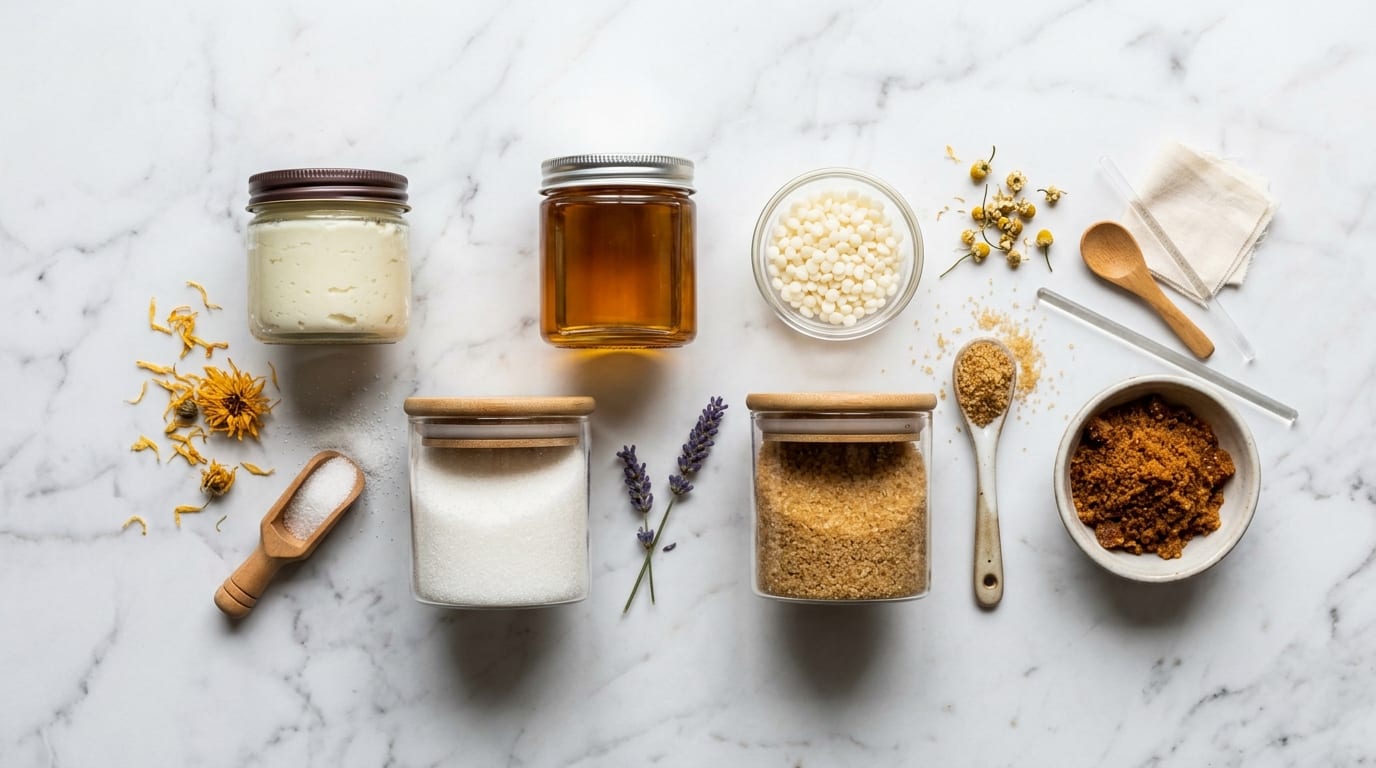
A body scrub is one of the first products that home formulators start with. It seems simple: take some sugar, add oil, mix it up — and you're done. But that is exactly where the trap lies: most homemade scrubs either separate within a week, irritate the skin, or wash down the drain along with half of the abrasive. To make a body scrub at home that works like a professional product, you need to understand the chemistry behind every ingredient — from the particle size of the abrasive to the role of an emulsifier in an anhydrous base. This is exactly what this article from the online school "Walker Formulation Academy" is dedicated to.
What is a scrub from the perspective of cosmetic chemistry
A scrub is a dispersed system in which solid abrasive particles are distributed in a soft base (oil, emulsion, or gel). The mechanism of action is twofold: physical exfoliation (abrasion) and simultaneous moisturizing or nourishing of the skin via the base. From a rheological point of view, a scrub must have sufficient viscosity to keep the particles in suspension, while still being easy to spread over the skin with minimal effort.
This is where tribology, gums, and gelling agents come into play — the science of friction and sliding, which directly explains why some scrubs feel velvety while others feel like sandpaper. The coefficient of friction between the abrasive particle and the skin surface determines the intensity of exfoliation and the risk of micro-injuries.
Types of scrubs by base
- Oil-based (anhydrous) — the abrasive is dispersed in a mixture of oils and butters. These are the most nourishing but require careful selection of the base viscosity.
- Emulsion-based — cream scrubs based on oil-in-water or water-in-oil. They wash off more easily and are suitable for oily skin.
- Gel-based — abrasive in a thickened aqueous phase with hydrophilic polymers. These are the most difficult to stabilize due to the difference in densities.
- Dry — powder mixtures activated by water upon application. The simplest form in terms of preservation.

Choosing an abrasive: particle size is everything
The abrasive is the heart of a scrub. Its physical characteristics determine not only the effectiveness but also the safety of the product. The main parameter is particle size, measured in microns or on the mesh scale. The higher the mesh number, the finer the particles.
Natural abrasives and their characteristics
Sugar (sucrose) is one of the most popular options for those who want to make a body scrub at home. It dissolves in water, which makes it gentle and self-limiting: the longer you massage, the softer the effect becomes. Coarse-ground cane sugar (particle size 500–800 µm) is suitable for the body, while fine-ground (200–400 µm) is better for the décolleté and shoulders.
- Sea salt — insoluble in an oil base, it retains the sharpness of its particles longer than sugar. The optimal size for the body is 300–600 µm. It is not recommended for sensitive skin or after hair removal.
- Ground coffee — particles have an irregular shape, and the size varies depending on the grind. A medium grind (400–700 µm) provides good exfoliation. It contains caffeine, which in theory stimulates microcirculation.
- Rice bran — a gentle abrasive (50–150 µm) rich in gamma-oryzanol. Suitable for sensitive skin and the face.
- Walnut shell — be careful: the sharp edges of the particles can cause microscopic cuts. It requires careful control of particle shape.
- Bamboo powder — an eco-friendly alternative to plastic microbeads, with a particle size of 150–300 µm and a neutral scent.
Why particle shape is more important than size
Sharp, angular particles (salt, crushed shell) are more traumatic than rounded ones (sugar, rice bran) of the same size. In professional cosmetology, this is called the sharpness index. For home production, a simple rule is sufficient: if the abrasive cuts the skin on the inside of your elbow under light pressure, it is too aggressive for regular use.

Oil base: how to make a body scrub at home with the right texture
The scrub base performs three functions: it keeps the abrasive in suspension, provides slip during application, and nourishes the skin after rinsing. For oil-based scrubs, the key parameter is viscosity at room temperature.
Selecting oils and butters for the base
Liquid oils on their own create a base that is too runny — the abrasive will settle to the bottom in a matter of days. The solution: add solid components that increase viscosity. The optimal strategy is to mix a liquid oil (60–70%) with a butter (20–30%) and add a thickener such as carnauba wax or beeswax (5–10%).
For more on how the properties of oils depend on the origin of the raw materials, read the article How climate affects the fatty acid and essential oil composition in plants — this directly affects the stability of your base.
To choose oils for a specific skin type, we recommend studying our guide to oils and butters for different skin types. And if you plan to work with cocoa butter as a thickener, be sure to read about butter polymorphism, otherwise your scrub may "bloom" or separate.
Basic oil scrub formula (100 g)
- Sweet almond oil — 45 g (main carrier oil)
- Shea butter (unrefined) — 20 g (butter for viscosity and nourishment)
- Beeswax — 5 g (structuring agent)
- Cane sugar (medium grind) — 28 g (abrasive)
- Vitamin E (tocopherol) — 0.5 g (antioxidant)
- Orange essential oil — 0.5 g (fragrance, no more than 0.5% for body use)
- Preservative (e.g., Geogard ECT) — 1 g
Method: melt the wax and butter in a double boiler at 70–75°C, add the liquid oil, cool to 40°C, add the tocopherol and preservative, at 35°C add the sugar and essential oil, stir, and pour into jars.

pH, preservation, and scrub stability
Many beginner formulators believe that anhydrous scrubs do not need preservation. This is a dangerous misconception. Even in a purely oil-based system, fatty acid oxidation and mold growth can occur if moisture enters the jar — which is inevitable in a bathroom environment.
Is pH control needed in a scrub?
For anhydrous scrubs, pH measurement is irrelevant — electrodes only work in an aqueous medium. But if you are making an emulsion or gel scrub, pH is critical: at values above 6.5, the risk of microbial contamination increases sharply, and some active ingredients (e.g., AHA acids in exfoliating scrubs) only work at a pH of 3.5–4.5. Read more about working with acidity in our article pH in cosmetics: a basic guide for formulators.
Preservation and shelf life
For oil scrubs, the minimum protection set is: an antioxidant (tocopherol 0.1–0.5% or rosemary extract 0.1%) + a broad-spectrum preservative. For scrubs with an aqueous phase, a full preservation system is mandatory, just like in any emulsion. The shelf life of a homemade scrub without a preservative in a bathroom environment is no more than 2–3 weeks. With proper preservation, it is 6–12 months.
If you want to delve deeper into the topic of anhydrous formulas in general, we recommend studying our complete guide to anhydrous products — it details the principles of stabilization and choosing preservatives for water-free systems.
Common mistakes and how to avoid them
Even experienced formulators make typical miscalculations when working with scrubs. Understanding the mechanisms behind these errors allows you to avoid them during the formulation development stage.
- Excessively high abrasive concentration. More than 40% abrasive in an oil base makes the texture crumbly and difficult to apply. The optimal range is 25–35%.
- Incompatible aromatic components. Some essential oils (cold-pressed citrus) are photosensitizing to the skin. Use bergapten-free options or apply the scrub only in the evening.
- Ignoring oxidation. Oils with a high content of polyunsaturated fatty acids (flaxseed, hemp) go rancid quickly. For scrubs, stable oils are preferred: coconut, castor, jojoba oil.
- Incorrect packaging. Wide-neck jars without a spatula are a direct path to contamination. Use jars with a pump or always include a spatula.
- Overheating the abrasive. Sugar begins to dissolve in oil at temperatures above 60°C — you will end up with a caramel mass instead of a scrub. Add the abrasive at a temperature no higher than 35–40°C.

Advanced techniques: chemical peels in scrub formulas
Professional scrubs often combine mechanical exfoliation with chemical exfoliation. Adding AHA acids (glycolic, lactic, mandelic) at a concentration of 2–5% turns an ordinary scrub into a dual-action peel. An important nuance: acids practically do not work in an anhydrous system — an aqueous phase is needed for activation. Therefore, acid scrubs are always made on an emulsion or gel base with careful pH control.
Enzyme scrubs (with papain from papaya or bromelain from pineapple) are another option for chemical enhancement. Enzymes break down keratin bonds, making exfoliation more uniform. However, they are thermolabile: add them at a temperature no higher than 40°C and keep in mind that activity decreases at a pH below 4.5.
If you have already mastered basic scrubs and want to move further, study the complete guide to homemade cream formulation, which breaks down the principles of emulsion systems that will form the basis of your next products.
FAQ: frequently asked questions about homemade scrubs
Can I use food ingredients—sugar, coffee, salt—for a scrub without additional processing?
Yes, food-grade abrasives are safe for the skin when used correctly. The main thing is to ensure their microbiological purity (buy from trusted suppliers) and choose the right particle size. Standard granulated sugar (about 500 µm) is well-suited for the body. Brewed coffee grounds contain moisture, which drastically reduces the shelf life of a scrub—use only freshly ground or specially dried coffee.
Why does my scrub separate—the abrasive settles at the bottom?
This is a classic density difference problem. The density of sugar (~1.6 g/cm³) is significantly higher than that of oils (~0.9 g/cm³), so without sufficient base viscosity, the particles will inevitably settle. Solutions: increase the proportion of butter or wax in the base, add a thickener (hydrogenated castor oil 2–5%), reduce the abrasive particle size, or lower its concentration to 25–30%. Storing the scrub in the refrigerator also helps—at low temperatures, the base becomes thicker.
Do I need to get my homemade scrub formula approved by a regulator if I am selling it?
If you sell cosmetics in Great Britain — including products you make at home — they fall under the UK Cosmetics Regulation (assimilated Regulation (EC) No 1223/2009), enforced through the Cosmetic Products Enforcement Regulations 2013. Three things have to be in place before the first sale: a named Responsible Person based in the UK, whose name and address appear on the pack; a Cosmetic Product Safety Report (CPSR) drawn up by a qualified safety assessor; and a notification submitted to OPSS through the Submit Cosmetic Product Notification (SCPN) service. Making the product in a work-space at home is allowed, provided you follow Good Manufacturing Practice. Products made purely for your own use fall outside this regime. Read more about the professional path in cosmetics in our article How to become a cosmetic chemist: the path from curiosity to professional formula.
A scrub is not just "sugar plus oil." Behind every successful product lies an understanding of rheology, surface chemistry, ingredient stability, and microbiological safety. By mastering these principles, you will be able to not only make a body scrub at home that works better than store-bought ones, but also build a systematic approach to your entire line of homemade cosmetics. Join the Walker Formulation Academy Club—learn more in our courses and get access to professional formulas, error analysis, and live sessions with experts.