Every morning, millions of people apply a product to their face that has to do three incompatible things at once: soften the hair, lubricate the skin, and stay out of the blade's way as it cuts exactly what it's supposed to. It sounds simple — until you start breaking down the formula. Shaving cream is one of the most technically demanding products in the personal care category, and most consumers have no idea. Irritation, nicks, and post-shave dryness are almost always the result of a poorly formulated product, not "sensitive skin."
Why shaving damages the skin in the first place
Before we get to the formula, it helps to understand the physics of the process. A razor blade moves across the skin at an angle of roughly 30 degrees, creating enormous tribological stress at the metal–skin interface. If you've read our piece on tribology, gums, and gelling agents, you already know that the friction coefficient on dry skin can be 3–5 times higher than on a properly hydrated and lubricated surface. That's exactly what causes irritation.
A second mechanism is at work in parallel: dry hair is stiff. Keratin fibers in a dry state require significantly more force to cut through — trichology research shows that hydrated hair cuts roughly 70% more easily than dry hair. That's exactly why experienced barbers always work after a hot towel.
What an ideal formula needs to do
- Hydrate the hair and skin within 1–3 minutes of contact
- Form a stable lubricating film between the blade and the dermis
- Hold its foam or gel structure long enough that you don't have to re-shave the same area
- Not clog the blade or leave a greasy residue
- Keep the skin's pH in the 4.5–5.5 range after rinsing

The surfactant system: the heart of shaving cream formulation
Most classic shaving creams are built on a soap base — and that's no accident. Stearic Acid combined with Potassium Hydroxide or Triethanolamine (TEA) produces a potassium soap with unique rheological properties: it forms a dense yet plastic foam that doesn't collapse for 5–7 minutes.
A typical surfactant system makes up around 10% of the total formula mass. Stearic Acid is used at 8–15%, neutralized with KOH or TEA to a pH of 8.5–9.5 — yes, that's alkaline, and it's normal for this product type, though it does require caution when working with sensitive skin.
Why potassium beats sodium
If you've ever made handmade soap, you know the difference: sodium soap (NaOH) gives you a hard bar, potassium soap (KOH) gives you a soft paste or liquid. Shaving cream is, essentially, a partially neutralized blend of potassium and sometimes sodium soap. The KOH:NaOH ratio governs the consistency: more potassium means a softer texture, more sodium means a denser, "fluffier" foam.
Secondary surfactants — Sodium Lauryl Sulfate or Cocamidopropyl Betaine — are added to stabilize the foam and improve lather generation. Their concentration usually doesn't exceed 1–3%, otherwise the product starts foaming too aggressively and loses its creamy texture.
Alternative approaches: gel and soap-free systems
Modern "sensitive" formulas are increasingly moving away from a soap base toward non-ionic surfactants — PEG-based or glucoside-type. This brings the pH down to 6.0–7.0, which is significantly more comfortable for skin with rosacea or atopic dermatitis. The trade-off is a less rich foam and the need to add gelling agents to achieve the desired rheology.

Lubrication and hydration: where most formulas fall short
Surfactants create the foam. But it's the humectant and lubricating components that determine how the skin will feel an hour after shaving. This part of the formula — 5–10% of the composition — is often underrated.
Humectants and conditioning agents
Glycerin is the genre classic, used at 3–8%. It draws water to the hair and skin, accelerating that same keratin softening. Propylene Glycol works in a similar way but penetrates the hair shaft better. Guar Hydroxypropyltrimonium Chloride — the cationic variant of guar gum — deposits onto the negatively charged surface of the skin and hair, creating a slick film. We covered the mechanics of these molecules in detail in our article on tribology and gelling agents.
Lanolin is an old-school ingredient, but a surprisingly effective one: its fatty acid composition is close to sebum, it forms an occlusive film, and it doesn't clog the blade. A concentration of just 1–3% already produces a noticeable effect.
Oils and emollients: choosing wisely
Mineral Oil is still used in professional barbering formulas — it's chemically inert, doesn't go rancid, and delivers predictable lubrication. Among plant oils, jojoba oil (Simmondsia Chinensis Seed Oil) and castor oil (Ricinus Communis Seed Oil) work well — the latter is especially valued for its high viscosity and ability to hold moisture in the foam. When choosing oils, it's important to understand their fatty acid profile — we cover that in detail in our guide from kitchen to cosmetics.
Silicones — Dimethicone, Cyclomethicone — are added to modern "smooth" formulas. They reduce friction mechanically without reacting with the skin. A concentration of just 0.5–2% already changes the product's tactile profile dramatically.

pH, preservation, and stability: the details that decide everything
A soap base dictates an alkaline pH — a headache for any formulator. Skin is already irritated after shaving, and an alkaline environment disrupts the acid mantle even further. That's exactly why it's important to understand that the pH of the shaving cream isn't the pH the skin is left with. The product is rinsed off, and a properly chosen toner or after-shave moisturizer restores the balance. For more on how pH affects the skin and how to measure it, see our guide to pH in cosmetics.
Preservation in an alkaline environment
An alkaline pH creates a paradox: many classic preservatives (parabens, phenoxyethanol) perform worse at a pH above 7.0. For shaving creams with a pH of 8.5–9.5, the following work well:
- Sodium Benzoate — effective up to pH 9.0, used at 0.5–1%
- Bronopol (2-Bromo-2-Nitropropane-1,3-Diol) — broad spectrum, works in alkaline environments, but requires caution around nitrosamine formation
- DMDM Hydantoin — a stable formaldehyde donor, pH-independent, 0.3–0.6%
- Potassium Sorbate + Sodium Benzoate combination — a "cleaner" profile, but requires thorough testing
We covered the detailed logic of choosing a preservative for a specific system in our article on preserving clay masks — the principles are the same, even though the environment is different.
Aerosol systems: a different story
Aerosol shaving foam cans are aerosol emulsions with a propellant (typically isobutane/propane, 3–4% of the mass). The formula inside the can looks like a concentrated cream; on contact with air, the propellant evaporates and creates the foam. California VOC regulations cap propellant content at 5% — a typical propellant level of 3–4% fits within that limit. This is a fundamentally different technology from a tube of cream, and it requires a separate approach to formulation and to testing stability under pressure.

What this looks like in numbers: a typical formula
To turn everything above into a practical picture, here's an approximate structure of a classic tube shaving cream:
- Stearic Acid — 12–18% (primary surfactant, structuring agent)
- Potassium Hydroxide — 3–5% (neutralizer, forms the soap)
- Glycerin — 5–8% (humectant, hair softening)
- Coconut Acid or Palmitic Acid — 2–4% (improves foam formation)
- Lanolin or Castor Oil — 1–3% (lubrication, conditioning)
- Triethanolamine — 1–2% (secondary neutralizer, pH buffer)
- Preservative — 0.3–1% (system-dependent)
- Fragrance — 0.5–1% (aesthetics; menthol or eucalyptus essential oils give a fresh feel)
- Aqua — to 100%
Water is added hot (70–80°C) under constant stirring — the stearic acid must fully melt before neutralization. The order of KOH addition is critical: too fast, and you get an uneven soap with unreacted acid. Too slow, and the mass thickens before neutralization is complete. This is one of those rare cases where the process matters just as much as the composition.
Sensitive skin and men's grooming routines: where the growth points are
The market is moving toward "skin-first shaving" — products that don't just provide glide, but actively care for the skin during shaving. This means adding Niacinamide (2–5%) to the formula to reduce redness, Panthenol (1–3%) to help restore the barrier, and even peptides — although their effectiveness in an alkaline soap environment is highly questionable (denaturation at pH >8.0 is a real risk).
Soap-free gel formats based on Hydroxyethylcellulose or Carbomer, with a pH of 6.0–6.5, are a more promising base for active ingredients. They lather less well, but they're better compatible with sensitive skin and modern multi-blade razors, which don't need a thick foam — they need lubrication.
Can you make shaving cream at home without KOH?
Technically, yes — if you use a soap-free base built on neutral surfactants (Cocamidopropyl Betaine, Sodium Cocoyl Isethionate) with thickeners like Hydroxyethylcellulose or Xanthan Gum. Such a product will have a pH of 5.5–7.0, will irritate the skin less, and doesn't require working with caustic alkalis. The trade-off is a less "classic" foam and a different texture. To get started with gelling agents, we recommend our article on tribology and gums.
Why does my skin feel tight after shaving even though I'm using a "moisturizing" cream?
It's most likely the pH. A soap base with a pH of 8.5–9.5 disrupts the skin's acid mantle, and even if glycerin and aloe are in the formula, the alkaline environment temporarily impairs the barrier function. The fix is to apply an acidic toner (pH 4.0–5.0) or a ceramide-based moisturizer after shaving — or to switch to soap-free formats with a neutral pH.
How is shaving cream chemically different from shaving gel?
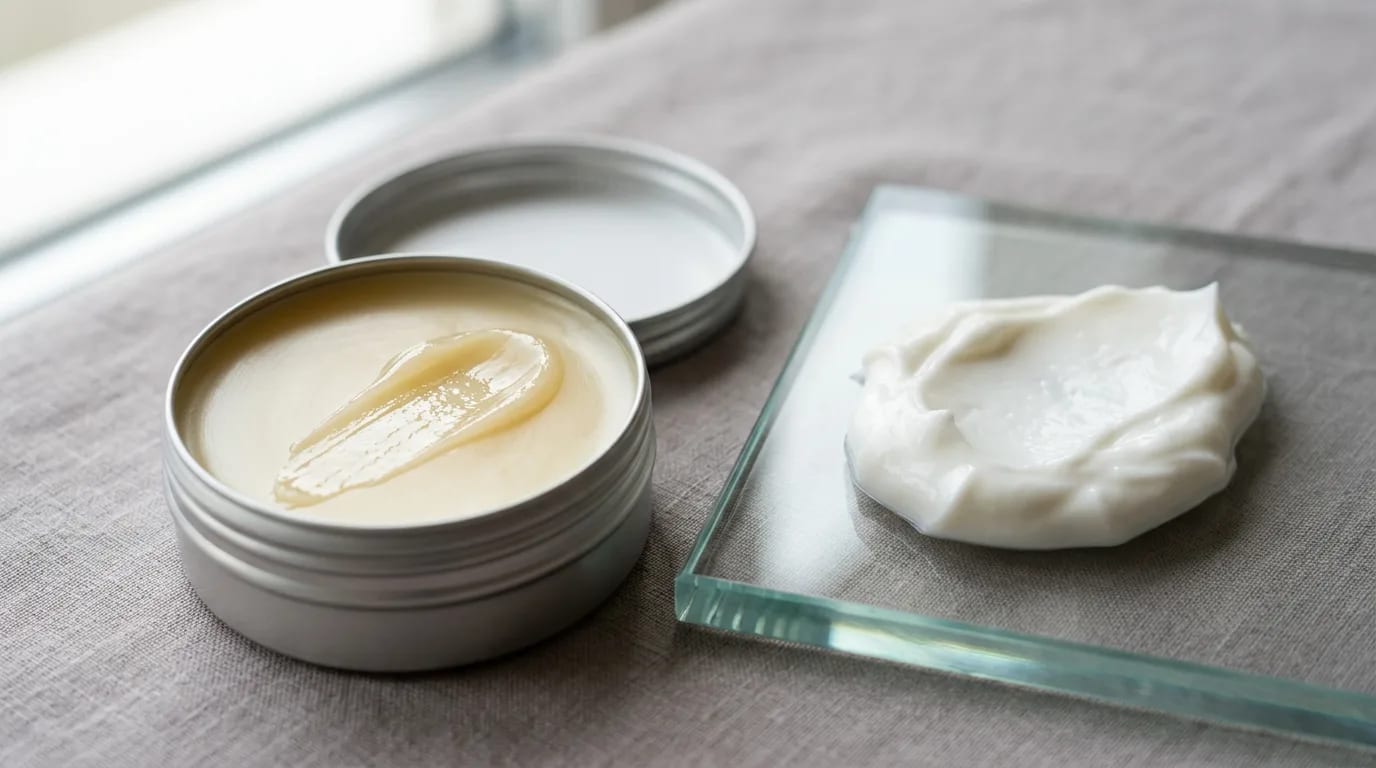
Cream is an emulsion or soap paste with a high fatty acid content (12–20%) that forms a dense, creamy foam. Gel is built on water-soluble polymers (Carbomer, Hydroxyethylcellulose) without a soap base, has a near-neutral pH, and produces minimal foam or none at all. Gel works better for sensitive skin and is compatible with a wider range of active ingredients — which is exactly why "sensitive" lines are more often released in gel format.
Shaving cream is a product that deceptively looks simple. Behind that familiar white foam lies a finely calibrated system where every percentage point matters. If you'd like to learn how to formulate products like this yourself — from choosing surfactants to stability testing — take a look at the Walker Formulation Academy Club: that's exactly the kind of non-trivial challenge we work through there, in a live community of practicing cream formulators.