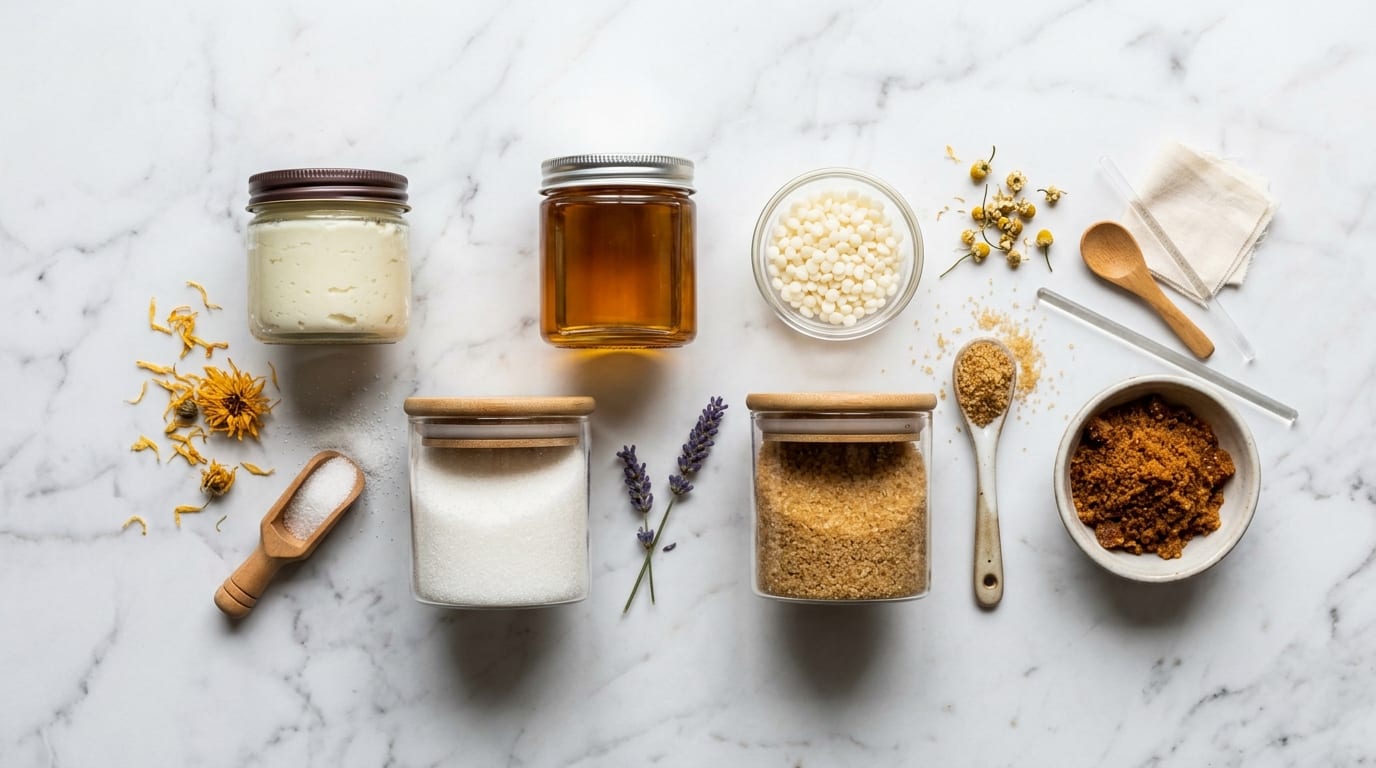
Anyone who has ever held a cold-process bar with the scent of lavender and layers of shea butter has wondered: what is actually happening inside this piece? You can buy handmade soap on every marketplace today, but understanding what distinguishes a high-quality product from a beautiful but chemically illiterate craft is a task for those who understand cosmetic chemistry. This article is written for formulators and beginner soap makers who want not just to make soap "from an internet recipe," but to consciously manage every gram of fatty acids, control pH, and understand why one soap lathers luxuriously while another is slippery and won't rinse off.
What is soap from a chemical perspective: the saponification reaction
Soap is a salt of a fatty acid formed as a result of the saponification reaction: a triglyceride (oil or fat) reacts with an alkali and breaks down into glycerin and fatty acid salts. It is these salts that are the surfactants that allow soap to cleanse the skin.
The reaction looks like this:
Triglyceride + NaOH (or KOH) → Soap (fatty acid salts) + Glycerin
For solid soap, sodium hydroxide (NaOH) is used; for liquid soap, potassium hydroxide (KOH) is used. The fundamental difference is in the size of the ion: potassium provides a softer, paste-like structure, while sodium provides a dense and hard one.
SAP value: a key formulation parameter
SAP (Saponification Value) is the number of grams of alkali required for the complete saponification of 1 gram of a specific oil. Each oil has its own SAP value because the carbon chain length and the degree of saturation of fatty acids determine how many NaOH molecules are needed for the reaction.
- Coconut oil — SAP for NaOH ≈ 0.190: a high value; the soap produces abundant lather but can dry out the skin if the concentration is too high
- Olive oil — SAP ≈ 0.134: a low value; the soap is mild and conditioning, with a creamy lather
- Palm oil — SAP ≈ 0.141: provides hardness to the bar and stable lather
- Castor oil — SAP ≈ 0.128: enhances lathering, used in small doses (5–8%)
- Shea butter — SAP ≈ 0.128: adds conditioning properties, softens the feeling of "tight" skin
If you want to understand how the fatty acid profile of an oil changes depending on the climate where the plant grows, we recommend reading our article How climate affects the composition of fatty acids and essential oils in plants — this directly affects the SAP value of the same oil from different batches.
Superfat: intentional oil excess
Superfat (or lye discount) is the percentage of oils that are intentionally left unreacted. The standard range is 5–8%. Superfat solves two problems: it protects against an excess of alkali in the finished product and leaves free oils in the soap that soften the skin.
An important nuance: you cannot control which specific oil will remain in the superfat. Alkali saponifies fatty acids in order of reactivity, not in the order ingredients are added. Therefore, expensive shea butter added "for the superfat" may be saponified just as much as basic coconut oil.

Soap pH: why 9–10 is the norm, not a problem
One of the most common myths in soap making is "neutral soap with a pH of 7." Soap is by definition an alkaline product: fatty acid salts hydrolyze in water to create an alkaline environment. The pH of finished cold process soap is in the 9–10 range, and this is a chemically justified norm.
Human skin has a pH of 4.5–5.5. After washing with soap, the pH of the skin surface rises temporarily, but a healthy skin barrier restores the acid mantle within 15–90 minutes. Problems arise not from a pH of 9–10 per se, but from:
- residual free alkali (insufficiently cured soap or a calculation error)
- excessively high coconut oil content without compensating conditioning oils
- using soap on sensitive or atopic skin without additional moisturization
For more on how pH affects the stability of cosmetic formulas and why buffer systems are critical, read our article pH in cosmetics: a basic guide for formulators.
Soap maturity test: phenolphthalein and the "zap test"
The phenolphthalein test involves a drop of alcoholic phenolphthalein solution on a slice of soap. If a pink or crimson color appears, free alkali is present in the soap. The soap is not ready for use.
The "zap test" involves touching the tip of your tongue to the surface of the soap. A "bite" or tingling sensation indicates the presence of active alkali. It is an old but effective method used by experienced soap makers for quick checks during the process.

Soap making methods: cold process and hot process
The two main methods—cold process (CP) and hot process (HP)—yield fundamentally different results in terms of texture, appearance, and curing time.
Cold process
Oils and the alkaline solution are mixed at a temperature of 35–50°C without additional heating after mixing. The saponification reaction continues inside the mold for 24–48 hours (gel phase), after which the soap requires a curing period of 4–6 weeks to complete the reaction and allow excess moisture to evaporate.
Advantages of the method: smooth texture, the ability to create complex patterns and layers, and the preservation of heat-sensitive actives (added after trace). Limitation: the soap cannot be used immediately; a curing period is necessary.
Hot Process
After reaching trace, the mass is heated in a water bath or a slow cooker until the saponification reaction is complete. The soap is ready for use 24–48 hours after molding. The texture is more rustic, and patterns are more difficult to create.
Hot process is preferred when speed is important: for example, when producing handmade soap intended for purchase immediately after manufacture, or when working with milk bases that are unstable during long-term storage in a raw form.

How the fatty acid profile determines soap properties
Each fatty acid in an oil's composition makes a specific contribution to the final properties of the soap. Understanding these relationships is the foundation of conscious formulation.
Lauric and myristic acids: lather and cleansing
Lauric acid (C12) is the primary "lathering agent" in soap making. Its main sources are coconut and palm kernel oil. Soap with a high lauric acid content produces a rich, fluffy lather even in hard water, but at a coconut oil concentration above 30–35%, it begins to noticeably dry out the skin.
Myristic acid (C14) enhances the cleansing effect and stabilizes the lather. It is found in coconut, palm kernel, and nutmeg oils.
Oleic acid: conditioning and softness
Oleic acid (C18:1) is the basis for the conditioning properties of soap. Oils with a high oleic acid content (olive, avocado, almond) produce soap that does not dry out the skin but requires a longer curing period and produces less fluffy lather.
If you want to select oils for a specific skin type — for both soap and cream formulas — we recommend our article How to choose oils and butters for your skin type: a guide for beginner formulators.
Saturated acids: bar hardness
Palmitic (C16) and stearic (C18) acids are responsible for the hardness of the finished bar. Their sources are palm oil, shea butter, cocoa butter, beef tallow, and lard. Soap without saturated acids will be soft, "slimy," and will dissolve quickly in the soap dish.
Working with butters in soap making has its nuances — especially with cocoa butter, which is prone to polymorphic transitions. Read more about this phenomenon in the article Butter polymorphism: why cocoa butter is temperamental and how to work with it.

Additives and actives: what really works in soap
The market offers a huge number of additives for handmade soap — from activated charcoal to gold. Let's analyse what is chemically justified and what works only as marketing.
Clays and mineral pigments
Kaolin, French green clay, rhassoul — these ingredients are stable in an alkaline environment and truly perform the function of a mild abrasive and sorbent. The recommended concentration is 1–3% of the total oil weight. Exceeding this makes the soap brittle and impairs lathering.
Essential oils and fragrances
Essential oils are added at the light trace stage in an amount of 2–3% of the oil weight. It is important to consider that some essential oils accelerate trace (clove, cinnamon) or cause ricing (rippling on the surface). The role of essential oils in cleansing formulas is described in detail in our article The power of nature: the role of essential oils in modern cleaning products.
What does not work in an alkaline environment
The following ingredients are destroyed or lose their activity at pH 9–10:
- Most peptides and proteins (hydrolyzed by alkali)
- Vitamin C and its unstable derivatives
- Hyaluronic acid (partially degrades)
- Probiotics and live cultures
- Most water-based plant extracts (change color and activity)
This does not mean they cannot be added — but marketing claims about "collagen," "hyaluronic acid," and "probiotics" in soap have no chemical justification.
Handmade soap as a product: what is important for the buyer and manufacturer to know
When a consumer wants to buy handmade soap consciously, they should understand a few key things. Both the manufacturer and the buyer benefit from ingredient transparency.
Labelling and INCI
In most countries, soap sold as a cosmetic product must have a full INCI list. If a manufacturer lists only "natural oils and alkali," this is a violation of labelling requirements. The full composition must include: oil names in INCI format (Olea Europaea Fruit Oil, Cocos Nucifera Oil, etc.), Aqua, Sodium Hydroxide (or an indication that it has fully reacted).
Shelf life and rancidity
Soap does not have an infinite shelf life. The free oils in the superfat oxidize — especially oils with a high content of polyunsaturated fatty acids (flaxseed, hemp). Signs of rancidity include yellow spots on the surface (DOS, dreaded orange spots) and the smell of rancid fat. The shelf life of high-quality CP soap is 12–18 months when stored correctly.
If you are interested in the broader topic of creating cosmetic products at home — from soap to creams — we recommend starting with our guide How to make a cream at home: a complete guide to homemade cream formulation.
Frequently asked questions about soap making
Is it possible to make soap without lye?
No. By definition, soap is the product of a saponification reaction, which is impossible without lye. Products sold as "soap-free" are either detergent bases (synthetic surfactants) or melt & pour soap bases in which saponification has already taken place during production. In finished cold or hot process soap, no free lye remains — it has fully reacted with the oils.
Why is it more beneficial to buy handmade soap than industrial soap?
From a chemical perspective, the main advantage is the presence of glycerin. In industrial production, glycerin is extracted from the soap mass and sold separately. In handmade soap, the glycerin remains in the product, making it more moisturizing and gentle on the skin. Furthermore, the maker can control the fatty acid profile, superfat, and the absence of synthetic fragrances.
How do I calculate the amount of lye for a formula?
Use online calculators (SoapCalc, Brambleberry Lye Calculator) or calculate manually: multiply the mass of each oil by its SAP value for NaOH, sum the results, and multiply by the superfat coefficient (for example, for a 5% superfat, multiply by 0.95). Never estimate the amount of lye "by eye" — an error of 5–10% can result in either caustic soap or soap with an unreacted greasy residue.
Soap making as a start in cosmetic chemistry
Soap making is one of the best entry points into the world of cosmetic chemistry. The saponification reaction is visual, the result is tangible, and calculation errors provide immediate feedback. By mastering SAP values, superfat, and fatty acid profiles, you gain the foundation for understanding more complex systems — emulsions, anhydrous formulas, and active delivery systems.
If soap making seems too simple and you are ready to move on, take a look at our material on anhydrous products: balms, lipsticks, and oil serums, which contain no water and therefore have no issues with preserving an aqueous phase. And if you are interested in a professional career in the industry, check out our page How to become a cosmetic chemist: the path from curiosity to professional formulation.
Soap making teaches you to think in terms of molecules, not ingredients. This is the exact shift in mindset that distinguishes an amateur formulator from a professional technologist. Learn more about cosmetic chemistry, learn how to build formulas from scratch, and work with professional calculation tools in the Walker Formulation Academy Club courses.