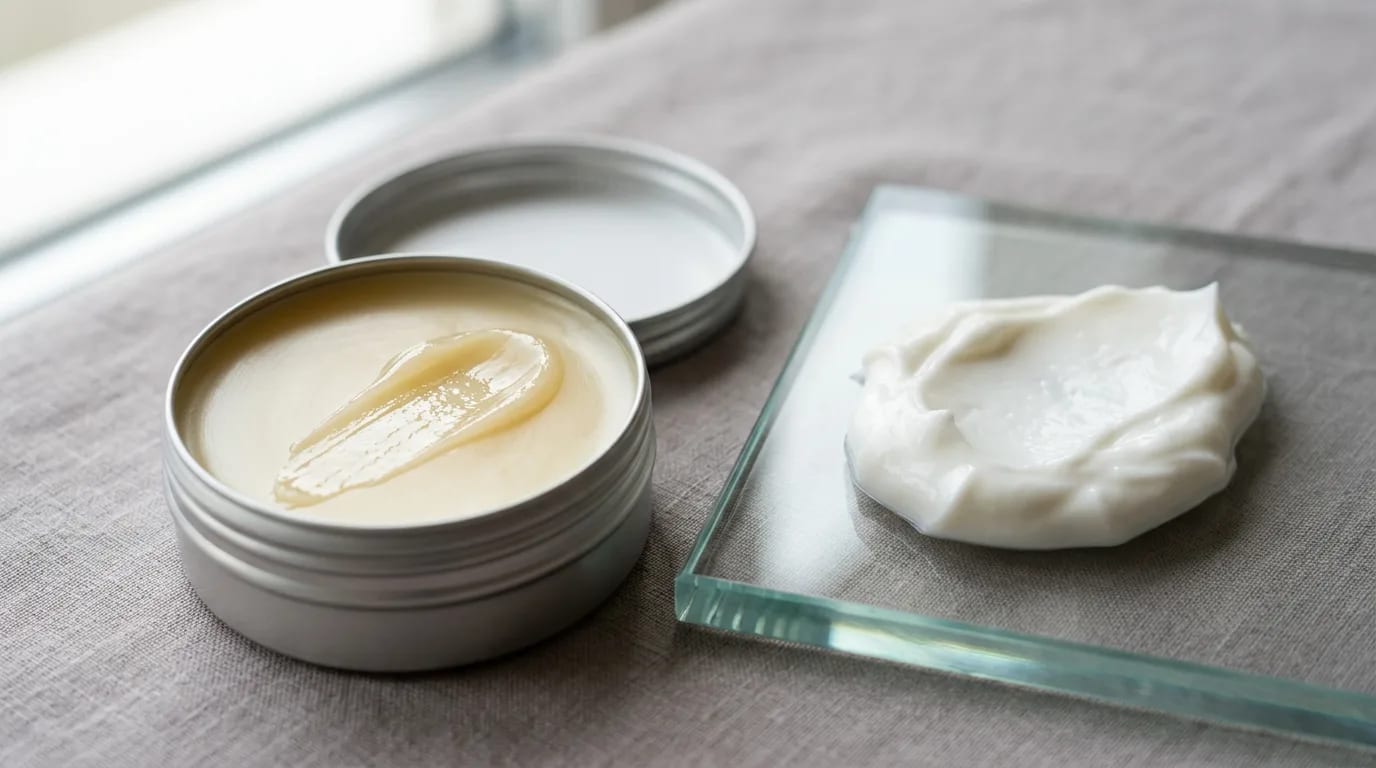
There's one thing almost nobody warns beginners in home formulation about: finding a good formula is only half the job. The other half is finding what to actually make it from. And that's where the real quest begins. Because between "I want to make a cream with niacinamide and ceramides" and "I have quality ingredients in hand" lies a whole chasm of suppliers, trade names, certificates, and marketing promises.
The INCI dictionary currently lists more than 17,000 raw materials. Each one can be supplied by dozens of manufacturers under different trade names — and these aren't just synonyms. The same Cetyl Alcohol from different suppliers can behave completely differently in an emulsion. So working with raw materials is a discipline in its own right, no less important than the formula itself.
Why raw materials aren't just "buy it on a marketplace"

When a professional cosmetic chemist works at a company, access to raw materials is a matter of one phone call to a distributor. There's a supplier database, established relationships, and the ability to request samples literally the next day. For an independent formulator — whether a home cremaker or a budding entrepreneur — things work very differently.
The first thing anyone starting to formulate at home runs into: cosmetic raw materials are sold in packaging sized either for industrial volumes (25 kg and up) or for retail buyers at prices that already bake in a double- or triple markup. Finding the sweet spot — a small volume at a reasonable price with proper documentation — is no trivial task.
Trade name ≠ INCI: making sense of labeling
One of the first stumbling blocks is the gap between the trade name and the INCI name. You read a formula, and it says "Olivem 1000." You go to a supplier's website — and see dozens of emulsifiers with similar descriptions. Olivem 1000 is a trade name owned by Hallstar (formerly Bioeurope), and its INCI is: Cetearyl Olivate (and) Sorbitan Olivate. So can you just grab any emulsifier with a similar composition? No. The ratio of components, particle size, manufacturing method — all of this affects how the ingredient will behave in your system.
That's exactly why professional formulators always work with technical documentation — TDS (Technical Data Sheet) and SDS (Safety Data Sheet). This isn't bureaucracy for its own sake: the TDS lists real physicochemical parameters — acid value, iodine value, melting point, recommended concentrations. Without this data, you're formulating blind.
What "cosmetic grade" means and why it matters
There's a common misconception that a food-grade ingredient automatically works for cosmetics. We covered this topic in detail in From Kitchen to Cosmetics: A Practical Guide to Food Ingredients for Home Cremakers, but the key point here is that "cosmetic grade" means not just the purity of the substance, but also specific requirements for its microbiological profile, heavy metals, and residual solvents. Food-grade glycerin and cosmetic-grade glycerin are different products with different certificates. For skin, that distinction is critical.
Where home cremakers actually buy their raw materials

The market for small-volume cosmetic raw materials has changed a lot over the past five years. Specialized retail suppliers have emerged that repackage professional-grade raw materials into 100 g to 1 kg quantities — exactly what's needed for home experiments and small-scale production.
Types of suppliers and what sets them apart
- Distributors of major manufacturers (BASF, Evonik, Croda, Clariant) — work mostly with legal entities, minimum order 25 kg and up, but the documentation is impeccable and the product is guaranteed to match its stated specifications.
- Specialized retail suppliers — repackage professional-grade raw materials into small volumes. The key question is: who do they source from? A good supplier can always name the manufacturer and provide a CoA (Certificate of Analysis).
- Marketplaces — a risk zone. Here you can find just about anything, including ingredients of dubious origin with no documentation at all. Hyaluronic acid at £2 for 10 g raises serious questions about quality.
- Direct purchases from manufacturers — realistic for small companies willing to take 5 kg and up. Some manufacturers work with individuals through startup programs.
Documents you should always request
Before ordering an ingredient from a new supplier, request three documents. If they can't provide even one of them, that's a serious red flag:
- CoA (Certificate of Analysis) — confirms that a specific batch matches its stated specifications. Important: the CoA should be for your actual batch, not a generic "reference" one.
- TDS (Technical Data Sheet) — the product's technical specifications: appearance, pH, viscosity, recommended concentrations, and storage conditions.
- SDS (Safety Data Sheet) — information on safe handling. Especially important for active acids, preservatives, and essential oils.
By the way, working with documentation properly is directly tied to understanding the pH of your ingredients and finished formula — we cover this in detail in pH in Cosmetics: An Essential Guide for Cremakers.
How to navigate 17,000 ingredients: a practical filter
A figure of 17,000+ entries in the INCI dictionary sounds intimidating, but in practice a home cremaker's working "library" rarely exceeds 50–80 ingredients. The question is how to get there.
Functional, aesthetic, and "claims" ingredients
Professional chemists divide all raw materials into three categories, and this breakdown helps structure the search:
- Functional ingredients — the ones that "hold" the formula together: emulsifiers, thickeners, preservatives, pH adjusters. Without them, the product simply won't exist as a stable system. For example, Carbomer (Carbopol) at 0.3–1% creates a gel structure; Phenoxyethanol combined with Ethylhexylglycerin at 0.9–1% provides preservation.
- Aesthetic ingredients — responsible for how the product feels on the skin: glide, absorption, "silkiness." These are silicones, light oil esters, certain waxes. This is exactly where tribology becomes a practical science — we covered how ingredients affect tactile properties in more detail in Tribology, Gums, and Gelling Agents.
- Claims ingredients — actives that deliver the stated effect: peptides, niacinamide, retinol, acids, plant extracts. These are most often at the center of marketing promises — and they're the ones that cause the most confusion around dosage.
Why "natural" raw materials need special attention
Natural ingredients — oils, extracts, hydrosols — are inherently variable. The fatty acid composition of rosehip oil depends on climate, plant variety, extraction method, and storage conditions. This isn't abstract theory: we covered in detail how geography and climate affect the chemical profile of plant-based raw materials in From Kitchen to Cosmetics. The practical takeaway: for natural raw materials, a CoA matters even more than for synthetic ones — it's what shows the real profile of a specific batch.

Storing raw materials: what formulas don't tell you
Buying an ingredient is only half the battle. Improper storage can completely ruin even the highest-quality raw material. Oils oxidize, hydrosols get contaminated with microorganisms, and some actives degrade in light faster than you can use them up.
Basic rules that actually work
- Oils and butters: dark glass containers, 10–18°C, adding an antioxidant (Tocopherol, 0.1–0.5%) slows oxidation. Flaxseed oil goes rancid within 2–3 months at room temperature; refrigerated, it keeps for up to a year.
- Hydrosols: store refrigerated, use within 3–6 months of opening. Without a preservative, it's a risk zone. For more on preserving water-based systems, see Preserving Clay Masks.
- Active acids and peptides: sensitive to temperature and humidity. Hyaluronic acid clumps and loses solubility under humid storage; peptides degrade above 30°C.
- Preservatives: most are stable at room temperature, but some (for example, natural extract-based systems) require cold storage and have a shelf life of 12–18 months.
Labeling your own stock
A professional habit worth building from day one: every raw-material container should be labeled with the date received, the date opened, and the shelf life. This seems excessive until you find three unlabeled bottles of white powder in your stash and start guessing which one is Niacinamide and which is Zinc Oxide. This, incidentally, is exactly the kind of story behind the "cosmetics from a scrap of paper" phenomenon — enthusiasts trying to recreate formulas from notes scribbled on random slips of paper, then wondering why the result is unstable.
How to build your raw-material library: a strategy for beginners

Starting small isn't just budget advice. It's a professional approach. Every new ingredient takes time to learn: how it behaves in different systems, at different pH levels, in combination with other components. Trying to master 30 ingredients at once is a surefire way to end up with unstable formulas and frustration.
A starter kit that actually covers most needs
If you're just starting out, here's a minimal kit that lets you formulate basic emulsions, gels, and anhydrous products:
- A general-purpose emulsifier — for example, Emulsifying Wax NF or Olivem 1000
- A water-phase thickener — Carbomer or Hydroxyethylcellulose
- 2–3 oils with different fatty-acid profiles (for example, Jojoba Oil, Squalane, Rosehip Seed Oil)
- A preservative — Phenoxyethanol (and) Ethylhexylglycerin, or Sodium Benzoate (and) Potassium Sorbate for pH below 5.5
- A pH adjuster — Citric Acid and NaOH (10% solution)
- One or two basic actives — Niacinamide 5–10%, Panthenol 2–5%
This isn't "cosmetics from a scrap of paper" in the figurative sense — it's a real working base you can use to start understanding how ingredients interact with each other. From there, your library grows organically as you master new formats: anhydrous systems (in detail in Anhydrous Products: A Complete Guide for Beginners), anhydrous emulsions, solid formats.
When it's time to move on to more advanced raw materials
The answer is simple: when you understand why your basic formulas work the way they do. Not before. Silicones, complex peptide blends, specialized emulsifiers like Polyglyceryl-6 Distearate — all of these are tools for solving specific problems, not decorations for a formula. Without an understanding of basic chemistry, they turn into an expensive source of instability.
Can food-grade ingredients be used in cosmetic formulas?
Technically — some can, but with caveats. Glycerin, cold-pressed oils, citric acid — these are ingredients that exist in both worlds. However, "food grade" and "cosmetic grade" are different standards of purity and microbiological control. A food product isn't tested for heavy metals and residual solvents against cosmetic norms. For a one-off home experiment, the risk is minimal, but for regular use — and especially for selling a product — only cosmetic-grade raw materials with documentation will do.
How can you check raw-material quality without a lab?
A full-fledged check without a lab isn't possible — that's the honest answer. But there are basic organoleptic tests: color, smell, and consistency should match the TDS description. Oils shouldn't have a rancid smell. Powdered ingredients should be uniform, with no clumps or foreign particles. The pH of aqueous solutions can be checked with an accurate pH meter (not litmus paper — the margin of error is too large). For critically important parameters — such as preservative efficacy — the only reliable method is microbiological testing at an accredited lab.
Where should you look for information on new ingredients?
Primary sources: manufacturers' technical data sheets (BASF, Evonik, Croda publish them openly), the European Commission's CosIng database, PubMed for clinical data on actives. Among professional resources — Prospector (UL), Mintel GNPD for market analysis. Forums and blogs are a good supplement, but not a primary source: verify any information against the original TDS. And remember: a supplier's marketing materials are not scientific data, no matter how convincing they look.
Working with raw materials is a skill built up gradually. Every ingredient you've truly figured out — its chemistry, its behavior in a system, its limitations — is a brick in the foundation of your expertise. That's exactly why professional formulators value hands-on experience with specific materials so highly: no amount of theory replaces understanding how Cetyl Alcohol from one particular supplier changes the texture of your cream.
If you want to build this knowledge systematically — from the chemistry of basic raw-material classes to working with actives and stabilizing complex systems — check out the Walker Formulation Academy Club. There, formulators of every level tackle exactly these kinds of practical questions: not just "what to add," but "where to get it, how to check it, and why it works."