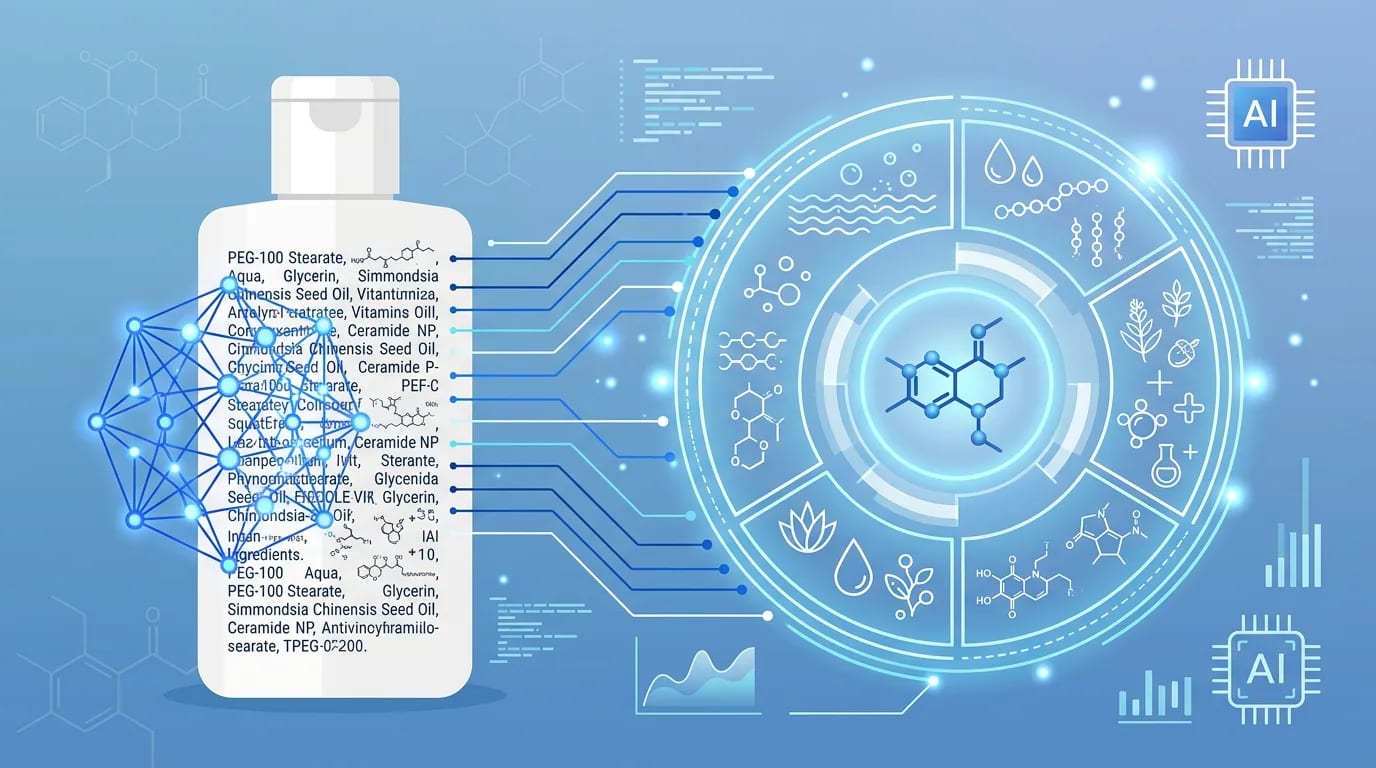
An anhydrous formulation is a cosmetic made without a water phase: oils, butters, waxes, silicones and powders, typically with under 1% residual water. Because microbes need free water to grow, these products are often self-preserving, but they are not oxidation-proof. Heat, light and oxygen still degrade unsaturated oils.
- Typical water content of an anhydrous formulation: below 1% (mass fraction of the finished product).
- Rule of thumb for accelerated ageing: storage at 40 °C for 12 weeks is often used to approximate roughly 12 months at room temperature.
- Tocopherol (active substance) is commonly used at 0.05-0.2% w/w as an antioxidant in oils.
- Peroxide value is the standard early-warning marker; fresh refined oils typically sit well below 10 meq O2/kg.
Here is the uncomfortable part: the balm that survives a year with no preservative can smell like old crayons by month four. Microbes are not the problem. Oxygen is.
Why Water-Free Doesn't Mean Stable: The Hidden Oxidation Threat
In an anhydrous formulation, the absence of water removes the microbial risk and hydrolysis of esters, which is why many formulators relax. But lipids oxidise by a radical chain reaction that does not need water at all. Our earlier piece on emulsifying wax in sugar scrubs covers the water side; here we stay on the oil side.
The radical chain in three steps
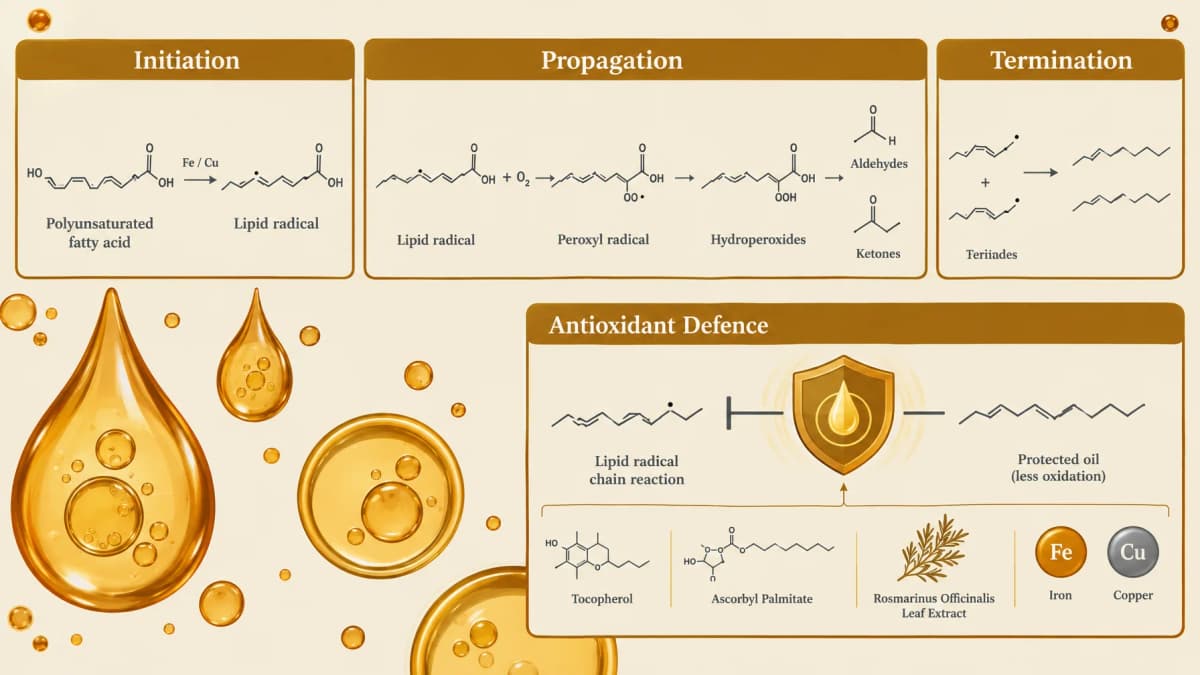
- Initiation: heat, light or trace metals (iron, copper) pull a hydrogen from a polyunsaturated fatty acid, forming a lipid radical.
- Propagation: the radical binds oxygen and forms a peroxyl radical, which attacks the next fatty acid, producing hydroperoxides.
- Termination and breakdown: hydroperoxides split into aldehydes and ketones, the molecules you smell as rancidity.
The more double bonds, the faster the chain. Linoleic and linolenic acids oxidise far faster than oleic or saturated acids, as reviewed in the literature on lipid oxidation in cosmetics and foods (PubMed search of lipid oxidation studies). We looked at this in more depth in the article on oxidative stability of oils, so use it for iodine value background.
Why anhydrous systems can be worse
- Oxygen dissolves more readily in oils than in water, so a lipid-only matrix holds a generous oxygen reservoir.
- Large surface area in sticks, balms and powders-in-oil speeds exposure.
- Pigments and mineral UV filters in anhydrous sunscreens or tints can carry trace metals that catalyse initiation.
Regulatory note: preservative need is a safety-assessment question under the UK Cosmetics Regulation (retained EU 1223/2009). A product being water-free does not remove the Responsible Person's duty to document microbiological and stability data; check the legislation.gov.uk text and CosIng for any ingredient you add.
Building an Antioxidant Defence Inside the Formula
Choosing the right antioxidant pairing
Tocopherol (INCI: Tocopherol) is the workhorse, usually at about 0.05-0.2% active. Higher is not better: at high levels tocopherol can turn pro-oxidant. Pair it with a regenerator such as Ascorbyl Palmitate or a rosemary extract (Rosmarinus Officinalis Leaf Extract), and a chelator suited to oils for trace metals. Verify each ingredient's status and any limits in CosIng and the UK Cosmetics Regulation annexes rather than assuming natural equals permitted.
Choose the base oil first
| Base | Dominant fatty acids | Oxidation risk |
|---|---|---|
| Rosehip, flax | Linoleic, linolenic | High |
| Sunflower (standard) | Linoleic | Medium-high |
| Jojoba (liquid wax ester) | Monounsaturated esters | Low |
| Squalane, coconut fractions | Saturated | Very low |
A practical trick: blend a delicate oil at 10-20% into a stable base instead of making it the main phase. For help screening a blend, see AI for matching actives to skin type and formula goal.
Advanced Packaging Solutions for Sensitive Anhydrous Actives
Packaging is the second antioxidant. Light accelerates initiation, and every time a jar opens, fresh oxygen enters.
What actually helps
- Opaque or amber containers to block UV and blue light.
- Airless pumps or tubes in place of open jars, to limit headspace oxygen.
- Minimal headspace; fill to the neck, or flush with nitrogen in production.
- Avoid caps and liners that leach metals or plasticisers into the oil.
Sticks, balms and capsules
Single-dose capsules and sealed sachets are the strongest option for highly unsaturated actives such as retinoids or carotenoid-rich oils, because every dose is a fresh, unopened environment. Compatibility of the pack with the formula should be part of your stability documentation. See also our home stability test guide if available in your library, and the notes on AI errors in concentration calculations before you scale a batch.
Quantifying Shelf Life: Accelerated Testing Protocols for Oils
Markers to measure
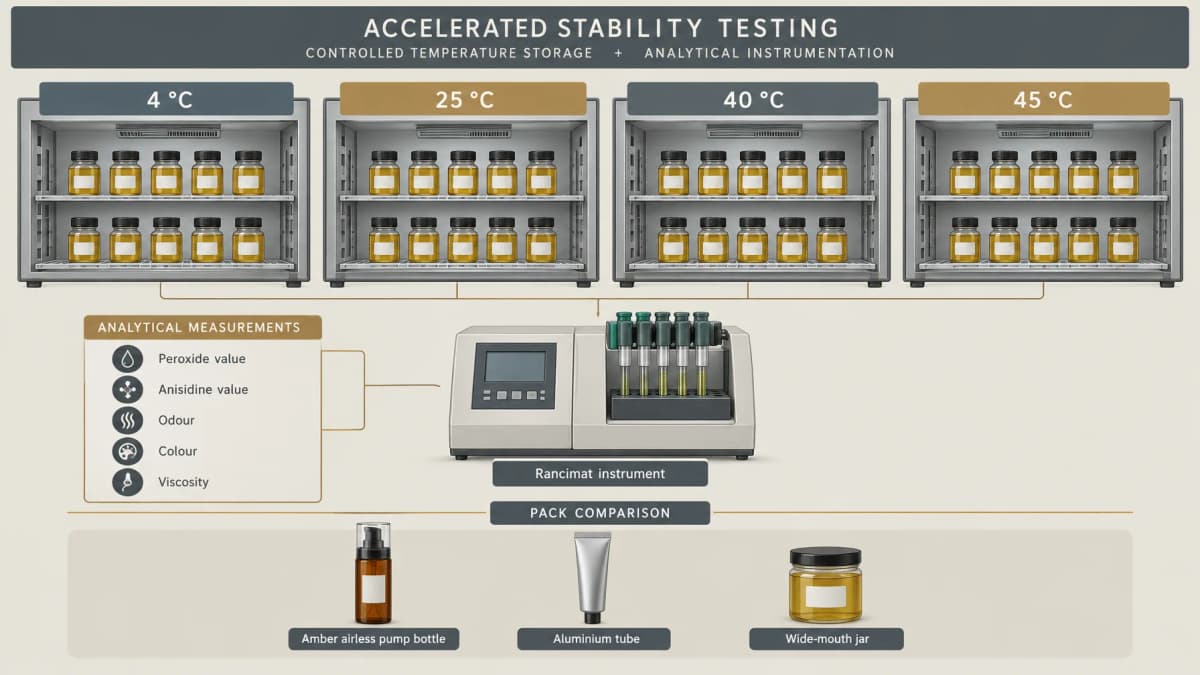
- Peroxide value (primary oxidation; hydroperoxides).
- Anisidine value (secondary oxidation; aldehydes).
- Induction time on a Rancimat-type instrument, which runs oil at elevated temperature under airflow.
- Sensory panel, colour and viscosity change.
Peroxide value rises then falls as hydroperoxides decompose, so a low PV alone can mislead; always pair it with anisidine value, as discussed in reviews of oxidation measurement (PubMed overview of oxidation methods).
A practical protocol
- Prepare three packs per condition in the final packaging.
- Store at 4 °C (control), 25 °C and 40 °C; add a light-exposure shelf if the pack is clear.
- Test at 0, 2, 4, 8 and 12 weeks for PV, anisidine value, odour, colour.
- Keep a 45 °C rack only as a stress test, since extremes can melt waxes and change mechanisms.
The common 40 °C for 12 weeks approach is a screening heuristic, not a guarantee; each 10 °C rise roughly doubles reaction rates, but real products deviate (PubMed search on accelerated stability testing). Confirm with real-time data and keep records for your Product Information File under UK rules.
Pricing and Practical Costs
Formulators often ask what protection costs. Airless packaging typically adds about £0.40-£1.20 per 30 ml unit at small scale compared with a plain jar, and a Rancimat-type or outsourced oxidation panel from a contract lab may cost in the region of £150-£400 per sample series. Cheaper than a recalled batch.
If you want to learn to design these systems from scratch, we teach it in our formulation course, and you can also read what a chemical formulation course actually teaches you.