Emulsifying wax in sugar scrub is a blend of fatty alcohol and surfactant that lets oil and water mix. Typical use is 5-10% of the total formula (commercial raw material, by mass). It makes the scrub rinse off milky instead of greasy, but it does not preserve the product, and any water in the scrub needs a preservative.
- Typical use level: 5-10% emulsifying wax (commercial raw material, by mass) in a sugar scrub.
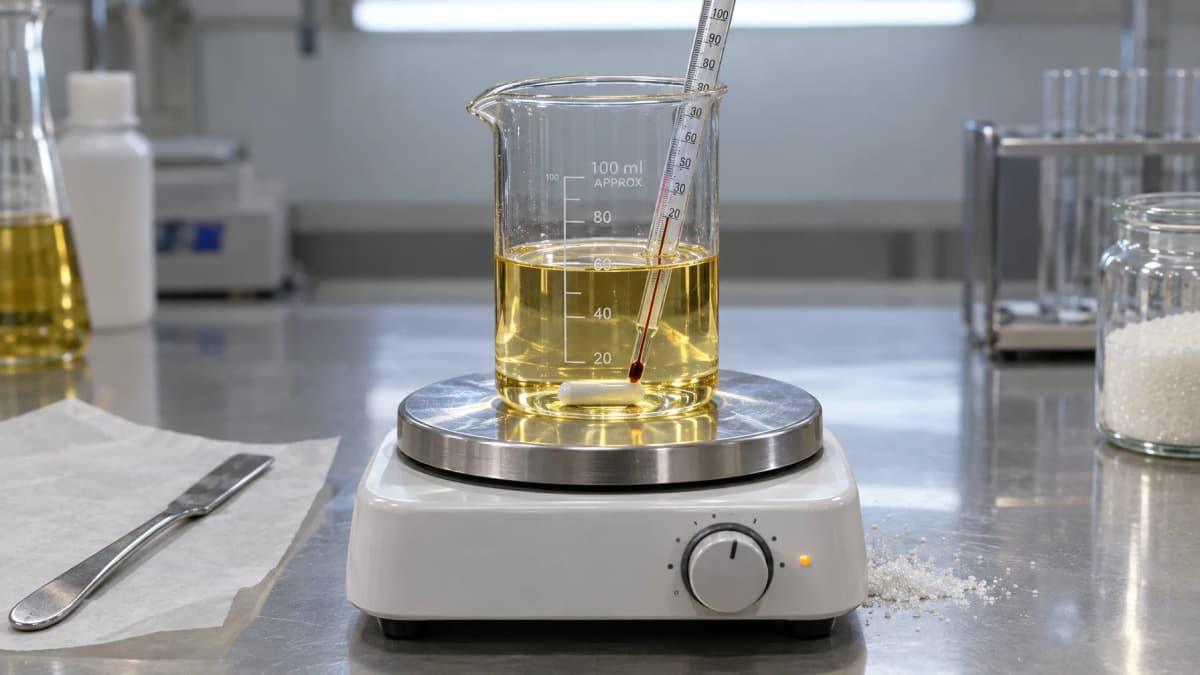
- Melting the wax needs roughly 70-75 °C, so the wax and oils are heated until fully clear.
- Anhydrous scrub (oil, wax, sugar) contains 0% water, but it is contaminated the moment wet hands touch it.
- A scrub that contains any water needs a preservative that is checked against the permitted list in the UK Cosmetics Regulation.
Why does one jar of sugar scrub leave an oily film on the bath while another rinses away like a cleanser? The answer is rarely the sugar, and almost always the one waxy ingredient in the middle of the recipe.
What emulsifying wax actually is
A blend, not a wax in the beeswax sense
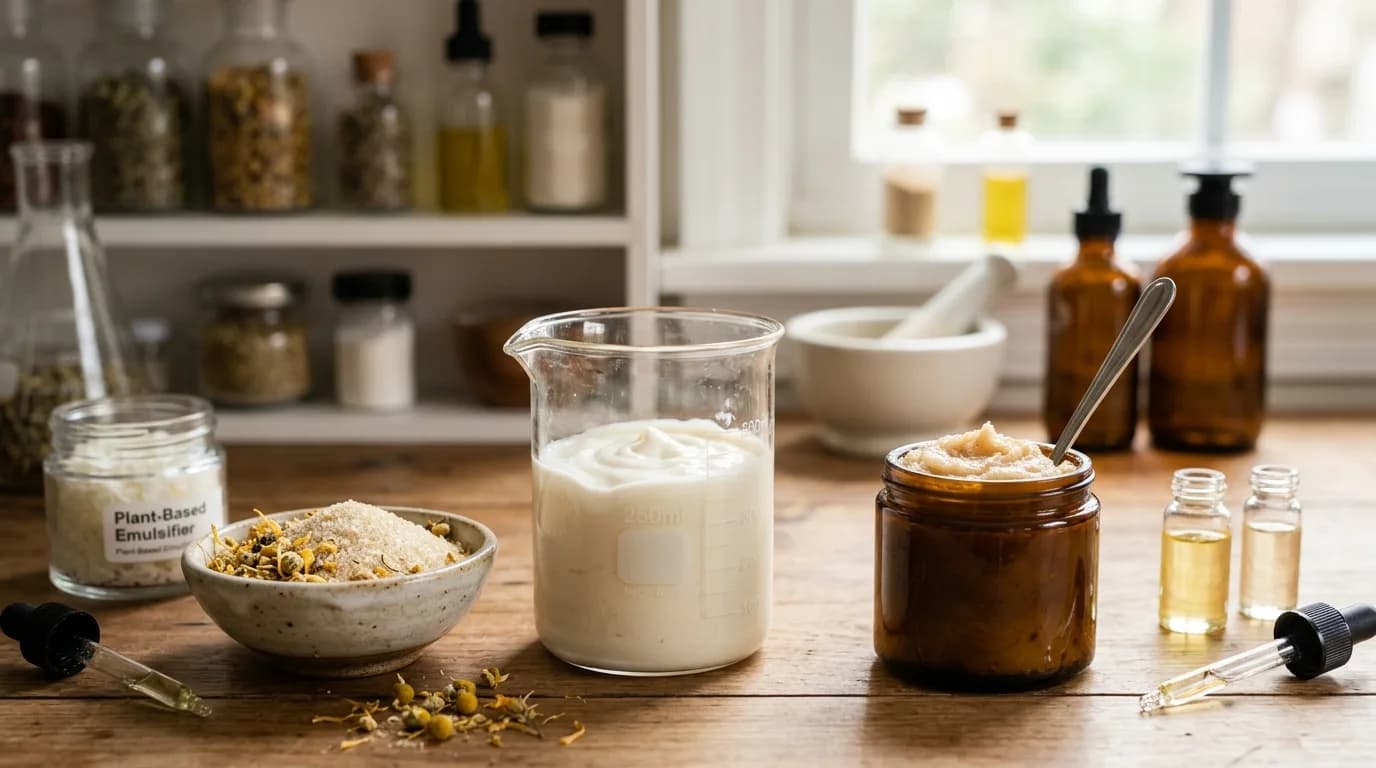
Despite the name, emulsifying wax is not a natural wax. The common INCI names are Cetearyl Alcohol (and) Polysorbate 60, or Cetearyl Alcohol (and) Cetrimonium Chloride in conditioning variants. It pairs a fatty alcohol that gives body with a surfactant that grabs both oil and water. The exact blend and its permitted use are set by your supplier's specification and the ingredient listings in CosIng, so check both before you buy.
Why a scrub needs an emulsifier at all
A classic scrub is sugar suspended in oil. That is lovely on dry skin, but in the shower the oil beads up and clings. Add an emulsifier and the oil disperses in water when you rinse. The skin feels clean and soft instead of coated. For the deeper mechanics, see Emulsifiers in cosmetics: how to choose the right one and not ruin your cream.
We covered the broader idea in our piece on the emulsified scrub, so here the focus is on the wax itself: dose, method and trade-offs.
How much emulsifying wax in sugar scrub
Starting formula
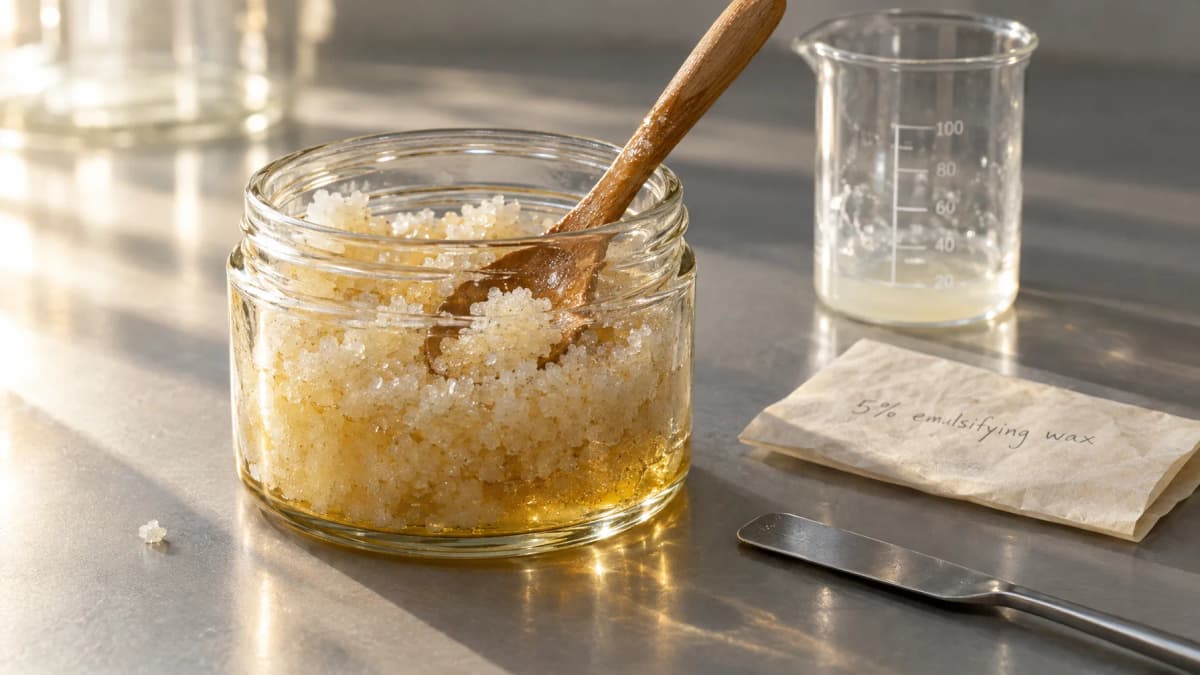
A reliable base for a rinse-off scrub, by mass:
- 45-55% sugar (granulated or fine, dry)
- 30-40% liquid oil, such as sunflower, sweet almond or jojoba
- 5-10% emulsifying wax (commercial raw material)
- 0.5-1% fragrance, only within the IFRA Standards for the product category and the allergen labelling rules of the UK Cosmetics Regulation
- Preservative as required, if any water is present
Below about 5% the rinse effect is weak. Above 10% the scrub turns stiff, waxy and slightly drying on the skin. Surfactant-rich blends can also feel stripping when overused.
Method that avoids a gritty, separated mess
- Heat the wax and oils together to about 70-75 °C until completely clear.
- Cool, stirring, until the mixture thickens and turns opaque.
- Fold in the sugar at a lukewarm temperature so it does not dissolve.
- Add heat-sensitive fragrance and preservative last, according to the supplier's guidance.
Adding sugar to a hot melt is the most common mistake. Sugar dissolves and recrystallizes into hard lumps overnight.
The preservation catch
Anhydrous is not the same as safe
Wax, oil and sugar contain no water, so the jar starts out hostile to microbes. But a wet hand, a damp spoon or a steamy bathroom lets water in, and sugar plus water is food for microbes. Emulsifying wax makes this worse, because its job is to carry water into the oil. Under the UK Cosmetics Regulation, a product placed on the market must be safe and have a safety assessment, and the permitted preservatives are those in Annex V. Verify any preservative and its maximum concentration against that list rather than assuming from its origin. Our article on the white soaping effect explains another side effect of this water uptake.
Practical protections
- Use a pump or a scoop, never fingers.
- Choose a broad-spectrum preservative that works in anhydrous-to-wet conditions, and confirm its approved dosage in Annex V.
- Add an oil-soluble antioxidant, such as tocopherol, to slow rancidity in the oils.
Wax versus the alternatives
| Option | Rinse feel | Texture | Main drawback |
|---|---|---|---|
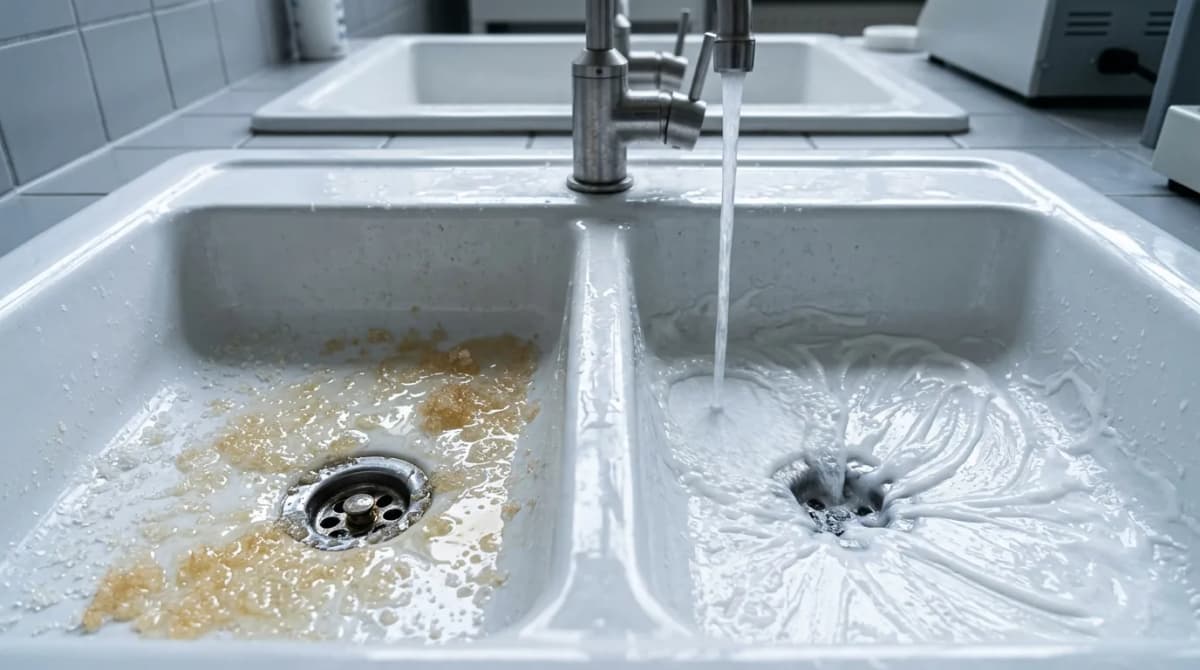
| No emulsifier | Oily film | Loose, glossy | Slippery tub |
| Emulsifying wax | Milky, clean | Creamy, thick | Needs preservation |
| Polysorbate 80 or PEG-type oil dispersants | Light, clear | Looser | Can be harsher on skin |
| Hydrophilic oil base | Very easy rinse | Oily | Less body |
If you want the cleansing-oil route, read how HLB works. For thickness without more wax, see what is happening inside your moisturizer.
Troubleshooting
Common problems
- Hard, grainy lumps: sugar went in too hot, or too much wax was used.
- Greasy rinse: too little wax, or a heavy oil such as castor.
- Stinging on shaved skin: coarse sugar and surfactant together. Use a finer grain and keep wax toward 5%.
- Cloudy spots or a sour smell: water ingress and spoilage. Discard the jar.
Scrubs are for body skin. Facial skin is thinner, and sugar crystals can leave micro-scratches, so a gentle fine-grain formula is the only reasonable option there.
If you want to learn to build products like this on a solid scientific footing, we have a course that walks through emulsifier selection, preservation and stability testing step by step.
Key takeaways
Emulsifying wax gives a sugar scrub a creamy, easy-rinse character, with the best results around 5-10% (commercial raw material, by mass). The trade-off is that the water-carrying ability needs a preservation plan, and any ingredient you choose must be checked against the permitted lists in UK law and CosIng.