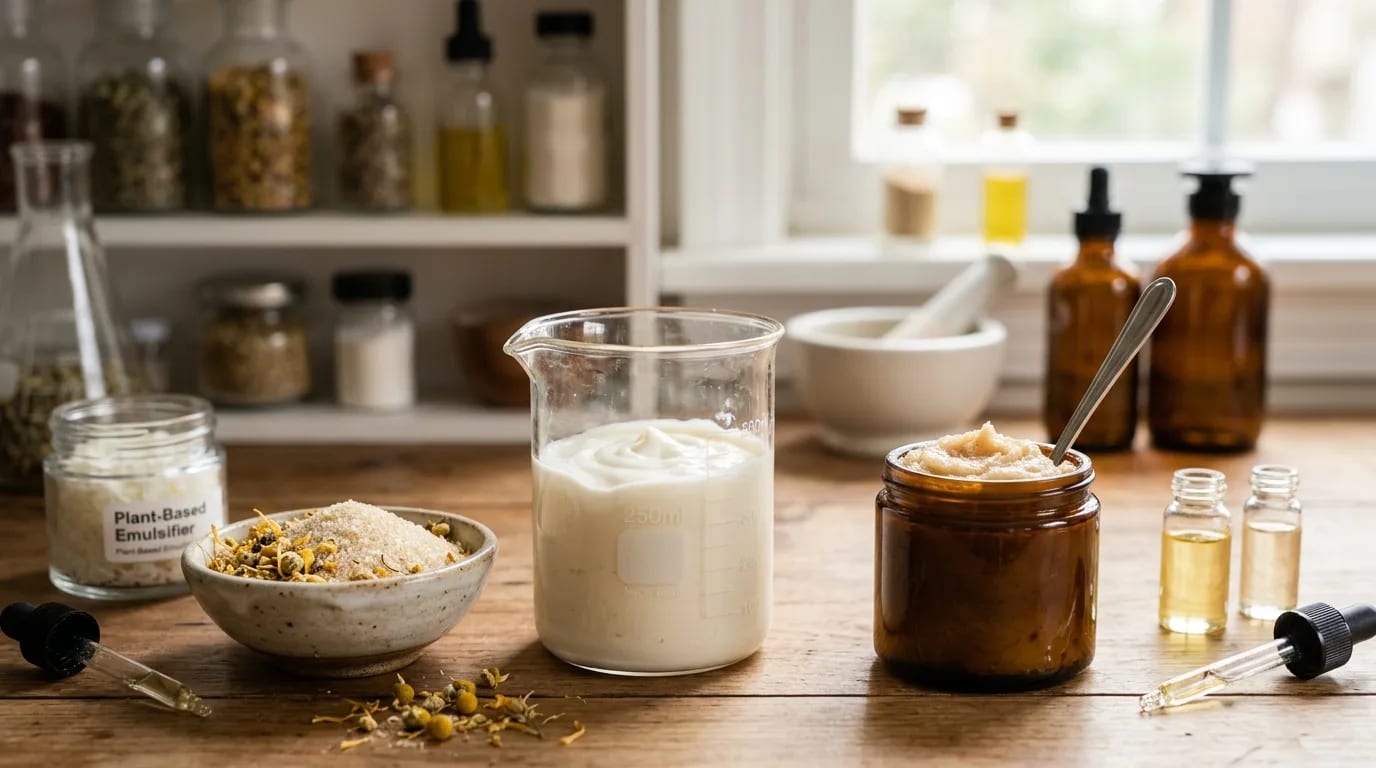
Ingredients for sunscreen formulation fall into six groups: UV filters (organic and mineral, listed in Annex VI of the UK Cosmetics Regulation), photostabilizers, an emulsifier system, emollients that dissolve the filters, film formers and rheology modifiers, and a preservative system plus antioxidants. Zinc oxide is limited to 25% and avobenzone to 5%, and every filter must be checked against Annex VI.
- Zinc oxide (non-nano) is capped at 25% as the active substance in finished products under Annex VI; confirm the current entry in the UK retained Regulation 1223/2009, Annex VI.
- Butyl methoxydibenzoylmethane (avobenzone) is permitted up to 5% as the active substance, per the same Annex VI list.
- Avobenzone can lose a large share of its absorbance after ~1 hour of UV exposure when unstabilized, as shown in published photostability studies.
- Typical oil-phase photostabilizer inclusion is roughly 1-10% commercial raw material (by mass), depending on the filter system.
Here is the uncomfortable truth: a sunscreen can be built entirely from permitted ingredients, tested at SPF 50 on day one, and still fail by month three, because the filters quietly destroy each other, or because a pretty botanical water thins the film they depend on.
The Core Ingredients for Sunscreen Formulation: What Each Group Does
Before discussing failure, a map. Permission to use any ingredient is decided by the lists, not by how natural it sounds. For UV filters that is Annex VI of the UK Cosmetics Regulation, with the EU equivalent in EU cosmetics legislation and the CosIng database. If you are unsure about a specific filter, concentration or nanoform, check the current entry rather than relying on memory or a supplier brochure.
UV filters: the active layer
- Organic (chemical) filters such as butyl methoxydibenzoylmethane (UVA), ethylhexyl triazone and bis-ethylhexyloxyphenol methoxyphenyl triazine (broad spectrum), octocrylene, and ethylhexyl salicylate. They absorb UV and dissipate it as heat, and most need to be dissolved in the oil phase.
- Mineral filters: zinc oxide and titanium dioxide, which scatter and absorb. Their dispersion quality, particle coating and nano status are each regulated or labelled separately, so verify them against the list.
Supporting cast
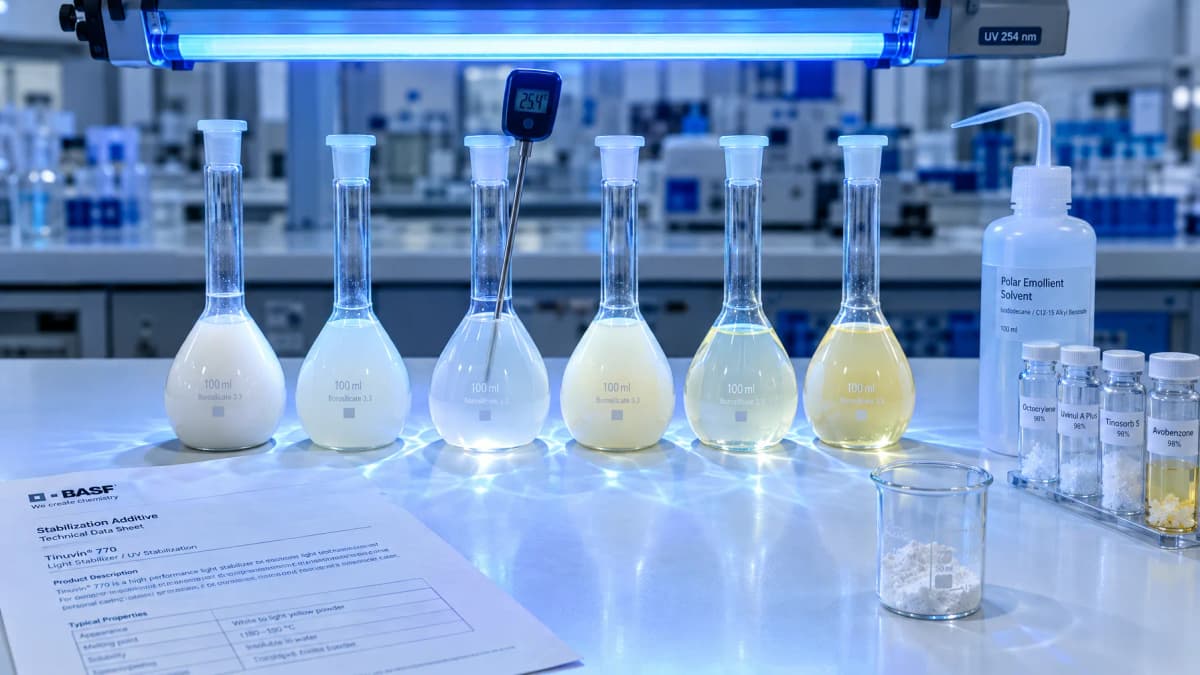
- Solvents/emollients (e.g. C12-15 alkyl benzoate, dibutyl adipate) keep crystalline filters dissolved. Without them, filters recrystallize and SPF drops.
- Emulsifiers, polymers and film formers that determine how evenly the filter sits on skin.
- Preservatives and antioxidants, each subject to their own annexes.
For deeper background on building around a lead active, see our piece on formulating with hero ingredients.
Chemical Incompatibilities: Why Mixing Filters Fails Without Stabilizers
The avobenzone problem
Avobenzone is the classic UVA workhorse and the classic casualty. Under UV it tautomerizes from its enol to keto form and fragments, and the effect is faster alongside certain partners such as ethylhexyl methoxycinnamate, as documented in photodegradation research. The practical outcome: a formula labelled for broad-spectrum protection may lose its UVA arm during a beach afternoon.
Stabilizers that actually work
- Octocrylene acts as a triplet-state quencher for avobenzone; typical use is about 2-10% active substance, within the Annex VI limit.
- Diethylhexyl syringylidenemalonate, bemotrizinol-type filters and certain polyester-8 grades are used as stabilizing partners by raw material suppliers such as BASF and dsm-firmenich; consult their technical datasheets for exact levels.
- Antioxidants (tocopherol, ubiquinone-type) help against radical side reactions but do not replace a proper triplet quencher.
Mineral plus organic: the quiet clash
Uncoated zinc oxide and titanium dioxide can generate reactive oxygen species and catalyze breakdown of some organic filters. Coated grades (silica, dimethicone or alumina treatments) reduce this. Ask the supplier for the coating and check the INCI listing.
| Combination | Risk | Typical fix |
|---|---|---|
| Avobenzone + cinnamate | Fast photodegradation | Add octocrylene or switch partner |
| Avobenzone + uncoated mineral | Radical-driven loss | Use coated grade, add antioxidant |
| Crystalline filter + weak solvent | Recrystallization, SPF drift | Increase polar emollient |
| High filter load + low emulsifier | Phase separation | Rebalance emulsifier and polymer |
The Role of Hydrosols in Disrupting Sunscreen Film Integrity
Why a lovely floral water can wreck a film
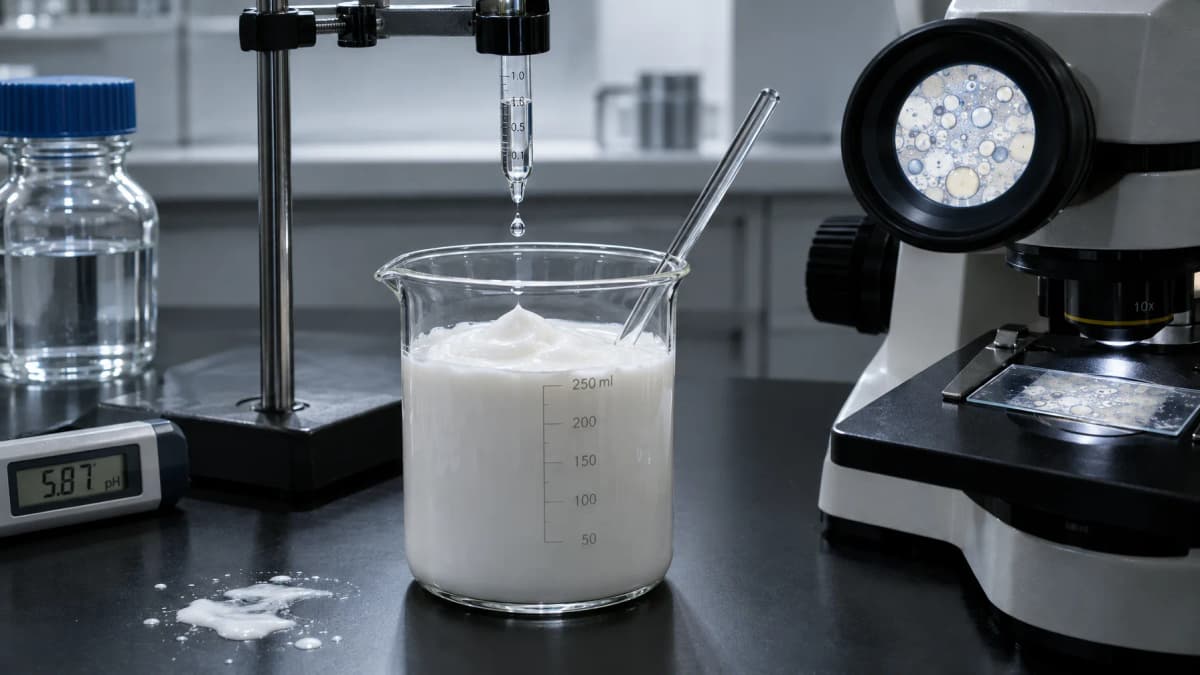
Hydrosols are tempting in a sunscreen: they sound gentle and sell well. But they bring variable electrolytes, trace organic acids, a pH that moves with batch and distillation, and dissolved essential oil fractions. Salts reduce the efficiency of many carbomer and acrylate thickeners and can weaken emulsion droplets, so the film dries unevenly and filter coverage becomes patchy. Patchy coverage lowers real-world SPF even if the filter percentage is unchanged.
Practical rules when a hydrosol is non-negotiable
- Replace only part of the water phase and test the finished emulsion, not the hydrosol alone.
- Measure pH and conductivity per batch; reject deviations.
- Choose salt-tolerant emulsifiers and polymers.
- Confirm preservative efficacy, as hydrosols are a microbial risk and their presence changes the challenge.
- Check fragrance-type components against the IFRA Standards and allergen labelling rules.
The same logic applies to brightening agents: acids and phenolic actives shift pH and may interact with filters, so read our alpha arbutin formulation guide before adding one to a daily SPF.
Synergistic Effects: Enhancing SPF While Preventing Degradation
Filter pairs that help each other
Combining filters is not only a risk; done well it raises protection with less total load. Broad-spectrum triazine filters such as bis-ethylhexyloxyphenol methoxyphenyl triazine are photostable, and their presence improves the stability of the whole system, as described in reviews on filter combinations. Mixing UVB-strong with UVA-strong filters, and adding a mineral for scattering, lets formulators spread the load.
Boosting without cheating
- Use film-forming polymers to spread the filter evenly.
- Choose emollients with a high polarity index so the filter stays dissolved.
- Verify SPF and UVA protection by the recognised in vivo and in vitro methods; calculators are only a pre-screen.
Sensible market context
Good raw materials are not cheap. A well-made, tested broad-spectrum SPF 30-50 lotion typically retails around £15-£30 for 50-100 ml; far below that and corners are often cut on filter load or testing.
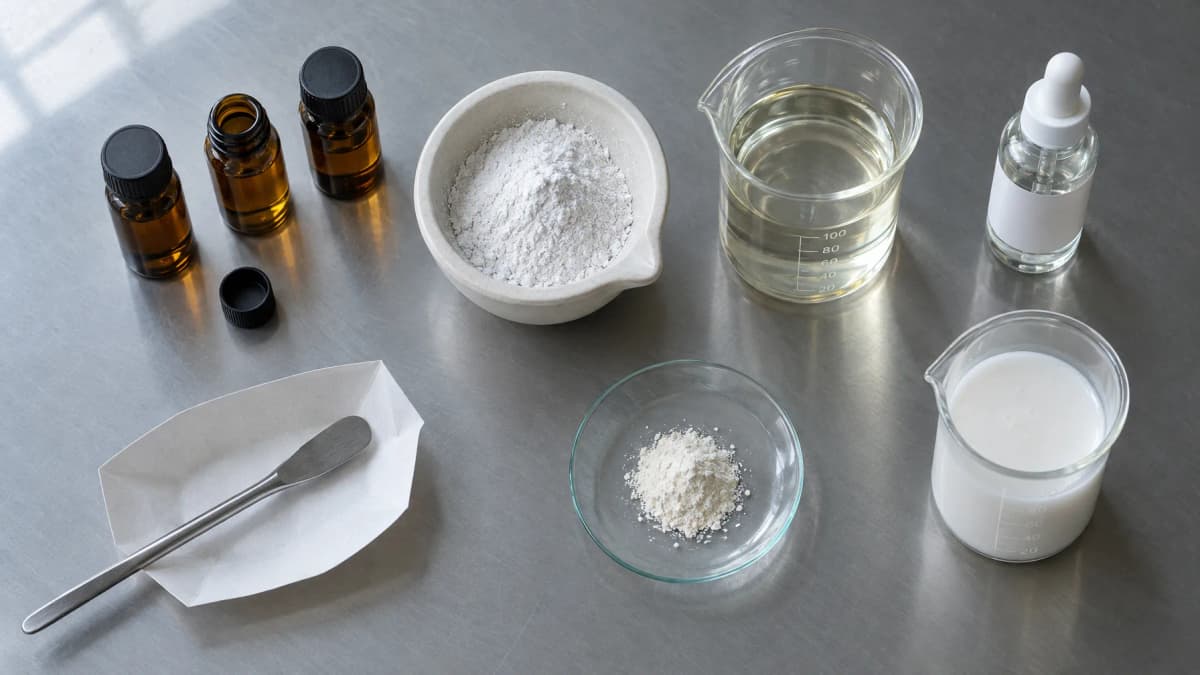
A Bench Checklist for Stable Sunscreen Formulas
- Confirm every filter and its maximum against Annex VI before the first trial.
- Pair avobenzone with a quencher, not just hope.
- Use coated minerals when combining with organic filters.
- Run 3-month stability at elevated temperature, plus freeze-thaw cycles.
- Irradiate and measure the UV absorbance spectrum before and after exposure.
- Treat every water-phase botanical as a variable until proven otherwise.
Related reading on label reading: how to read an ingredient list, and for checking claims with verified data, why a verified INCI database matters. If you want to learn to formulate with confidence, we have a course that walks through emulsion building step by step.