A polymeric emulsifier lets you turn oil and water into a cream without heating anything — a spoon is enough. It works differently from a classic emulsifier: instead of wrapping each oil droplet, it builds a gel net through the water and anchors the droplets inside it. That is why these creams feel so light, and also why salts can ruin them.
- One ingredient, two jobs: a polymeric emulsifier thickens the water and holds the oil in place.
- No heat needed: with liquid oils the whole cream is made cold, in one bowl.
- Light skin feel: the net breaks as you rub, so the cream feels fresh rather than waxy.
- Weak spot — electrolytes: ingredients whose names start with sodium, potassium or magnesium can thin the cream.
- Still needs a preservative: cold process does not make a water-based cream safe by itself.
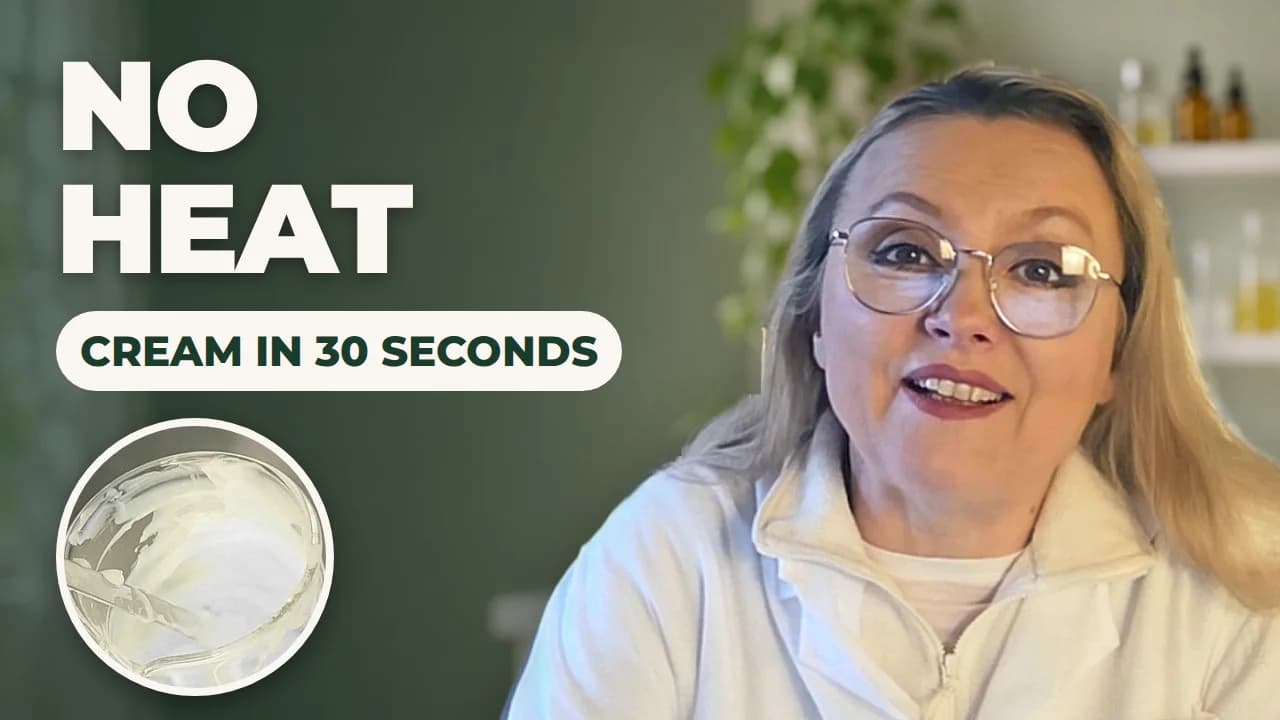
Watch: a cream made with a spoon
In this six-minute lesson cosmetic chemist Oksana Walker explains how polymeric emulsifiers work, makes a light face moisturiser step by step, and shows the three mistakes that most often spoil it.
How a classic emulsifier works
Oil and water do not stay mixed on their own. A classic emulsifier solves this with a two-sided molecule: a water-loving head and an oil-loving tail. Millions of these molecules settle on the surface of every oil droplet — like a cosy jacket — and stop the droplets from merging back together.
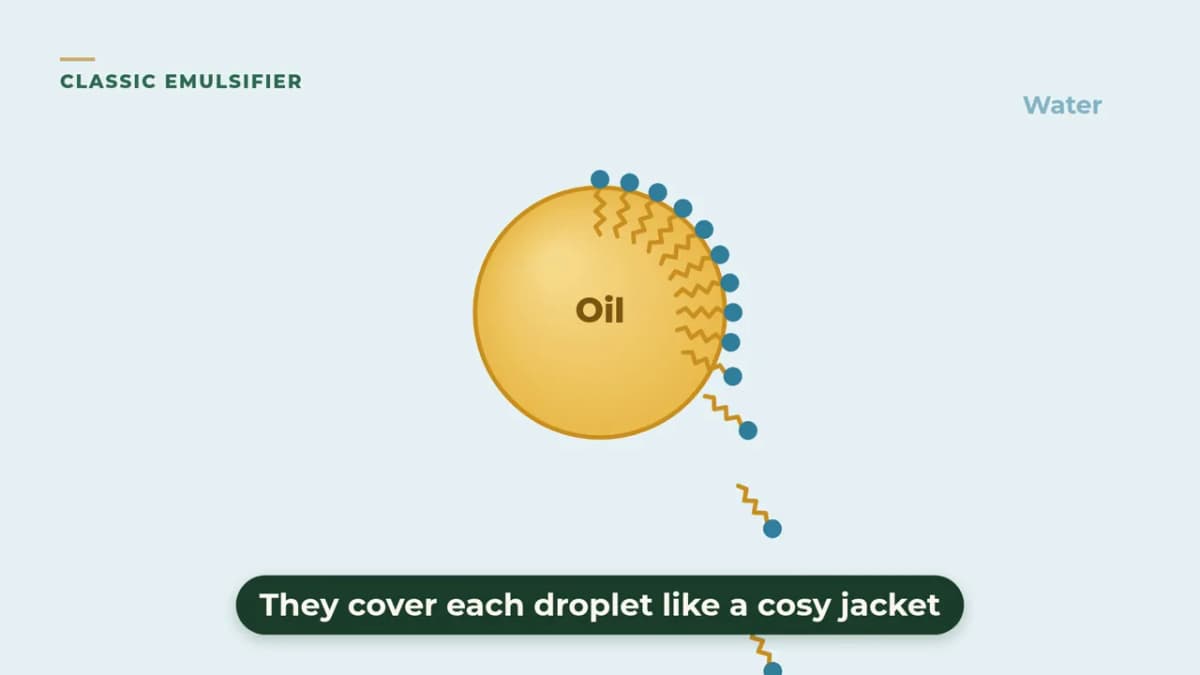
Many classic emulsifiers are sold as waxy solids. You melt them with the oils at up to 75 °C, heat the water phase to match, and combine the two. This is the familiar hot process, and it is still the right choice for many creams — we compare the main types in our guide to choosing an emulsifier.
What makes a polymeric emulsifier different
A polymeric emulsifier is not a small two-sided molecule. It is a polymer: very long chains that sit coiled up like a ball of hair. Put them in water and they unwind. Each chain carries electrical charges, the charges push each other apart, and the chain stretches out.
Millions of stretched chains tangle into a net, and this net is what makes the water thick. The same idea is behind the acrylic gelling polymers used in clear gels.

The “hairy gel”: anchors for the oil
A net alone would only give you a gel — it could not hold oil. The clever part is that each chain also has oil-loving sections. They stick into the oil droplets like anchors, so every droplet is held in place inside the net. It cannot float up, and it cannot join another droplet.
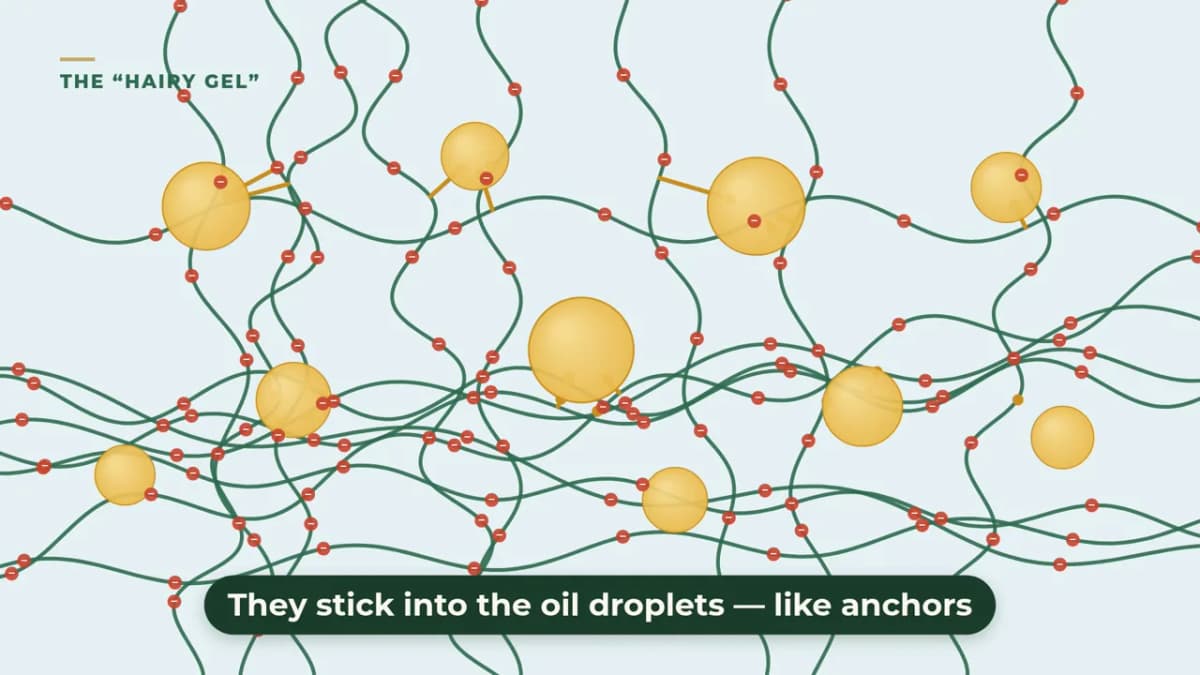
So one ingredient does two jobs: it thickens, and it holds the emulsion together. It also explains the skin feel. When you rub the cream in, you break the net and the oil is released onto the skin straight away — the cream feels light and fresh and sinks in quickly. For more on why different emulsifiers feel so different, see emulsifiers and cream texture.
A light cold-process moisturiser, step by step
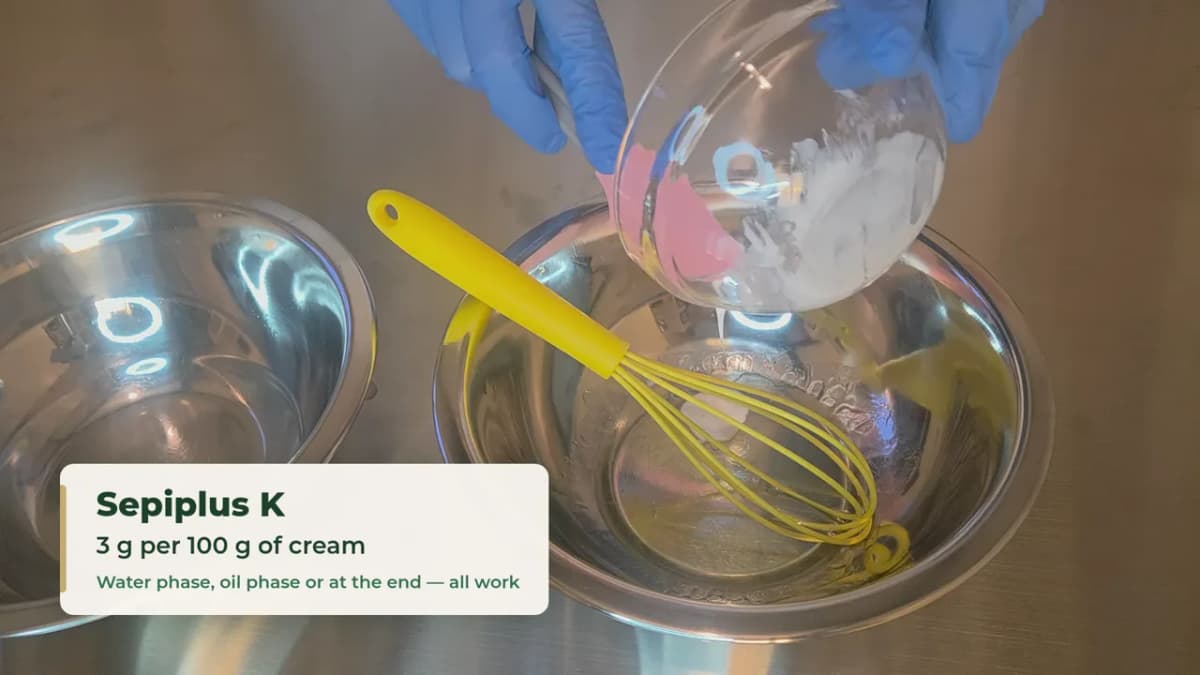
The cream in the video uses Sepiplus K, a liquid polymeric emulsifier (INCI: Polyacrylate-13, Hydrogenated Polyisobutene, Polyglyceryl-10 Laurate). Because every oil in the formula is liquid at room temperature, nothing needs melting.
| Phase | Ingredient | % |
|---|---|---|
| Water phase | Water | to 100 (75.6) |
| Glycerin | 3 | |
| Panthenol | 1 | |
| Oil phase | Squalane | 6 |
| Jojoba oil | 5 | |
| Sweet almond oil | 5 | |
| Tocopherols | 0.2 | |
| Emulsifier | Sepiplus K | 3 |
| Finishing | Preservative (Euxyl PE 9010) | 1 |
| Fragrance | 0.2 |
Final pH: about 5.5. If yours is higher, lower it with a few drops of 50 % citric acid solution.
- Clean first. Wipe bowls, spoon and whisk with alcohol and let them dry.
- Water phase. Weigh water, glycerin and panthenol into one bowl and stir.
- Oil phase. Weigh squalane, jojoba oil, sweet almond oil and tocopherols into a second bowl.
- Add the emulsifier. Stir the Sepiplus K into the oils, then pour the oil phase into the water while stirring. The mixture turns white and thickens within seconds.
- Finish. Stir in the preservative and fragrance, then check the pH.
Spoon or mixer?
A spoon is enough to make the emulsion form. A short blitz with a mini mixer gives smaller oil droplets, so the cream looks whiter and feels smoother — a nice extra, not a requirement.
Glycerin and panthenol are safe choices here because they carry no electrical charge. Remember that word: charge is exactly what the next section is about.
Three mistakes that ruin a polymer cream
1. Electrolytes
The net exists because charges along each chain push it open. Electrolytes — salts that split into charged ions in water — cancel that push. The chains coil back up, the net collapses, and a thick cream can turn into liquid.
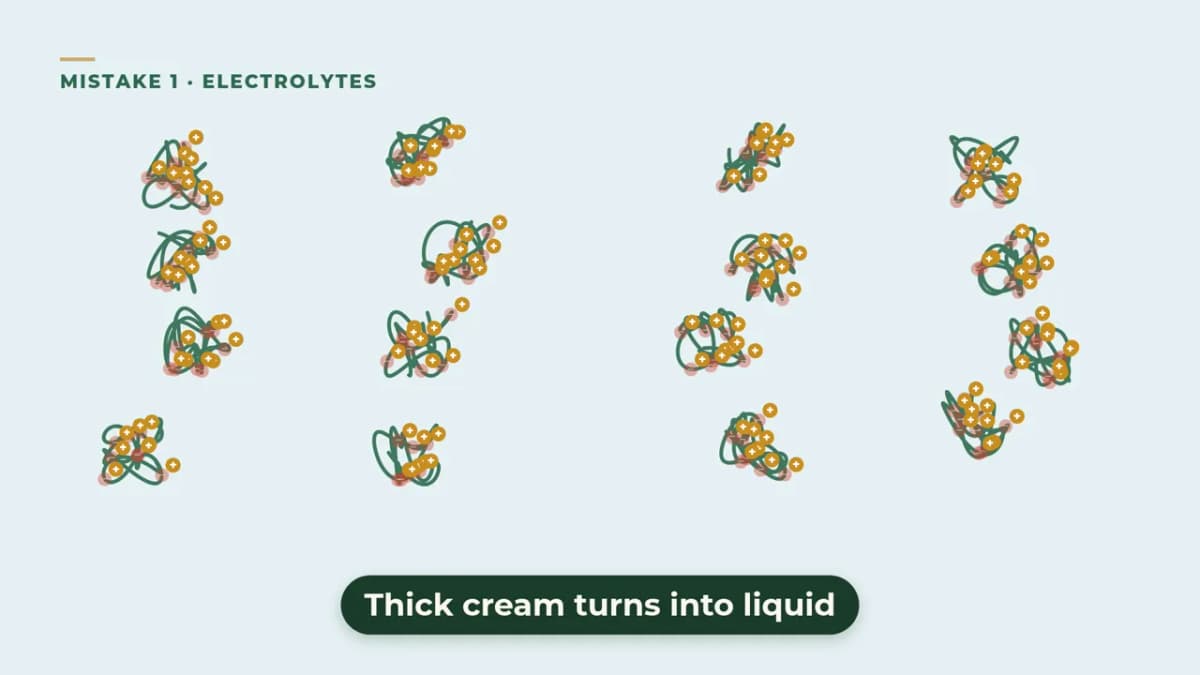
Electrolytes hide in many popular ingredients: sodium PCA, sodium lactate, aloe vera, many plant extracts, and even preservatives such as sodium benzoate and potassium sorbate.
Oksana’s rule: if an ingredient’s INCI name starts with sodium, potassium or magnesium, treat it as a suspect and test it in a small batch first. Modern polymeric emulsifiers tolerate salts better than older gelling polymers, and how much they tolerate differs from product to product — so a small test tells you more than any general rule.
2. The wrong pH
Polymers like this work inside a pH window stated by the manufacturer. Push the pH outside it and the net cannot hold. A strong acid exfoliant or a low-pH vitamin C serum is usually a job for a different thickener. If pH is new to you, start with our pH guide for cosmetics.
3. Skipping the preservative
This cream is about three-quarters water, and bacteria do not care how you made it. In a hot process the heating step at least reduces the microbes that came in with the ingredients; in a cold process nothing is killed along the way. So clean tools and a proper broad-spectrum preservative matter even more here, not less. Our preservation guide explains how to choose one.

When to use a polymeric emulsifier — and when not to
| Where it shines | Where to pick something else |
|---|---|
| Light day creams and lotions | Formulas full of salts and plant extracts |
| Gel-creams and serums with a little oil | Very acidic products |
| Anything with heat-sensitive oils or actives | Rich creams with lots of butters and waxes |
| Fun textures, such as a gel-in-gel | |
| Your very first emulsion — it is forgiving |
Butters and waxes need melting anyway, and that is where a classic emulsifier does a better job. If a rich cream is what you are after, see how to keep an emulsion base stable.
In short
A classic emulsifier puts a jacket on every oil droplet. A polymeric emulsifier builds a net and anchors every droplet in it. That is why the cream feels light and fresh — and why electrolytes can undo it.
If you are just starting out, the free course How to Make a Foaming Sugar Scrub is a gentle first step. When you are ready to make and understand a proper emulsion, Your First Cream takes you through it with Oksana.
Sources
- Seppic. SEPIPLUS™ K — product information (INCI: Polyacrylate-13, Hydrogenated Polyisobutene, Polyglyceryl-10 Laurate). seppic.com
- Villa C., Russo E. Hydrogels in Hand Sanitizers. Materials, 2021; 14(7): 1577 — overview of acrylic and other gelling polymers, including pre-neutralised liquid grades. PMC8037907
- Cheng Y.S. et al. An integrative approach to product development — A skin-care cream. Computers & Chemical Engineering, 2009 — how emulsifier and thickener choices shape a cream. PMC7112257
- U.S. Food and Drug Administration. Microbiological Safety and Cosmetics. fda.gov