Sunscreen formulation relies on UV filters (organic absorbers like avobenzone, octocrylene, or mineral filters like zinc oxide and titanium dioxide), plus emulsifiers, film-formers, antioxidants and rheology modifiers that keep filters stable, evenly spread and photostable on skin. In the UK/EU, only filters listed in Annex VI of Regulation (EC) 1223/2009 may be used, each with a fixed maximum concentration.
- Titanium dioxide and zinc oxide are permitted up to 25% in Annex VI of the EU Cosmetics Regulation
- Avobenzone (Butyl Methoxydibenzoylmethane) is capped at 5% under EU/UK rules, a lower ceiling than in some other markets
- The US OTC monograph, for comparison, lists 16 historically permitted actives with limits such as octinoxate at 7.5% and oxybenzone at 6%
- SPF testing and broad-spectrum claims depend on both the filter blend and the vehicle, not the active alone, per peer-reviewed photostability studies
- A well-designed sunscreen base typically carries 8–20% total UV filter load, blending two to four actives to cover UVB and UVA1/UVA2 ranges
Here's the part that surprises most people starting out: the UV filter is rarely the reason a sunscreen formula fails. It's usually the base — the emulsifier that can't hold 15% oil-soluble actives, the film former that streaks, or the missing antioxidant that lets avobenzone degrade within an hour of sun exposure. Formulating SPF is less about picking a filter and more about building a system that keeps that filter working.
UV Filters: The Organic and Mineral Toolkit
Every sunscreen starts with its actives, and in the UK and EU these are governed strictly by Annex VI of Regulation (EC) 1223/2009 (retained in UK law) — a closed list. If a UV filter isn't named there, with its maximum authorised concentration, it cannot be used in a marketed product, regardless of how it performs in other regions' monographs. This is worth repeating because formulators often reference US FDA lists out of habit: the US OTC monograph permits actives like aminobenzoic acid up to 15% and homosalate up to 15%, but UK/EU permissions and ceilings for the same chemical can differ, so each filter's status has to be checked against Annex VI directly, not assumed by analogy.
Organic (Chemical) Filters
These absorb UV photons and re-emit the energy as heat. Commonly used organic filters in UK/EU formulation include:
- Ethylhexyl Methoxycinnamate (Octinoxate) — a strong UVB absorber, typically used at 3–7%
- Butyl Methoxydibenzoylmethane (Avobenzone) — the main UVA1 filter, capped at 5% in Annex VI, but notoriously photounstable unless paired with a stabiliser
- Octocrylene — a UVB filter that also helps stabilise avobenzone photochemically
- Ethylhexyl Salicylate (Octisalate) — a weaker UVB filter, often used as a solvent for other crystalline UV actives
- Bis-Ethylhexyloxyphenol Methoxyphenyl Triazine (Tinosorb S) — broad-spectrum, oil-soluble, and prized for photostability
Mineral (Inorganic) Filters
Zinc oxide and titanium dioxide work by a combination of absorption, scattering and reflection. Both are permitted up to 25% in the EU/UK Annex VI listing, and both come with a separate regulatory question when used in nano form — nano-titanium dioxide and nano-zinc oxide have their own entries and restrictions (including a ban on nano-TiO2 in sprayable formats that could be inhaled). This is one detail that trips up newer formulators buying "micronised" mineral filters without checking whether the grade counts as nano under the regulation's definition.
Beyond the Actives: What Actually Makes SPF Work
An SPF value on a jar is a property of the finished film on skin, not of the raw filter. This is why two creams with identical filter percentages can test at SPF 30 and SPF 50 — the difference lives in the vehicle.
Emulsifiers and the Oil Phase
Organic filters are oils or oil-soluble solids, and many need to be dissolved at elevated temperature before they crystallise into the wrong polymorph and lose efficacy. This makes emulsifier choice critical: a sunscreen's oil phase often runs 15–25% by weight once you add filters, emollients and waxes, which is a heavier load than a typical face cream discussed in our Face Cream Recipe breakdown. Emulsifiers with a high HLB and strong oil-holding capacity — think PEG-100 Stearate/Glyceryl Stearate combinations or polymeric emulsifiers — are standard choices because they resist the destabilising effect of high internal phase volume.
Film-Formers and Water Resistance
Water resistance claims depend on film-forming polymers such as VP/Eicosene Copolymer or acrylate copolymers, which create a flexible, water-repelling network that keeps filters distributed evenly rather than pooling into micro-droplets — pooling is one direct cause of lower measured SPF, since it leaves UV-unprotected "gaps" on skin.
Antioxidants and Photostabilisers
Avobenzone degrades under UV exposure unless protected. Octocrylene is the classic photostabiliser pairing, but formulators also add antioxidants like tocopherol or BHT (within IFRA-referenced limits for fragrance-related use) to slow oxidative breakdown of both the filters and the surrounding emollients — a concern we've covered from the oil side in our piece on oxidative stability, induction period, and shelf life.
Rheology Modifiers
Because mineral filters are dense powders, sunscreen emulsions need robust suspension: xanthan gum, cellulose derivatives, or acrylate crosspolymers keep zinc oxide from settling in the bottle and help control the notorious "white cast" that comes from uneven particle distribution rather than the filter itself.
| Ingredient role | Example INCI | UK/EU concentration note |
|---|---|---|
| UVB organic filter | Ethylhexyl Methoxycinnamate | Listed in Annex VI, specific % cap applies |
| UVA1 organic filter | Butyl Methoxydibenzoylmethane | Max 5%, needs photostabiliser |
| Broad-spectrum organic filter | Bis-Ethylhexyloxyphenol Methoxyphenyl Triazine | Listed in Annex VI, check current cap |
| Mineral filter | Zinc Oxide / Titanium Dioxide | Up to 25%; nano forms separately restricted |
| Photostabiliser | Octocrylene | Listed in Annex VI, specific % cap applies |
| Film former | VP/Eicosene Copolymer | Not a UV filter — not subject to Annex VI cap |
Why the Base Formula Decides the SPF Number
A film that spreads unevenly, or that a wearer rubs off within twenty minutes because it feels heavy, will never deliver its theoretical SPF in real life. This is the gap between the lab-tested number, generated under controlled application rates of 2 mg/cm², and the number consumers experience, which typically involves a much thinner, patchier application. Formulators compensate partly through sensory design — silicones, esters like C12-15 Alkyl Benzoate, and lightweight emollients that encourage full-strength application without the greasy after-feel. Getting this balance wrong is one reason so many mineral sunscreens historically felt chalky; modern coated, surface-treated zinc oxide grades have largely solved this, but the underlying emulsion still needs to carry a heavy powder load without separating, which circles back to the same emulsifier and rheology choices discussed above and echoed in our look at white soaping effect in emulsions — a related failure mode when surfactant and electrolyte balance goes wrong.
Reading and Reverse-Engineering an Existing Sunscreen
If you're studying a commercial SPF product, the INCI list order tells you roughly how the formulator prioritised the oil phase, filter blend, and finishing agents — much like the general label-reading principles in our breakdown of what's on the label vs. what's behind it. For a systematic approach to pulling apart a competitor's SPF formula ingredient by ingredient, the method described in How to Break Down a Competitor's INCI List with AI applies directly, since sunscreen INCI lists tend to be long and layered with functional ingredients beyond the actives themselves.
Common Formulation Mistakes
- Ignoring filter compatibility: some organic filters recrystallise or destabilise each other; blends need photostability testing, not just SPF-additivity assumptions
- Underestimating oil phase load: a 15% filter blend behaves nothing like a 15% emollient blend in terms of viscosity and crystallisation risk
- Skipping pH checks: some UV filters and film-formers are pH-sensitive, and a shift outside their stable range can cause haze or reduced efficacy over shelf life
- Assuming nano-free equals simpler compliance: non-nano mineral grades still fall under the same Annex VI concentration caps, they just avoid the additional nano-specific labelling and restriction requirements
Anyone building toward a formulator's toolkit eventually has to treat SPF as its own specialised discipline — it borrows emulsion science from everyday creams but adds a strict regulatory ceiling on actives and a testing burden (SPF, UVA-PF, water resistance) that few other cosmetic categories carry. If this is a direction you want to take further, our broader path from hobbyist to professional is mapped out in How to Become a Cosmetic Chemist.
Chemical Compatibility: Avoiding Filter Degradation in Water-in-Oil Systems
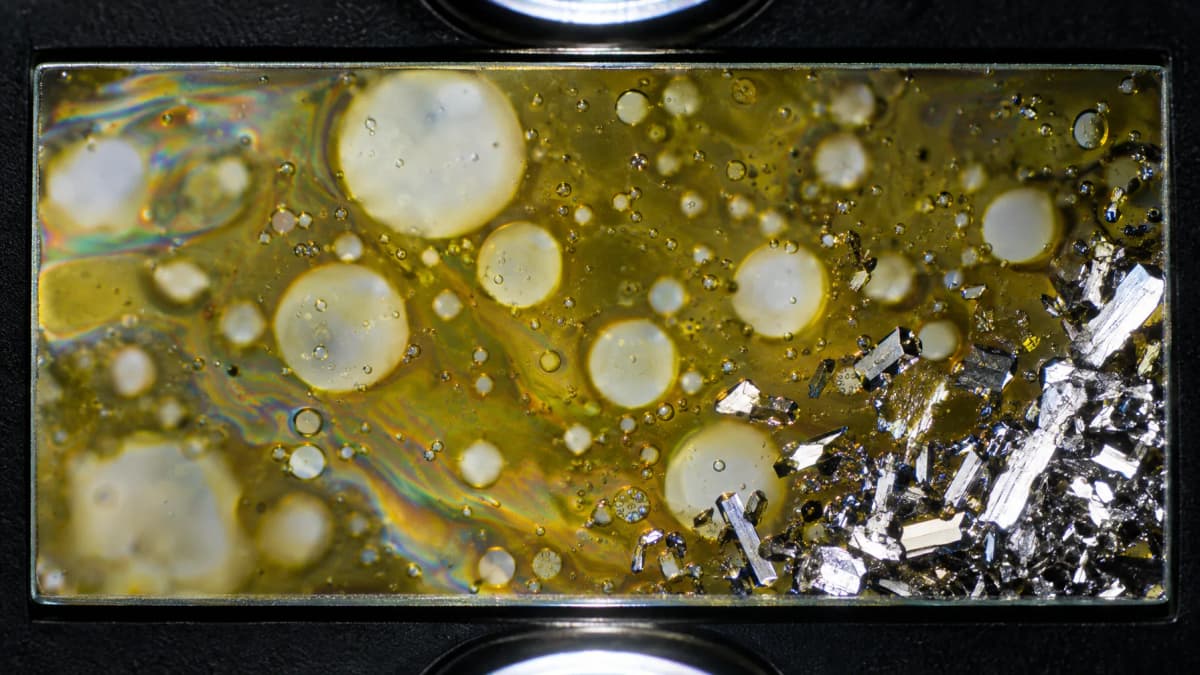
Water-in-oil (W/O) emulsions are a favourite for water-resistant sunscreens: the continuous oil phase forms a hydrophobic film and dissolves oil-soluble filters nicely. But the same architecture concentrates risk. Avobenzone sits in an oil phase that may also contain oxidisable lipids, trace metals from pigments, or reactive fragrance components. The result can be yellowing, filter loss and a lower real-world SPF than the one measured on day one.
Why avobenzone is the diva
Avobenzone exists in keto and enol forms. Under UV it can shift to the keto form and break down into radical fragments. Formulators counter this in three ways:
- Pair it with a triplet quencher or stabiliser such as octocrylene, or with a purpose-designed photostabiliser.
- Choose the solvent carefully. Polar emollients tend to stabilise the enol form differently from non-polar oils, so the oil phase is part of the filter system.
- Keep metal ions away. Chelators protect against iron and other trace metals that can complex with the molecule and cause discolouration.
Emulsifier interactions
Emulsifiers are not neutral bystanders. Polyglyceryl-based and silicone W/O emulsifiers (for example PEG-10 Dimethicone or Polyglyceryl-4 Isostearate types) tolerate high filter loads reasonably well, but electrolyte level, HLB and the polarity of the oil phase all shift filter solubility. A crystalline filter that drops out of solution leaves patches with no protection. If you want to see how emulsifier choice shapes structure in the first place, our piece on emulsifiers and cream texture: what is actually happening inside your moisturizer covers the physical chemistry.
Preservation matters too: a sunscreen with a large water phase still needs a robust system, and a single preservative rarely covers every organism. We discuss why in preservation in cosmetics: why a single preservative won't save your formulation.
A quick compatibility table
| Filter pairing | What happens | Formulation response |
|---|---|---|
| Avobenzone + Octocrylene | Octocrylene helps accept excited-state energy and slows avobenzone loss | Classic pairing; verify with in-vitro irradiation testing |
| Avobenzone + mineral filter with uncoated surface | Metal surface can catalyse degradation and discolour | Use coated grades, add a chelator |
| Avobenzone + oxidisable oils | Radical chain reactions consume both | Choose stable emollients, add antioxidants |
| Triazine filter + polar emollient | Good solubility, strong photostability | Check recrystallisation at low temperature |
Limits for every pairing apply individually and are found in Annex VI; there is no pooled allowance for stacked filters, so each one must stay within its own ceiling.
The Role of Antioxidants in Extending Photostability of Active Ingredients
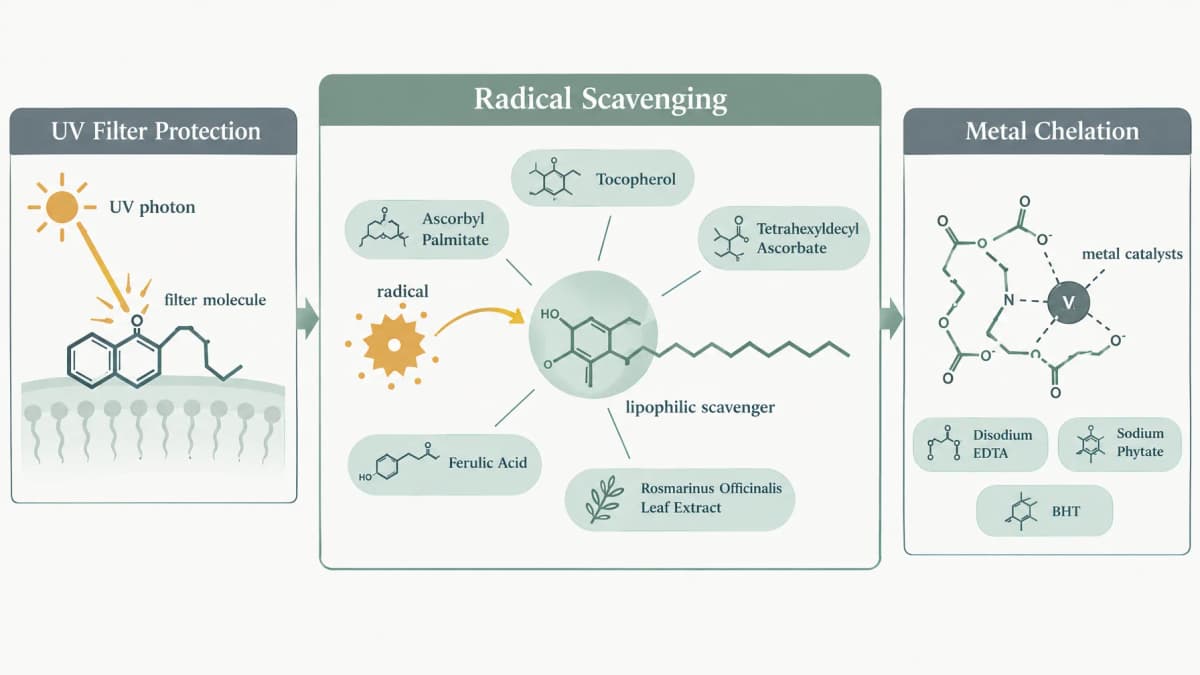
UV does not only excite filters; it also generates reactive oxygen species in the product film and on the skin. Antioxidants act as sacrificial guardians. They do not replace a photostable filter system, but they delay the oxidative chain reactions that bleach colour, create odour and eat filters.
Who does what
- Tocopherol (Vitamin E): a lipophilic radical scavenger that lives in the oil phase beside the filters.
- Ascorbyl Palmitate or Tetrahexyldecyl Ascorbate: oil-compatible vitamin C forms; they regenerate tocopherol in the presence of water-soluble partners.
- Ferulic Acid and Rosmarinus Officinalis Leaf Extract: plant antioxidants with additional colour and odour considerations.
- Disodium EDTA or Sodium Phytate: chelators; strictly not antioxidants, but they disable the metal catalysts that start the reactions.
- BHT: a cost-effective synthetic antioxidant, often used in technical systems.
Synergy, not stacking
The most effective antioxidant systems pair a lipophilic scavenger with a regenerating partner and a chelator. Adding five antioxidants at random produces a complicated INCI list, not a stronger system. Another trap: strongly coloured plant antioxidants can tint a pale mineral base. Match the antioxidant to the product aesthetic and stress-test it by exposing samples to light and heat, then measuring both filter content and colour drift.
The same oxidation logic explains why botanical oils spoil: our piece on linoleic oils and the price of their lightness shows why polyunsaturated oils are a poor foundation for a UV-exposed formula.
Particle Size Optimization for Zinc Oxide Dispersion and Transparency
Zinc oxide is a celebrity ingredient with a diva streak of its own. A broad-spectrum profile and an excellent safety record come with a catch: large particles scatter visible light and leave a white cast, while very small particles are more transparent but agglomerate and can raise nanomaterial labelling obligations. The legal ceiling is 25% as active substance in the Annex VI entry, but how a formula uses that room is a matter of dispersion engineering, not simple loading.
What particle size actually does
- Larger primary particles: stronger scattering, greater whiteness, typically better UVA attenuation per particle.
- Smaller particles: more transparent on skin, higher surface area, more demanding to wet and stabilise.
- Agglomerates: effectively behave as bigger particles, hurting both transparency and SPF uniformity.
Dispersion is half the formula
Most formulators buy pre-dispersed grades (zinc oxide in a cosmetic ester or silicone with a polymeric dispersant) rather than milling their own. The reasons are practical: high-shear milling, correct surface coating (for example Triethoxycaprylylsilane or Dimethicone) and wetting agent selection all decide whether the particles stay separate. Poorly dispersed zinc oxide may also interact with acidic ingredients or fatty acids and create soaps that thicken the emulsion over time.
If a nano grade is chosen, the finished product must meet the requirements for nanomaterials in Article 16, including the [nano] label wording. Verify the current status of each specific grade against the current regulatory text before you use it.
Practical checklist for a mineral SPF
- Choose a coated, pre-dispersed grade matched to your oil phase polarity.
- Add the dispersion early under low shear to avoid breaking the coating.
- Keep pH in the neutral range, since zinc oxide dissolves slowly in acid.
- Check viscosity and particle sedimentation after four to twelve weeks at elevated temperature.
- Measure SPF in vitro and, for claims, by the appropriate in vivo method.
The Role of Hydrosols in Disrupting Sunscreen Film Integrity
Why a lovely floral water can wreck a film
Hydrosols are tempting in a sunscreen: they sound gentle and sell well. But they bring variable electrolytes, trace organic acids, a pH that moves with batch and distillation, and dissolved essential oil fractions. Salts reduce the efficiency of many carbomer and acrylate thickeners and can weaken emulsion droplets, so the film dries unevenly and filter coverage becomes patchy. Patchy coverage lowers real-world SPF even if the filter percentage is unchanged.
Practical rules when a hydrosol is non-negotiable
- Replace only part of the water phase and test the finished emulsion, not the hydrosol alone.
- Measure pH and conductivity per batch; reject deviations.
- Choose salt-tolerant emulsifiers and polymers.
- Confirm preservative efficacy, as hydrosols are a microbial risk and their presence changes the challenge.
- Check fragrance-type components against the IFRA Standards and allergen labelling rules.
The same logic applies to brightening agents: acids and phenolic actives shift pH and may interact with filters, so read our alpha arbutin formulation guide before adding one to a daily SPF.
A Bench Checklist for Stable Sunscreen Formulas
- Confirm every filter and its maximum against Annex VI before the first trial.
- Pair avobenzone with a quencher, not just hope.
- Use coated minerals when combining with organic filters.
- Run 3-month stability at elevated temperature, plus freeze-thaw cycles.
- Irradiate and measure the UV absorbance spectrum before and after exposure.
- Treat every water-phase botanical as a variable until proven otherwise.
Related reading on label reading: how to read an ingredient list, and for checking claims with verified data, why a verified INCI database matters. If you want to learn to formulate with confidence, we have a course that walks through emulsion building step by step.
FAQ
What are the main ingredients for sunscreen formulation?
The core categories are UV filters (organic absorbers such as avobenzone and octocrylene, or mineral filters like zinc oxide and titanium dioxide), plus emulsifiers to stabilise the heavy oil phase, film-forming polymers for water resistance, antioxidants to prevent filter degradation, and rheology modifiers to suspend mineral powders evenly.
Which UV filters are approved in the UK and EU?
Only UV filters listed in Annex VI of Regulation (EC) 1223/2009, retained in UK law, are permitted, each with its own maximum concentration. This list should always be checked directly, since permissions and caps can differ from those used in other regulatory frameworks such as the US OTC monograph.
Why do sunscreens need photostabilisers like octocrylene?
Avobenzone, a widely used UVA1 filter, breaks down under prolonged UV exposure unless paired with a photostabiliser. Octocrylene is commonly used for this purpose, along with antioxidants that slow degradation of both the filter and surrounding emollients.
Does a higher percentage of UV filter always mean a higher SPF?
Not directly. SPF depends on the filter blend, how evenly it forms a film on skin, and the vehicle's stability — a poorly emulsified formula with a high filter load can test lower than a well-engineered formula with less active ingredient.
Sources
- European Commission CosIng, Annex VI — List of UV Filters Allowed in Cosmetic Products
- U.S. FDA — Sunscreen: How to Help Protect Your Skin in the Sun
- PMC — peer-reviewed literature on UV filter photostability
- GOV.UK — Cosmetic Products Regulation guidance
- CTPA — Cosmetic, Toiletry and Perfumery Association, UK regulatory guidance
- Regulation (EC) No 1223/2009 as retained in UK law, Annex VI: list of UV filters allowed in cosmetic products
- Regulation (EC) No 1223/2009 as retained in UK law, Article 16: nanomaterials
- European Commission CosIng database of cosmetic substances and ingredients
- PubMed: avobenzone photostability and octocrylene
- PubMed: avobenzone and cinnamate photodegradation
- PubMed: UV filter combinations, photostability and synergy